
Cross-Border Marketing Agency vs Local Agency: What the Evidence Shows
Cross-Border Marketing Agency vs Local Agency: What the Evidence Shows
A cross-border marketing agency is more effective than a local digital marketing agency when a brand needs one strategy coordinated across two or more markets, with each market adapted rather than simply translated. A local agency is usually more effective for execution inside a single market the brand already understands. Research on standardization and adaptation finds no universal winner, so the deciding conditions are the number of markets, the distance between them, and who owns cross-market accountability.
The question usually comes up at a specific moment. A brand that has grown in its home market is preparing to launch in a second or third country, and it has to decide whether to hire an agency in each market or one partner that runs the work across all of them.
Both models work, and both fail in predictable ways. Local agencies tend to struggle when the brief requires consistency across borders, while cross-border agencies tend to struggle when they lack real presence in the market where the campaign actually runs. The evidence below explains why, and the decision guide that follows turns it into a practical choice.
Is a Cross-Border Marketing Agency More Effective Than a Local Agency?

A cross-border marketing agency is more effective when the main problem is coordination across markets, and a local agency is more effective when the main problem is execution within one market. Effectiveness depends on matching the agency model to the problem, not on the model itself.
A cross-border agency carries one brand strategy into several markets and decides what stays fixed and what changes in each. A local agency knows its own market deeply but usually has no mandate, or visibility, beyond it.
The conditions that favor each model are fairly consistent. A cross-border agency fits brands entering two or more markets at once, brands whose home team doesn’t speak the target language, and brands that need one point of accountability for regional results. A local agency fits brands with an established in-market team, a single priority market, or a channel-specific need such as local PR or retail activation.
What Does the Research Say About Standardization Versus Adaptation?
Academic research on international marketing finds that both standardizing and adapting marketing can improve performance, with adaptation showing a slightly stronger effect on average. The research also shows that results vary widely by context, which is why no single agency model wins everywhere.
According to a meta-analysis by Brei, D’Avila, Camargo and Engels published in BAR Brazilian Administration Review (2011), 23 studies published between 1992 and 2010 showed a medium-strength positive relationship between performance and both standardization and adaptation of the marketing mix. The same meta-analysis found a mean effect size of 0.168 for adaptation and 0.134 for standardization, and identified price as the marketing mix element with the largest adaptation effect, followed by promotion, product, and distribution.
According to a systematic literature review by Mandler, Sezen, Chen and Özsomer in the Journal of Business Research (2021), findings on the performance effects of marketing standardization versus adaptation remain mixed and inconclusive. The authors identify gaps in research on emerging markets, digital services, and customer-related performance outcomes, which are the conditions many Asia-bound brands now operate in.
For agency selection, the practical reading is that the right degree of adaptation is a judgment made market by market. An agency model that can make that judgment, and then carry it through execution, matters more than a fixed position on global or local.
Why Does Language Affect Buying Behavior Across Markets?
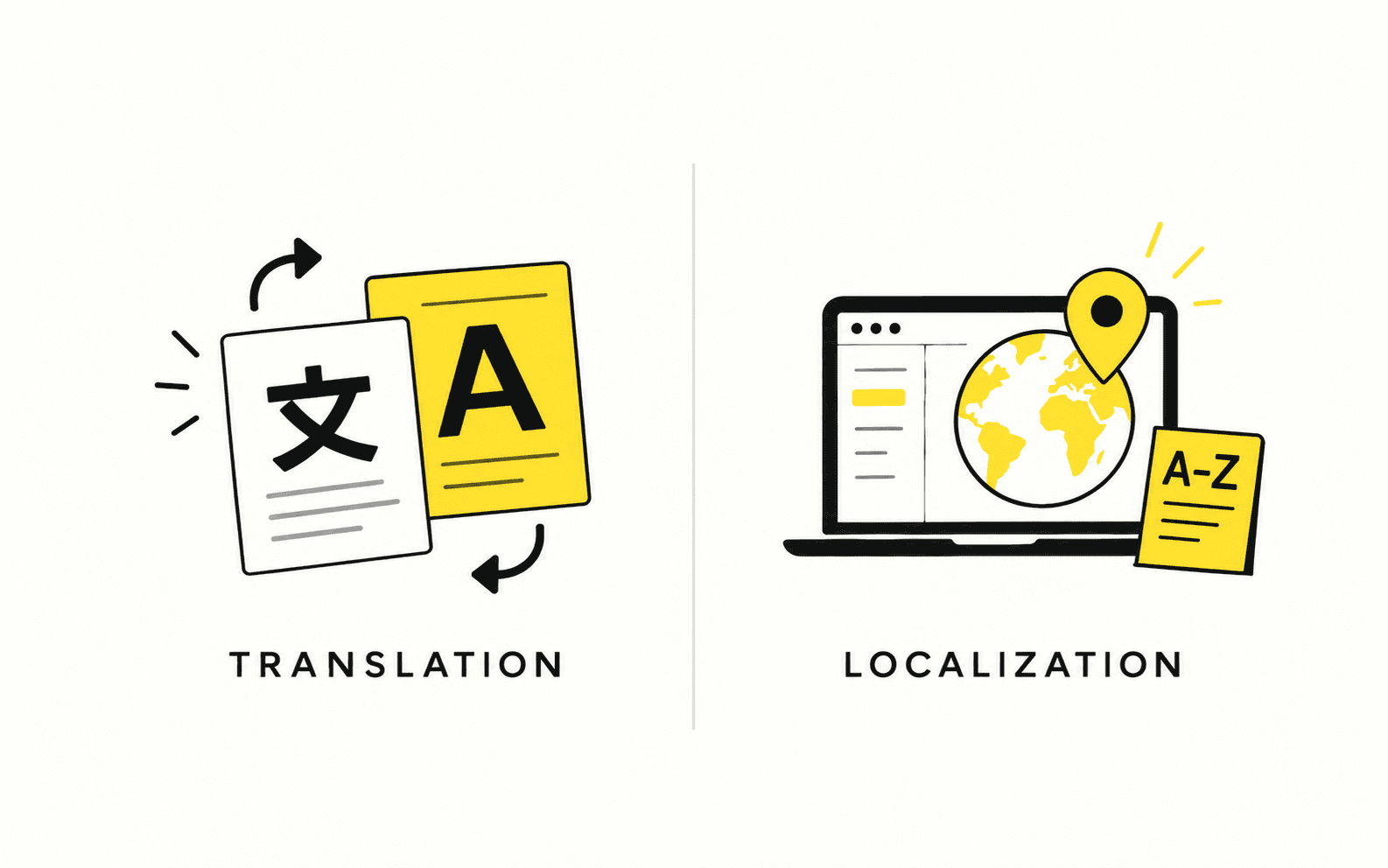
Language affects buying behavior because most online shoppers prefer product information in their own language, and a meaningful share won’t buy at all without it. This makes localization a commercial requirement rather than a stylistic choice.
According to CSA Research (2020), a survey of 8,709 consumers in 29 countries found that 76% prefer to buy products with information in their own language, and 40% will not buy from websites in other languages. The same survey found that the preference for local-language product information reached 90% among respondents in Japan and 88% in Indonesia.
CSA Research’s 2020 survey also found that 69% of respondents would choose a major global brand over one with information in their own language, with Japan lowest on that measure at 50%. Brand strength can offset weak localization in some markets, but Japan is a market where that offset is smallest.
How Does Distance Between Markets Change the Decision?
The greater the distance between a brand’s home market and its target market, the more value a cross-border agency adds. Distance here includes culture, regulation, and economics as well as geography.
According to Pankaj Ghemawat’s article “Distance Still Matters” in Harvard Business Review (2001), companies routinely overestimate the attractiveness of foreign markets, and the CAGE framework measures four kinds of distance: cultural, administrative or political, geographic, and economic. A US brand entering Canada faces little of each, while the same brand entering Japan or Indonesia faces more on almost every dimension.
Low-distance expansions can often be handled by the home agency with a local partner for media buying. High-distance expansions benefit from a team that already works on both sides of the gap.
How Do Local, Cross-Border, and Network Agencies Compare?
Local agencies lead on single-market depth, cross-border agencies lead on coordination across markets, and large network agencies lead on scale and global media buying. The table below compares the three models on the factors that usually decide the choice.
| Factor | Local agency | Cross-border agency | Network agency |
|---|---|---|---|
| Market knowledge | Deep in one market | Working knowledge across a defined set of corridors | Varies by local office |
| Coordination across markets | Limited, needs a client-side coordinator | Core capability | Available, often through separate local offices |
| Brand consistency | Depends on the client’s brand guidelines | Managed centrally with local adaptation | Strong at global level, uneven locally |
| Speed in one market | Fastest | Fast where it has in-market staff or partners | Slower, more approval layers |
| Cost | Lowest per market, multiplies with each market | Mid-range, shared strategy cost across markets | Highest, minimum retainers common |
| Accountability | Per market, no regional owner | One partner for regional results | Global lead, local offices report separately |
| Best for | One priority market with an in-house team | Two to six markets, mid-size brands, market entry | Large enterprises with global media budgets |
A brand can use more than one model at once. The comparison is most useful for deciding which partner leads, not for deciding which partner is the only one.
What Is the Difference Between a Market Entry Consultant and a Marketing Agency?

A specialized market entry consultant advises on whether and how to enter a market, while a marketing agency builds and runs the campaigns once the decision is made. Many brands need both, and a cross-border agency often covers the go-to-market planning stage as well as execution.
Market entry consultants typically work on market sizing, regulatory checks, partner and distributor selection, and entity setup. Their output is usually a recommendation or a plan.
Marketing agencies work on positioning, creative, channels, and media. The risk of separating the two is a plan that the execution team didn’t help write, which is a common reason global launches stall between strategy and the first campaign.
How Do You Choose Between a Cross-Border and a Local Agency?
Choose a cross-border agency when coordination across markets is the main risk, and a local agency when single-market execution is the main risk. The steps below help identify which risk applies.
- Count the markets. One market with an existing team points to a local agency, while two or more markets launching within the same year point to a cross-border lead.
- Measure the distance. Use the CAGE dimensions to score cultural, administrative, geographic, and economic distance from the home market, and weigh a cross-border partner more heavily as the score rises.
- Check language coverage. Confirm whether the agency has native speakers on the account, not only translators, for every market in scope.
- Ask who owns regional results. If no one on the client side can coordinate several local agencies, a single cross-border partner removes that gap.
- Verify in-market presence. Ask where the people running each market are based and whether local partners are used for production, media, or influencer work.
- Review relevant case studies. Look for work in the same corridor, such as US to Asia or Japan to Southeast Asia, rather than general international experience.
- Compare the total cost. Add up the retainers of several local agencies plus internal coordination time, and compare it with one cross-border retainer covering the same scope.
Our guide on how to build a cross-border marketing team covers the internal roles that sit alongside whichever agency model a brand chooses.
Does a Hybrid Model of Cross-Border Lead and Local Specialists Work?

A hybrid model works well for most brands entering several markets, with a cross-border agency owning strategy and coordination while local specialists handle market-specific execution. This model captures the coordination benefit without giving up local depth.
In practice, the cross-border lead sets positioning, the brand system, the measurement framework, and the rules for what each market can adapt. Local specialists then handle work that rewards being on the ground, such as influencer relationships, retail activation, PR, or production shoots.
The hybrid model fails when roles are unclear. A written split of responsibilities, one shared reporting format, and a single owner for budget allocation across markets prevent most of the friction. Our guide to cross-border brand localization explains how to decide which brand elements stay fixed and which adapt by market.
How Does Creative For More Approach Cross-Border Marketing?

Creative For More is a cross-border marketing agency founded in 2019, headquartered in Singapore with an office in Tokyo and a New York presence. We run a hybrid model by design, with strategy and coordination held centrally and execution supported by in-market talent and a network of more than 30 agency and business matching partners.
Our work focuses on four corridors: US to Asia, Asia to US, Japan to Southeast Asia, and Singapore to Japan. The team includes Japanese account managers based in Japan and supports clients in Japanese, English, and Chinese.

Our Wise case study shows the model applied to a global brand. Wise had a global “no hidden fees” proposition, and we translated it into concepts grounded in everyday money behavior in Singapore and Malaysia, using local cues such as bubble tea comparisons and carpark rates, with full-funnel assets produced for Meta, TikTok, Google Display, and The Trade Desk.
The same approach applies across our digital marketing services, where one strategy is planned once and then adapted for each market’s platforms, language, and buying habits.
If you’re planning a launch across more than one market and want a single partner that adapts the work for each one, we can help you scope the right model. If your company is looking for a strategic marketing partner, the Creative For More team can help. Book a discovery call to explore how we can support your brand’s growth.
Read More

charlene
Creative For More