

How to Market a Medical Clinic in Singapore Without Violating MOH Guidelines
How to Market a Medical Clinic in Singapore Without Violating MOH Guidelines
If you run a medical clinic in Singapore, every Google Ad, Instagram post, website update, and WhatsApp broadcast you publish is governed by advertising regulations that carry fines up to SGD 20,000, imprisonment of up to 12 months, and licence suspension or revocation as penalties for non-compliance, according to Yang’s Web’s analysis of Singapore’s HCSA advertising regulations. MOH enforcement is active. Each non-compliant advertisement may constitute a separate offence.
The frustrating reality for most clinic owners is that compliance guidance is typically framed around what is prohibited rather than what is permitted. This guide takes the opposite approach. It covers what you can say, what you cannot say, the specific channels that are permitted and restricted, and the practical content formula that produces patient inquiries within the framework rather than around it. Seventy-five percent of patient journeys now begin with an online search, according to PaperCut Singapore’s 2026 medical practice marketing guide. The clinics that are not visible in that search are invisible to three quarters of their potential patient population. The regulatory framework is not a reason to be invisible. It is the framework within which visibility is built.
Which Regulations Actually Apply to Your Clinic?

Two advertising regulatory frameworks apply to Singapore medical clinics simultaneously. The Private Hospitals and Medical Clinics (PHMC) Advertising Regulations 2019 and the newer Healthcare Services Act (HCSA) Advertising Regulations, which came into force on 3 January 2022, both govern your clinic’s advertising, according to First Page Digital’s Singapore medical advertising guidelines. The HCSA is the primary current framework for licensed healthcare service providers; the PHMC framework remains relevant for practitioners in specific licensing categories. In practice, a clinic that complies with the HCSA is operating within both frameworks for most content decisions.
Layered on top of these institutional advertising regulations are the Singapore Medical Council (SMC) Ethical Code and Ethical Guidelines for individual registered doctors, and the Singapore Medical Association’s professional conduct advisory. These apply to the individual doctor rather than the clinic entity, meaning a single piece of non-compliant content can simultaneously expose the clinic under HCSA and the doctor under the SMC ECEG. The clinic owner and the practice manager are responsible for understanding all three layers. The marketing agency is not.
The practical starting point is simple: the Ministry of Health is the regulatory authority, the HCSA Advertisement Regulations are the primary rulebook, and every piece of clinic marketing content, from the Google Business Profile description to the most recent Instagram Story, should be evaluated against that rulebook before publication rather than after an enforcement flag.
What Is the Intent Test and Why Does It Matter?
The most useful practical heuristic for evaluating whether a piece of clinic marketing content is compliant is the intent test: is this content primarily educating the patient about a condition or a treatment category, or is it primarily pushing the patient toward a specific service, product, or provider? According to Activa Media’s medical advertising guidelines analysis, the MOH pays attention to intent as much as format. A clinic profile, blog article, landing page, or social post can all fall under regulated communication if the message is pushing readers toward a specific service rather than genuinely informing them.

Truly educational content keeps the focus on the condition or topic. It explains causes, symptoms, risk factors, and broad management options in neutral language. It does not promote a specific treatment as superior, does not include pricing incentives to encourage uptake, and does not imply that a specific outcome is guaranteed or likely for any individual reading the content. Educational content that meets this standard is not just compliant. It is commercially more effective than promotional content in the medical category, because the patient who is genuinely informed makes a better-calibrated consultation decision and arrives at the clinic with realistic expectations.
The test you should apply before approving any piece of clinic marketing content: “If a patient read this and then asked me whether I was trying to inform her or sell to her, which would she say?” If the honest answer is sell, the content needs to be revised before publication.
What Can You Say in Singapore Clinic Marketing?
The permitted content territory for Singapore medical clinic marketing is broader than most clinic owners realize after their first encounter with the prohibitions list. The following content types are fully compliant and commercially productive.
| Content Type | Compliant | Notes and Examples |
|---|---|---|
| Doctor qualifications and credentials | Yes | “Dr. Lim is a Fellow of the Academy of Medicine Singapore (FAMS) with sub-specialty training in interventional cardiology” is fully compliant and builds the clinical authority the patient is evaluating |
| MOH registration number and SMC accreditation | Yes | Displaying registration numbers and accreditation is a trust signal; include on website footer, GBP, and marketing materials |
| Educational content about conditions and treatment categories | Yes | “What causes melasma and what treatment options exist” is compliant; “Why our laser is the best treatment for your melasma” is not |
| Factual service descriptions | Yes | “We offer colonoscopy, gastroscopy, and endoscopic procedures at our Novena clinic” states what is available without making claims about outcomes or superiority |
| Transparent pricing information | Yes | Displaying consultation fees and standard procedure cost ranges is permitted; promotional discounts designed to incentivize bookings are not |
| Third-party accreditations and institutional affiliations | Yes | JCI accreditation, hospital privileges, academic appointments, and professional body memberships are all compliant trust signals |
| Verifiable patient satisfaction data | Yes, with conditions | “92% of patients in our post-visit survey rated their experience as excellent or very good” is compliant if derived from a genuine documented survey with accessible methodology |
| Partial patient testimonials without specific health claims | Yes, with conditions | “Dr. Lee was incredibly thorough and made me feel at ease” is compliant; “Dr. Lee cured my back pain in two weeks” is not — the distinction is whether the testimonial includes a specific health outcome claim, according to PaperCut Singapore’s 2026 guide |
| Google Business Profile content | Yes | The internet is explicitly approved under HCSA Regulation 5(1); GBP optimization is fully compliant and high commercial priority |
| Clinic facilities and team photography | Yes | Professional photographs of the clinic space, equipment, and team members are compliant; before-and-after treatment photographs are not |
| Online booking and appointment information | Yes | Availability, booking links, consultation hours, and contact details are fully compliant and reduce the friction that loses high-intent patients after their digital evaluation |
What Cannot You Say in Singapore Clinic Marketing?
The prohibited content territory is specific rather than expansive. Understanding exactly what is prohibited, and having a compliant alternative ready for each prohibition, prevents the compliance paralysis that leads some clinics to avoid marketing altogether.
| Prohibited Content | Why It Is Prohibited | Compliant Alternative |
|---|---|---|
| Before-and-after photographs in advertising | HCSA Regulation 5: advertising cannot imply specific results from aesthetic treatments, plastic surgery, or dental procedures | Treatment mechanism animation or illustration; “what to expect” timeline content without individual patient imagery; doctor-led explanation video of typical process |
| Superlatives: “best,” “leading,” “safest,” “most experienced” | These constitute unsubstantiated claims that cannot be verified and mislead the patient about comparative clinical quality | Factual credentials and institutional recognition: “Accredited by SMC” or “Affiliated with National University Hospital” is compliant; “Singapore’s leading orthopaedic clinic” is not |
| Patient testimonials with specific health outcome claims | Testimonials that attribute specific clinical results to the provider’s treatment are prohibited in advertising content | Patient satisfaction data presented as aggregated survey results; general experience testimonials without specific health claims; independently posted Google reviews (not incorporated into advertising copy) |
| Guarantees of treatment outcomes | No medical treatment has guaranteed outcomes for all patients; guarantee language misleads the patient and creates both regulatory and professional liability | Evidence-based description of typical outcomes with appropriate range language: “most patients see improvement in four to six weeks” with a cited evidence basis |
| Free consultations as promotional incentives | HCSA Regulation 15 prohibits promotional offers that could encourage unnecessary consumption of medical services | Transparent statement of consultation fees; clinical justification for why the consultation is the appropriate first step; no promotional framing around the fee |
| Urgency and scarcity language | Tactics that pressure patients to seek treatment immediately by implying limited availability violate the principle that advertising must not induce unnecessary service uptake | Factual availability communication: “Appointments available Monday to Saturday, book online” without urgency framing |
| Outcome-based search ad keywords | Google Ads for Singapore medical practices cannot bid on keywords that imply a cure or specific clinical outcome, such as “cure acne” or “fix knee pain” | Condition and specialty keywords: “acne treatment specialist Singapore” or “orthopaedic surgeon Novena” are compliant; “cure acne Singapore” is not |
| Outdoor and broadcast advertising | Television, radio, billboards, LED displays, and banners are not permitted channels for licensed healthcare providers in Singapore | All digital channels including search, social media, and clinic website are permitted when content complies |
Which Digital Channels Are Permitted and How Do You Use Them Compliantly?
Google Search Ads
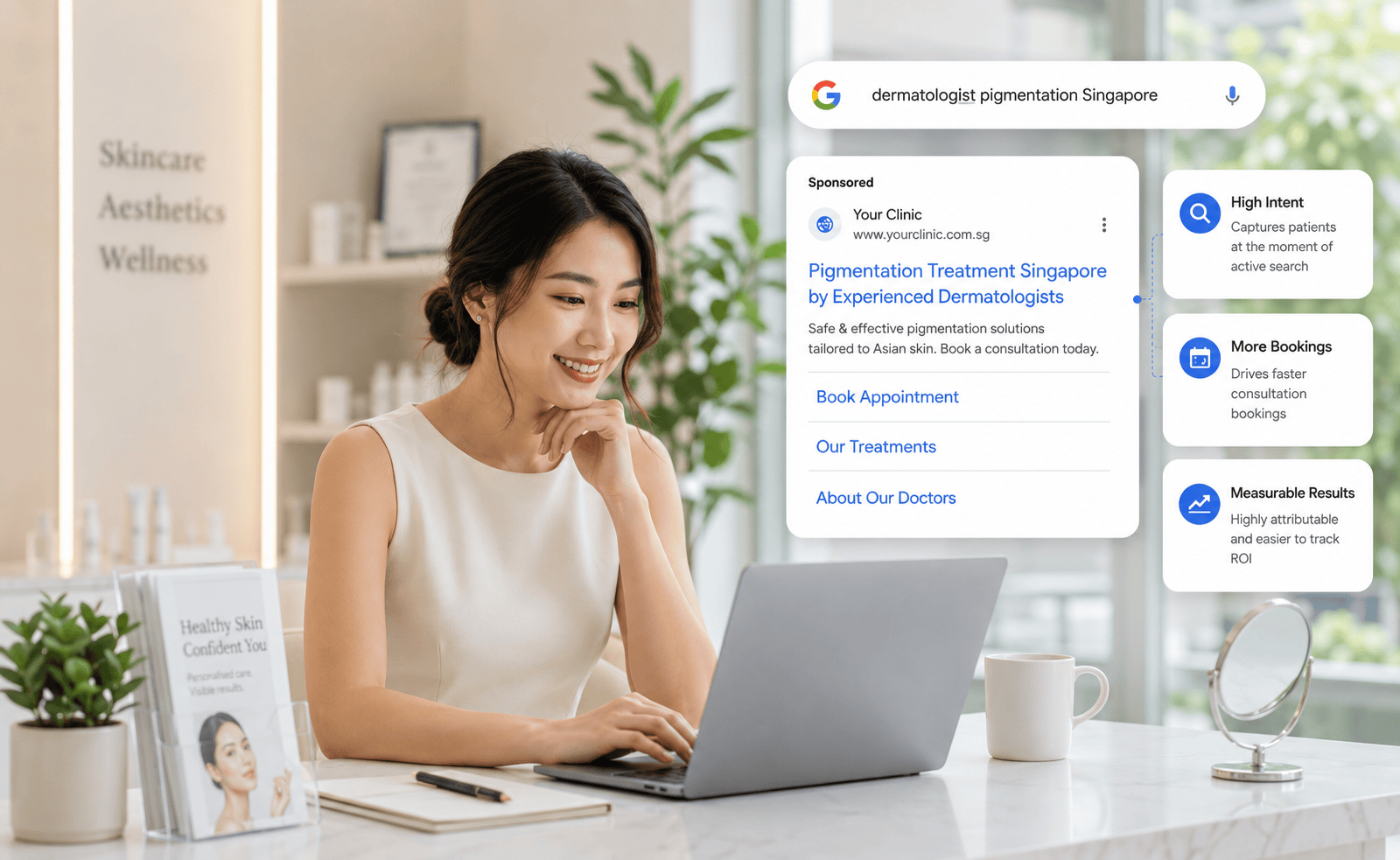
Google Search Ads are fully permitted for medical practices when they comply with both Google’s healthcare advertising policies and MOH guidelines, according to PaperCut Singapore’s 2026 guide. The critical compliance rules for medical Google Ads are: keywords must be condition and specialty-based rather than outcome-based, ad copy must not include testimonials with specific health claims, and landing pages must meet the same compliance standards as the ad itself. A landing page that is technically compliant but leads to a booking page with a patient success story that includes a specific health outcome claim creates a compliance exposure through the combination even if the ad copy itself is clean.
Display advertising and YouTube advertising are restricted for medical providers, according to PaperCut’s analysis, meaning search is the primary paid channel available to Singapore clinic marketing. This concentrates the paid advertising investment into the highest-intent channel available, which is commercially efficient: the patient who searches “dermatologist Orchard Road” is expressing active purchase intent, making search conversion rates materially higher than the awareness-stage audience that display advertising typically reaches.
Google Business Profile

Google Business Profile is the highest-priority digital asset for Singapore clinics and the most consistently underinvested. When a patient searches for a clinic by specialty and location, the Google Business Profile appears prominently in the local results that precede organic search listings. A fully optimized GBP with accurate hours, current services, professional clinic photographs, and an active review base consistently outperforms paid advertising for local patient discovery because it captures the same high-intent search query at zero per-click cost.
The review acquisition approach that is compliant under both MOH guidelines and PDPA is the post-appointment verbal invitation followed by a direct link to the Google review page sent by SMS or email. Patients can be asked to share their honest experience. They cannot be incentivized with discounts or prizes, which breaches both the promotional prohibition and PDPA consent requirements. The clinic that systematically generates post-appointment review invitations through its patient communication workflow accumulates the review volume that produces sustained local search ranking and patient trust over time.
Social Media

Instagram, Facebook, LinkedIn, and TikTok are all permitted channels for Singapore medical clinic marketing when the content meets HCSA requirements. The most commercially effective approach to social media for medical practices follows the educational content model: condition explanation content, treatment mechanism content, doctor expertise content, and clinic culture content, none of which makes specific outcome claims or uses prohibited imagery. Educational social content builds the clinical authority that positions the practice as the credible expert a prospective patient wants to consult, without requiring any of the promotional mechanics the regulations prohibit.
Influencer partnerships are permitted for medical clinic marketing in Singapore when the influencer’s content follows the same guidelines as the clinic’s own content. An influencer who documents their consultation experience, asks the doctor about the process and the clinical rationale, and shares their genuine impressions of the clinic without attributing specific health outcomes to the treatment is producing compliant partnership content. An influencer who shows a before-and-after result, claims a specific health benefit, or endorses a treatment as producing a particular outcome is producing non-compliant content for which the clinic bears responsibility regardless of the influencer’s awareness of the regulations.
Website and SEO

A clinic’s website is the digital asset that converts every other channel’s traffic into consultation bookings, and it must meet the same compliance standards as advertising content. Service pages that describe what a clinic offers without making outcome claims, doctor profile pages with accurate and fully attributed credentials, educational blog content that addresses the conditions the clinic treats without promotional framing, and a booking infrastructure that makes the consultation process effortless are the website investment that produces measurable patient acquisition return.
SEO for medical practices requires the specific discipline of avoiding over-optimization with promotional language, according to Impossible Singapore’s PHMC guidelines guide. A page optimized for “best dermatologist Singapore” is both non-compliant and likely to underperform against a page genuinely optimized for “dermatologist skin pigmentation Orchard Road,” because the latter matches the specific intent of a patient who knows her concern and is searching for specialist help rather than a generic superlative. Compliance and effective SEO point in the same direction: specific, helpful, factual content that answers the patient’s actual search question.
What Is the Pre-Publication Checklist Every Clinic Needs?

Every piece of marketing content a clinic publishes, regardless of channel, should be checked against this list before it goes live. The five-minute check prevents the enforcement exposure that a five-second compliance failure creates.
First: Does the content make any claims about treatment outcomes, including phrases like “effective for,” “results in,” “treats,” “cures,” or “improves”? If yes, is each claim supported by published clinical evidence that the clinic can produce on request? If the evidence is not available, the claim must be removed or rephrased as a general treatment category description.
Second: Does the content include any superlative language: “best,” “leading,” “most,” “top,” “safest,” “fastest”? If yes, remove it and replace with a factual credential or an attributable third-party recognition.
Third: Does the content include patient imagery, stories, or experiences that attribute a specific health outcome to the clinic’s treatment? If yes, revise to remove the health outcome attribution while retaining the permissible elements of the patient experience that do not constitute clinical claims.
Fourth: Does the content include any pricing language that frames a fee reduction, a free service, or a time-limited offer as a reason to book? If yes, remove the promotional framing and replace with transparent pricing stated factually.
Fifth: Does the content as a whole pass the intent test? Would a patient reading it describe its primary purpose as informing her or selling to her? If selling, revise the framing before publication.
Creative For More’s medical and aesthetics digital marketing services are built around Singapore’s HCSA and SMC regulatory framework. Every piece of content we produce for clinic clients is reviewed against this checklist and against the full regulatory standards before publication. Our social media marketing programs for medical practices produce the educational content and doctor authority presence that generates patient inquiries within the framework, and our SEO content strategy captures the search intent of the researching Singapore patient at the awareness and consideration stages where compliant educational content produces the most durable acquisition advantage.
If your clinic wants a marketing partner who understands both the regulations and the commercial strategy that produces consistent patient acquisition within them, the Creative For More team can help. Book a discovery call to explore how we can support your practice’s growth.
Read More About Medical & Aesthetics
- How Aesthetic Clinics Can Market Ethically and Profitably in Singapore
- What Marketing Channels Work Best For Medical and Aesthetic Clinics in Singapore
- How Do You Measure the ROI of Digital Marketing for a Medical Practice?
- How Much Should a Medical Clinic Spend on Digital Marketing in Singapore?
- The Biggest Digital Marketing Mistakes Aesthetic Clinics Make (and How to Fix Them)
- What Is the SMC Advertising Code and What Does It Mean for Clinic Marketing?
- How to Build a Digital Marketing Strategy for a Medical Practice From Scratch
- What Is Medical Marketing and Why Do Clinics in Singapore Get It Wrong?
- How to Market a Medical Clinic in Singapore Without Violating MOH Guidelines

Geraldine Pang
Creative For More
Geraldine Pang is the founder of Creative For More, a cross-border digital marketing agency with offices in Singapore, Tokyo, and New York. She specializes in brand strategy, market entry, and cross-border marketing across Southeast Asia, Japan, and the United States.