

Pet Food Import Regulations Across Asia: Japan, Singapore, Malaysia, and Vietnam
Pet Food Import Regulations Across Asia: Japan, Singapore, Malaysia, and Vietnam
Regulation is the barrier most pet brands discover too late. Marketing plans get built, distributors get lined up, and then import registration adds three months nobody budgeted for. Across Asia, the rules differ enough that a single regional checklist doesn’t exist.
We help pet brands plan market entry across Asia, and regulatory sequencing is where launches either stay on track or quietly slip. Here’s a working view of what importing pet food into four key markets involves in 2026.
Why Is Pet Food Regulation So Hard to Navigate in Asia?

Asia has no single pet food standard, so every market carries its own labeling, ingredient, and registration rules. This fragmentation is the top structural barrier to entry across the region. According to IndexBox, regulatory fragmentation across Asia-Pacific remains a significant barrier to market entry, with divergent labeling requirements, ingredient approval processes, and import registration timelines increasing go-to-market complexity.
Tariffs add another layer. Pet food is categorised under HS codes 230910 and 230990, and import duties range from zero under ASEAN preferences to 10 to 20% in some markets depending on origin and trade agreement.
What Are the Import Requirements for Each Market?
The requirements vary by market, but they cluster around three things: registration, labeling, and certification. Here’s how the four markets compare on the factors that shape a launch timeline.
| Market | Key Requirement | Timeline Signal |
|---|---|---|
| Japan | Pet Food Safety Act compliance; origin and ingredient labeling | Longer; documentation-heavy |
| Singapore | AVS import licence and conditions; product-type dependent | Moderate; well-defined process |
| Malaysia | Import permits; halal a strong commercial factor | Moderate |
| Vietnam | Product registration and quarantine; format-sensitive | Variable; plan buffer |
The pattern to notice: Japan sits at the strict end because of documentation, while Southeast Asian markets vary based on infrastructure and certification demands. Vietnam’s constraints in particular favour shelf-stable formats, which can affect what you’re even able to import.
What Does Japan Require to Import Pet Food?
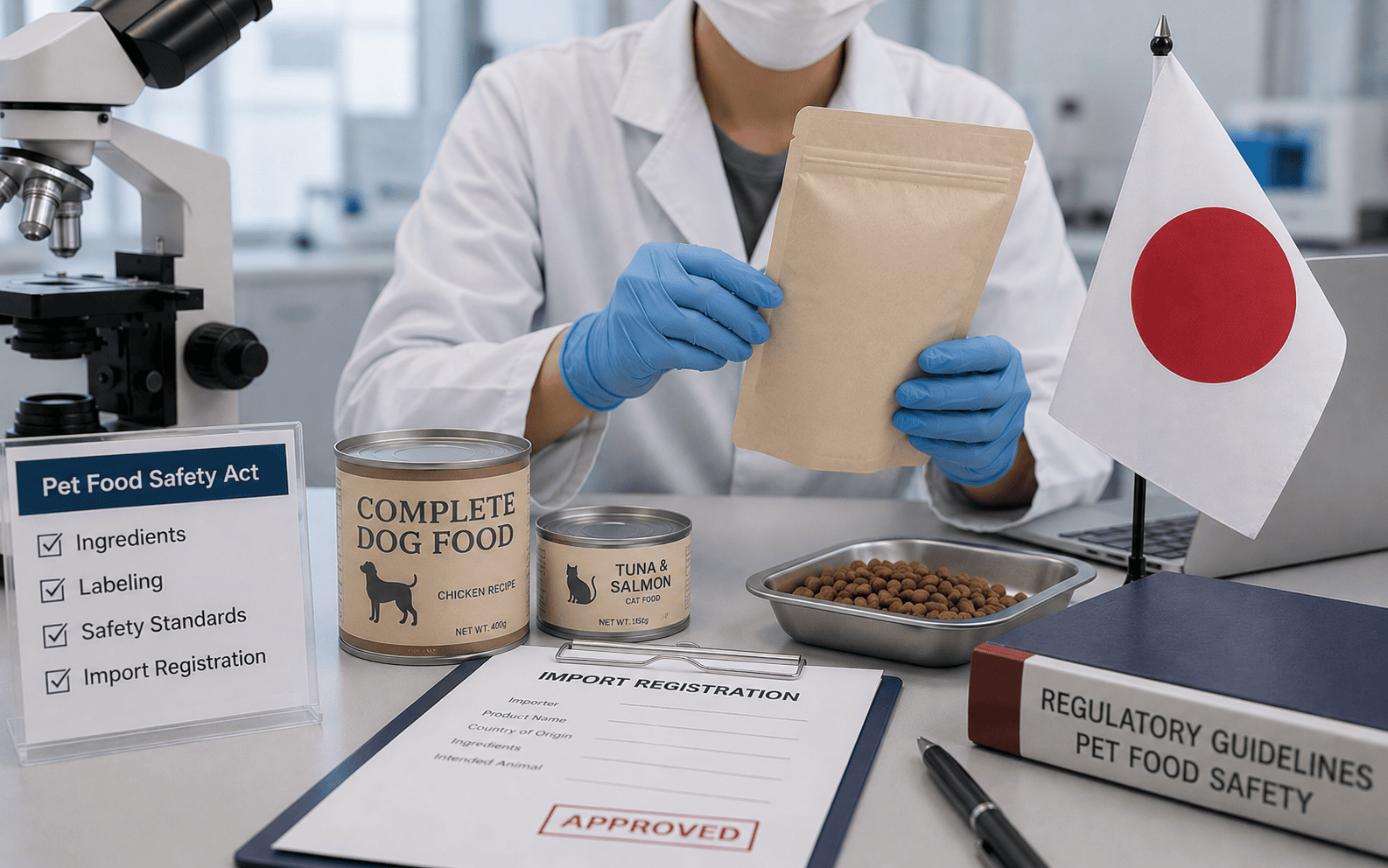
Japan regulates imported pet food under the Pet Food Safety Act, covering ingredient standards, labeling, and safety. Brands need to register import details and meet labeling rules for ingredients, origin, and intended animal before selling.
Beyond the legal minimum, Japanese buyers expect more information than most markets. According to Asia Pro Distribution, Japanese premium pet food consumers expect a full ingredient list with source country for protein components, a guaranteed analysis, and production batch traceability. In Japan, the regulatory floor and the consumer expectation are close together, so meeting one gets you most of the way to the other.
How Does Singapore’s Import Process Compare?
Singapore has one of the clearer import frameworks in the region, which is part of why it works well as a first market. Pet food imports are governed by the Animal and Veterinary Service under conditions that depend on the product type and country of origin.
Because the process is well-defined and English-language, Singapore gives brands a cleaner read on demand before they take on the heavier regulatory load of larger markets. According to Mordor Intelligence, Singapore also functions as a re-export hub, with branded products moving on to neighbouring Southeast Asian markets.
That re-export role is worth planning around. A Singapore entry can double as a regional staging point rather than a standalone market. We cover this in our guide to entering Singapore’s pet retail market.
What About Malaysia and Vietnam?
Malaysia requires standard import permits, and while halal isn’t legally mandatory for pet food, it’s a strong commercial factor in a Muslim-majority market. Brands that plan to sell across Malaysia and Indonesia should map halal certification into the timeline early.

Vietnam requires product registration and quarantine clearance, and the process can be variable enough that a timeline buffer is sensible. According to Mordor Intelligence, Vietnam’s infrastructure constraints favour shelf-stable formats, so product format and regulatory route need to be planned together, not separately.
How Should Brands Plan Around Regulation?

Run regulatory prep in parallel with everything else, not as a final step. The brands that lose the most time are the ones that finish branding and distribution first, then start registration.
A workable sequence is to map the certification and registration requirements per market before setting the launch calendar, then run compliance, localisation, and distributor conversations at the same time. This is how we structure Asia entry for pet brands, and it’s usually the difference between a launch that ships on schedule and one that stalls waiting on paperwork.
If you’re planning to import pet food into Asia and want a partner who maps the regulatory path alongside the marketing, the Creative For More team can help. Book a discovery call to explore how we can support your brand’s growth.
Read More About Pet Marketing
- How Much Does Pet Influencer Marketing Cost in Asia in 2026?
- Pet Brand Marketing: A Full-Funnel Guide Beyond Influencers
- Pet Food Import Regulations Across Asia: Japan, Singapore, Malaysia, and Vietnam
- Selling Pet Products in Southeast Asia: A Market-by-Market Playbook for 2026
- Halal Certification for Pet Food: What Brands Entering Malaysia and Indonesia Need to Know
- What Does a Pet Marketing Agency Actually Do? (And When Your Brand Needs One)
- Pet Influencer Marketing: How Brands Run Campaigns That Convert
- How to Choose a Pet Marketing Agency: A Brand-Side Checklist

Geraldine Pang
Creative For More
Geraldine Pang is the founder of Creative For More, a cross-border digital marketing agency with offices in Singapore, Tokyo, and New York. She specializes in brand strategy, market entry, and cross-border marketing across Southeast Asia, Japan, and the United States.