
Schema Markup for Service Businesses: What to Add First in 2026
Schema Markup for Service Businesses: What to Add First in 2026

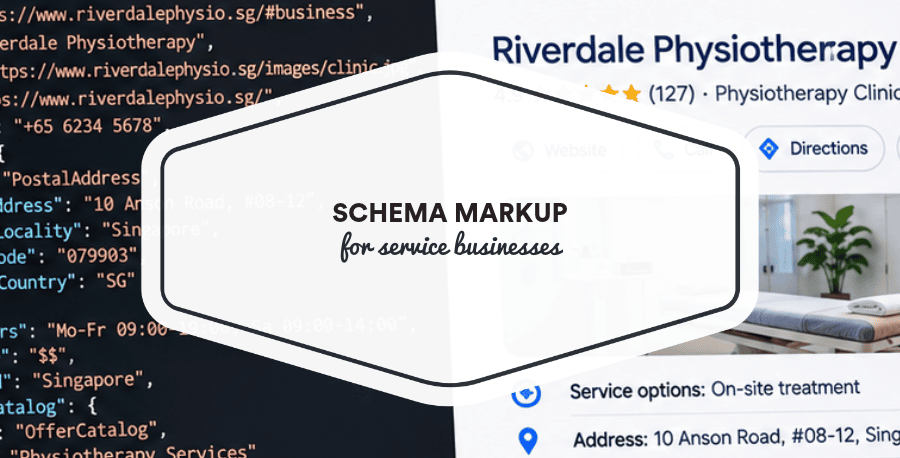
Schema markup for service businesses should start with Organization markup on the home page, LocalBusiness markup for each physical office, and Service markup on each service page, followed by author, breadcrumb and Article markup. FAQPage markup is now a low priority, because Google stopped showing FAQ rich results in May 2026. All markup should be written in JSON-LD and describe only content visible on the page.
Structured data helps search engines identify who a business is, where it operates and what it sells. For service businesses, which don’t have product listings or prices that fit neatly into shopping features, the main value lies in entity clarity and eligibility for a smaller set of rich results.
Google’s supported features have also changed, and much of the schema advice still circulating was written before those changes. The priority order below reflects Google’s current documentation as of October 2026.
What Is Schema Markup and Why Does It Matter for Service Businesses?
Schema markup is structured data, written in the schema.org vocabulary, that describes a page’s content in a machine-readable format. For service businesses, it tells search engines which organization runs the site, where its offices are, and which services each page describes.
Google recommends JSON-LD as the format for structured data where a site’s setup allows it, although Microdata and RDFa are also accepted. JSON-LD is a W3C Recommendation, and it sits in a single script block rather than being woven through the page’s HTML, which makes it easier to maintain across many pages and languages.
Structured data does not guarantee a rich result. Google’s structured data policies state that it doesn’t guarantee markup will appear in search results, and they warn that misleading or spammy markup can lead to a manual action that removes rich result eligibility.
Which Schema Types Should a Service Business Add First?
A service business should add schema types in order of how much they clarify the business as an entity and how many pages they affect. Organization and LocalBusiness come first, Service and author markup next, and FAQPage last.
| Priority | Schema type | Where it goes | Google rich result support (Oct 2026) |
|---|---|---|---|
| 1 | Organization | Home page or About page | Supported (logo and organization details) |
| 2 | LocalBusiness (most specific subtype) | Each office or location page | Supported (local business details) |
| 3 | Service | Each service page | No dedicated rich result; used for entity clarity |
| 4 | Person (as Article author) | Blog posts and author pages | Supported within Article and Profile page features |
| 5 | BreadcrumbList | Every page below the home page | Supported |
| 6 | Article or BlogPosting | Blog posts and insights | Supported |
| 7 | FAQPage | Pages with visible question and answer content | No longer shown in Google Search since May 2026 |
The support column reflects the Google Search Central structured data gallery, last updated in October 2026, which lists Organization, Local business, Breadcrumb, Article and Profile page among supported features. FAQ no longer appears in that list.
How Should Organization and LocalBusiness Markup Be Set Up?
Organization markup should describe the company once, on the home page or a single About page, while LocalBusiness markup should describe each physical office on its own location page. Google’s documentation recommends using the most specific subtype available for both.
According to Google Search Central (2026), Organization markup has no required properties, and recommended ones include name, legalName, url, logo, sameAs, address, telephone and contactPoint. The logo must be at least 112 by 112 pixels.
LocalBusiness markup requires a name and a postal address. Google also recommends geo coordinates, opening hours, a telephone number with the country code, and the URL of that specific location.
How should a business with offices in several countries mark them up?

A business with offices in several countries should mark up each office as its own LocalBusiness on that office’s page, linked back to one Organization. Each office then carries its own address, phone number and opening hours in local format.
For a brand with offices in Singapore, Tokyo and New York, this means three location pages, each with its own LocalBusiness block, plus one Organization block on the home page. Creative For More is set up the same way, with separate pages for our Japan and US offices. Our international website development guide covers how location pages fit into a multi-market URL structure.
<script type="application/ld+json">
{
  "@context": "https://schema.org",
  "@type": "LocalBusiness",
  "name": "Example Agency Tokyo",
  "url": "https://example.com/jp/tokyo/",
  "telephone": "+81-3-0000-0000",
  "address": {
    "@type": "PostalAddress",
    "streetAddress": "1-1 Example-cho",
    "addressLocality": "Chiyoda-ku",
    "addressRegion": "Tokyo",
    "postalCode": "100-0000",
    "addressCountry": "JP"
  },
  "parentOrganization": {
    "@type": "Organization",
    "name": "Example Agency",
    "url": "https://example.com/"
  }
}
</script>
Should a service business use the ProfessionalService type?
A service business should use a specific LocalBusiness subtype, such as LegalService or AccountingService, rather than the general ProfessionalService type. Schema.org’s own notes state that the general ProfessionalService type was deprecated because it was confused with Service.
Where no specific subtype exists, as with marketing agencies or consultancies, LocalBusiness or Organization is the safer choice. Choosing a type that doesn’t match the business adds no benefit and can confuse the entity description.
How Do You Mark Up Individual Services?
Individual services are marked up with the Service type on each service page, naming the service, the provider and the area served. Google has no dedicated rich result for Service, so the purpose is to connect each service clearly to the business that offers it.
The most useful properties are name, description, serviceType, provider and areaServed. For a multi-market business, areaServed can list the countries a service page targets, which should match the market the page’s language and URL are built for.
<script type="application/ld+json">
{
  "@context": "https://schema.org",
  "@type": "Service",
  "name": "Multi-language website development",
  "serviceType": "Web design and development",
  "provider": {
    "@type": "Organization",
    "name": "Example Agency",
    "url": "https://example.com/"
  },
  "areaServed": ["SG", "JP", "US"]
}
</script>
Review and rating markup needs care on service pages. Google’s LocalBusiness documentation recommends aggregateRating and review properties only for sites that capture reviews about other local businesses, so a business marking up its own testimonials isn’t eligible for review stars.
Is FAQ Schema Still Worth Adding?
FAQ schema is no longer worth adding for Google rich results, because Google stopped showing FAQ rich results in Google Search from 7 May 2026. Visible question-and-answer content on the page still has value for readers and for search, independent of the markup.
The change came in two stages. In August 2023, Google limited FAQ rich results to well-known, authoritative government and health websites, which removed them for almost all service businesses. In May 2026, Google added a deprecation notice to its FAQ documentation, and in June 2026 it removed that documentation entirely.
Existing FAQPage markup doesn’t need to be stripped out urgently, since it’s valid schema.org vocabulary and Google simply ignores it for rich results. New builds can leave it off and spend the time on Organization, LocalBusiness and Service markup instead.
Does Schema Markup Help With AI Search?

Schema markup is not required to appear in Google’s AI features, and Google says no special schema is needed for them. It still supports the standard rich results that structured data is designed for, so it remains part of normal SEO practice.
According to Google Search Central (2026), “Structured data isn’t required for generative AI search, and there’s no special schema.org markup you need to add.” The same guide recommends continuing to use structured data because it helps with rich result eligibility.
The practical benefit for service businesses is consistency. In the multi-market sites we scope, the most common structured data problem is conflicting entity details, such as a different company name, phone format or address on each market version. Markup that matches the visible page in every language gives search and AI systems one clear description of the business, and it forms part of our generative engine optimisation work.
How Do You Test and Maintain Schema Markup?
Schema markup should be tested before launch with Google’s Rich Results Test and the Schema Markup Validator, then monitored after launch in Search Console. Testing catches syntax errors, while monitoring catches markup that breaks when templates or content change.
- Validate syntax. Run each template through the Schema Markup Validator to check that the JSON-LD parses and the types and properties exist.
- Check Google eligibility. Use the Rich Results Test to confirm which supported features Google detects on the page.
- Monitor in Search Console. The Google Search Console Help rich result reports show valid items, warnings and errors for each supported feature across the site.
- Review after changes. Recheck markup after a redesign, a plugin update, a new office or a new language version.
WordPress sites usually generate part of this automatically through an SEO plugin, which typically covers Organization, WebSite, breadcrumb and Article markup. LocalBusiness and Service markup often needs to be added separately, either through an add-on or a custom template field per page.
Brands building or rebuilding a site can have structured data planned into each template from the start through our web design and development service, which covers multi-language WordPress and Shopify builds, international SEO and AI-search-ready content structure.
If you’re running a service business across more than one market and want your site’s structured data to describe each office and service correctly, we can audit what’s in place and set priorities. If your company is looking for a strategic marketing partner, the Creative For More team can help. Book a discovery call to explore how we can support your brand’s growth.
Read More

Geraldine Pang
Creative For More
Geraldine Pang is the founder of Creative For More, a cross-border digital marketing agency with offices in Singapore, Tokyo, and New York. She specializes in brand strategy, market entry, and cross-border marketing across Southeast Asia, Japan, and the United States.