

Website Localization for Japan: Translation, Transcreation and What Japanese Users Expect
Website Localization for Japan: Translation, Transcreation and What Japanese Users Expect
Website localization for Japan adapts a site’s language, tone, formats and functions to Japanese users, which goes further than translating the text. A localized Japanese site uses the right politeness level, Japanese date, address and name formats, prices shown with consumption tax, payment methods Japanese buyers use, and keywords researched in Japanese rather than translated from English.
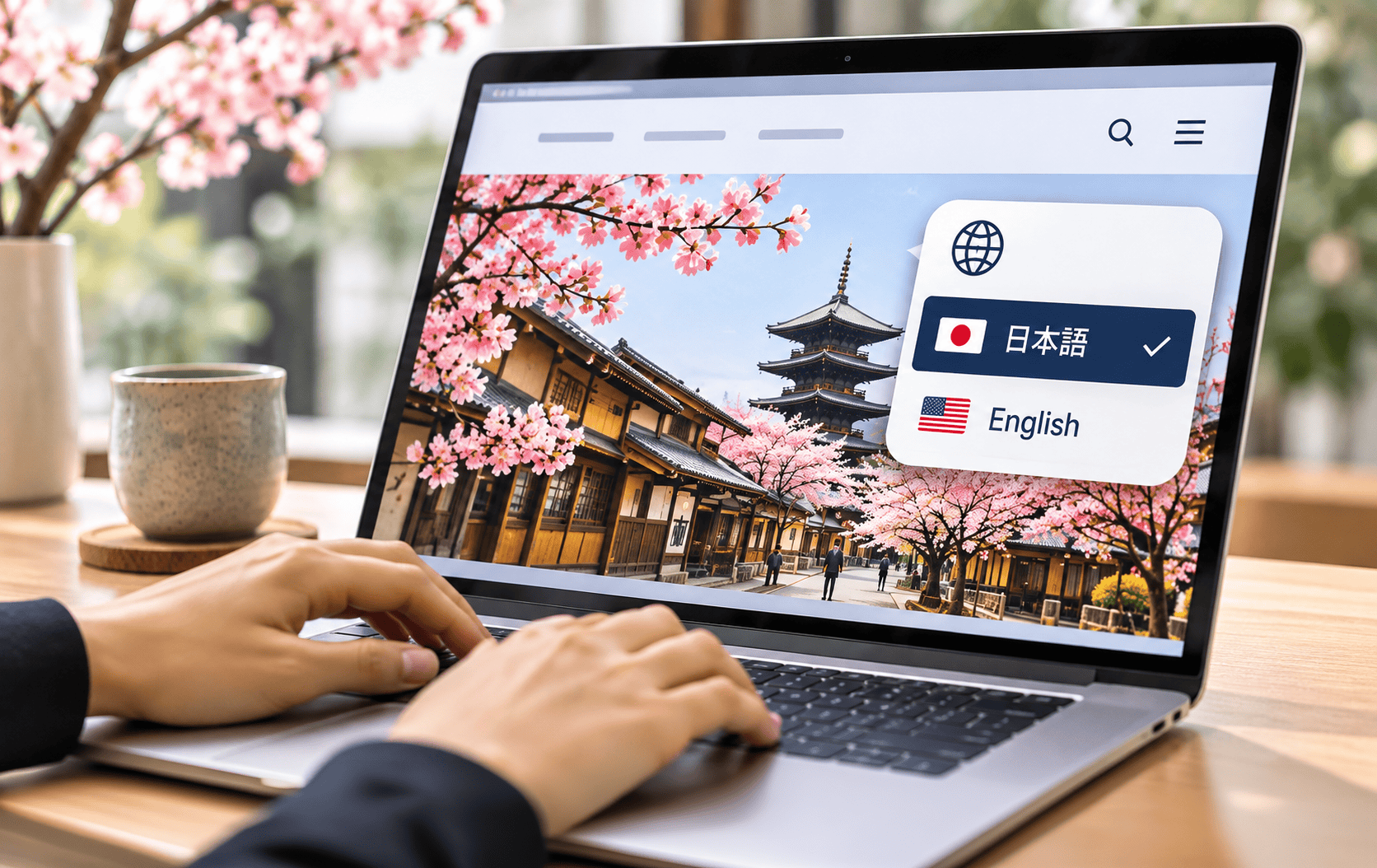
A translated website and a localized website can look similar on the surface. The difference shows up in conversion: forms that reject Japanese names, prices that don’t state tax, checkout pages without familiar payment options and copy that reads as stiff or abrupt all lose Japanese users who would otherwise buy.
This article focuses on the localization layer of a Japanese site. Structure, URL strategy and language targeting across several markets are covered in our international website development guide.
Why Does Website Localization Matter in Japan?
Website localization matters in Japan because most online consumers prefer to buy in their own language, and Japan was one of the markets where this preference was measured. A site that reads naturally in Japanese removes a barrier before price or product is even considered.
According to CSA Research (2020), 76% of online consumers across 29 countries prefer to buy products with information in their native language, and 40% will never buy from websites in other languages. The same study found that 75% of consumers are more likely to buy again from a brand that offers customer care in their language.
What Is the Difference Between Translation, Localization and Transcreation?
Translation converts text from one language to another, localization adapts the whole experience to a market, and transcreation rewrites marketing messages so they create the same effect in the new language. Most Japanese websites need all three, applied to different types of content.
Product specifications, legal pages and help content usually need accurate translation with local formats. Navigation, forms, checkout and customer service flows need localization. Headlines, taglines, campaign pages and brand stories usually need transcreation, because a literal Japanese version of an English slogan rarely carries the same meaning.
| Approach | What it changes | Best used for | Typical owner |
|---|---|---|---|
| Translation | Words, keeping meaning as close to the source as possible | Specifications, manuals, terms, FAQs | Professional translator |
| Localization | Language plus formats, units, payments, forms, imagery and UX | Product pages, checkout, forms, navigation | Localization team with developers |
| Transcreation | The message itself, rewritten for the same intent and effect | Headlines, taglines, ads, campaign and brand pages | Native copywriter working from a creative brief |
Machine translation can help with first drafts of high-volume, low-risk content. Customer-facing pages still need review by a native Japanese speaker, because errors in register and terminology are hard for non-speakers to detect.
How Should Keigo and Tone Be Handled on a Japanese Website?

Japanese website copy should use polite language (keigo) consistently, at a level that matches the brand and the audience. Most commercial sites use the polite desu/masu form for body copy and more formal honorific and humble forms in customer service, contact and apology text.
The choice affects every interface string, from button labels to error messages. A direct English instruction such as “Enter your email” is usually softened in Japanese with a polite request form, and an error message is expected to apologize or explain rather than simply state the fault. Our article on why even native speakers study keigo explains how high these communication standards sit in Japanese business.
Tone also needs to stay consistent across pages written by different people. A short style guide that sets the politeness level, preferred terms, brand name spelling in katakana and rules for loanwords helps translators and copywriters produce copy that reads as one voice.
Which Formats Need to Change for Japanese Users?
Dates, names, addresses, prices and phone numbers all follow Japanese conventions that differ from English-language defaults. In multi-market builds we scope, form fields built on English-language defaults are one of the most common localization gaps.
| Element | Japanese convention | Localization requirement |
|---|---|---|
| Dates | Year, month, day (2026年10月22日); the Japanese era calendar appears on some official forms | Display year-month-day; keep the Gregorian year unless the context needs the era |
| Names | Family name first, with a kana reading (furigana) often collected | Separate family and given name fields in that order, plus optional kana fields |
| Addresses | Postal code first, then prefecture, city, district, block and building | Postal code field that autofills the prefecture and city; fields ordered large to small |
| Prices | Yen with no decimals; tax-inclusive display is the norm for consumer prices | Show prices including consumption tax and state it clearly |
| Phone numbers | Domestic format starting with 0, such as 03 for Tokyo | Accept Japanese formats and full-width or half-width digits |
| Text input | Users may type full-width characters by default | Convert full-width numbers and letters automatically instead of rejecting them |
Name fields need particular care. According to the W3C Internationalization guidance on personal names, Japanese kanji names often have several possible readings, so Japanese users commonly supply a phonetic version in kana and sorting is usually based on that reading. Labels such as “first name” and “last name” confuse users who write the family name first.
Which Payment Methods Should a Japanese Website Offer?
A Japanese ecommerce site should offer credit cards at minimum, and usually code payments such as PayPay, convenience store payment and carrier billing as well. Credit cards dominate cashless spending in Japan, and code payments such as PayPay are the second-largest category.
According to METI (March 2026), cashless payments reached 58.0% of consumer spending in Japan in 2025, worth 162.7 trillion yen. Credit cards made up 82.7% of that cashless total, code payments 10.2%, electronic money 3.7% and debit cards 3.4%.
Payment availability depends on the platform and the payment provider a brand uses in Japan. Shopify, WooCommerce and most Japanese payment gateways support several local methods, but each needs a Japanese merchant setup and testing before launch.
How Do You Do Japanese Keyword Research?

Japanese keyword research starts from how Japanese users actually search, not from translated English keywords. The same idea can be written in kanji, hiragana, katakana or English letters, and each variant can have different search volume and intent.
A translated keyword list misses these variants. A skincare brand, for example, may find that users search with a katakana loanword for one product type and a kanji term for another, and that the English brand name is searched in both katakana and Latin letters. Research should cover each spelling, check the results Japanese users see for each, and choose the form that matches both volume and intent.
Google reads the language from the visible content of a page. According to Google Search Central, sites should use separate URLs for each language version and a single language for content and navigation on each page. Page titles, headings, image alt text and URLs where practical should all use the researched Japanese terms.
How Is a Japanese Website Localization Project Run?
A Japanese website localization project usually runs in five stages, from content audit to post-launch review. Planning the stages up front prevents the common pattern of translating everything first and fixing forms, payments and tone afterwards.
- Audit: list every page, template, form and system message, and sort content into translation, localization and transcreation.
- Research: run Japanese keyword research and review competitor sites in the category.
- Style guide: set politeness level, terminology, brand name spelling and formatting rules.
- Build and adapt: localize forms, address and name fields, payments, fonts and layouts alongside the copy.
- Review and test: have native speakers check copy in context, then test forms and checkout with real Japanese data.
Creative For More runs this process across our Singapore, Tokyo and New York offices, and our web design and development team builds multi-language WordPress and Shopify sites with localization and international SEO in the same project. Japanese account managers in our Tokyo team review Japanese-facing copy before launch.
If you’re preparing a Japanese version of your website and want localization, transcreation and the build handled by one team, we can scope the project with you. If your company is looking for a strategic marketing partner, the Creative For More team can help. Book a discovery call to explore how we can support your brand’s growth.
Read More
- International Website Development: The 2026 Guide for Multi-Market Brands
- A Guide to Cross-Border Brand Localization for Global Growth
- How to Start Selling Online in Japan: A Step-by-Step Guide for Global Brands
- Marketing to Japan: Navigating Consumer Preferences and Cultural Nuances
- Japanese Marketing Strategy: What Global Brands Should Know to Succeed in Japan

Geraldine Pang
Creative For More
Geraldine Pang is the founder of Creative For More, a cross-border digital marketing agency with offices in Singapore, Tokyo, and New York. She specializes in brand strategy, market entry, and cross-border marketing across Southeast Asia, Japan, and the United States.