

What Is Medical Marketing and Why Do Clinics in Singapore Get It Wrong?
What Is Medical Marketing and Why Do Clinics in Singapore Get It Wrong?
Medical marketing is not a subspecialty of digital marketing. It is a discipline with its own regulatory framework, its own trust-building logic, and its own patient psychology that differs from general consumer marketing in every dimension that matters. A Singapore clinic that approaches its marketing the way a retail brand or restaurant approaches its marketing will not merely underperform. It will likely violate the Healthcare Services Act, generate patient expectations it cannot fulfill, and spend budget on channels and tactics that produce no measurable clinical business outcome.

Singapore’s private healthcare sector is one of the most commercially significant in Asia. The hospitals segment alone is projected to reach USD 13.03 billion by 2029, growing at 7.19% annually, according to ClinicScalers’ Singapore healthcare market analysis. Approximately 1,980 private medical clinics cover around 79% of Singapore’s primary healthcare services. Singapore General Hospital was ranked the ninth best hospital in the world in 2025, the only Asian institution in the global top ten. Medical tourism contributes over SGD 1 billion annually, according to Kode Digital’s Singapore healthcare digital marketing guide. One in four Singaporeans will be aged 65 or older by 2030, creating structural and irreversible growth in demand for private clinic services across general practice, specialist care, and preventive health.
The market opportunity is not the problem. The problem is that most Singapore clinics are not marketing effectively within it. This article defines what medical marketing actually is, explains the regulatory context that makes Singapore medical marketing categorically different from any other industry’s marketing, and diagnoses the specific ways that clinics most commonly get it wrong.
What Is Medical Marketing?

Medical marketing is the set of strategies, channels, and communications that a healthcare provider uses to attract new patients, retain existing ones, build clinical authority, and grow its practice’s revenue, within the regulatory and ethical framework that governs healthcare advertising. It covers everything from how a clinic’s name appears in Google Search to how its doctors communicate their expertise on a website, how its Google Business Profile is managed, how its social media presence communicates clinical authority, and how its patient communication infrastructure converts inquiries into booked consultations.
Medical marketing differs from general marketing in three foundational ways. First, the purchase decision it influences carries a higher personal stakes than almost any other consumer decision. A patient choosing a dermatologist is not choosing a restaurant. She is choosing a person she will trust with her physical health, her appearance, or her wellbeing. The trust threshold is higher, the evaluation process is more thorough, and the consequence of a mismatch between marketing promise and clinical reality is more damaging, for the patient and for the practice, than the equivalent mismatch in any consumer category.

Second, medical marketing is governed by a specific and actively enforced regulatory framework. The Healthcare Services Act, the Singapore Medical Council’s Ethical Code and Ethical Guidelines, and the Singapore Medical Association’s advisory standards all apply simultaneously to any marketing a Singapore clinic produces. These regulations restrict what can be claimed, what imagery can be used, what promotional mechanics are permitted, and how patient data can be used in marketing communications. The regulatory framework does not make medical marketing impossible. It makes it different, in ways that a generalist marketing agency typically does not understand until enforcement produces an expensive lesson.
Third, medical marketing’s measure of success is patient outcomes, not campaign metrics. A digital marketing campaign that generates 10,000 impressions, 500 website visits, and 50 inquiry form submissions but produces five consultation bookings from patients who do not proceed past the first appointment has not succeeded commercially, even if its metrics dashboard shows strong engagement. Medical marketing success is measured in consultation bookings from clinically appropriate patients who proceed to treatment and who refer other patients. The marketing strategy that produces this outcome is structurally different from the marketing strategy that produces consumer brand engagement metrics.
What Is the Singapore Regulatory Context That Every Clinic Must Understand?
Singapore’s medical advertising is governed by three simultaneous regulatory layers that most clinic owners and their marketing partners do not fully understand. This knowledge gap is not neutral. It produces marketing content that creates enforcement exposure for the clinic and its doctors while simultaneously failing to produce the patient acquisition outcomes that justified the investment.

The Healthcare Services Act (HCSA) and its associated Healthcare Services (Advertisement) Regulations govern what the clinic entity can publish across all channels. The Singapore Medical Council (SMC) Ethical Code and Ethical Guidelines govern what the individual registered doctor can allow to appear in marketing under their name and practice. The Singapore Medical Association’s advisory standards add a third professional conduct layer. According to previous compliance research in this series, all three apply simultaneously: a clinic can be fined under HCSA while the individual doctor simultaneously faces SMC disciplinary proceedings for the same content. The penalties include fines up to SGD 20,000, imprisonment of up to 12 months, and licence suspension. Each non-compliant advertisement may constitute a separate offence.
The regulatory prohibitions that most directly affect digital marketing for Singapore clinics are: before-and-after photographs in advertising, guarantees of results, superlatives and claims of clinical superiority, patient testimonials used as advertising content, promotional pricing mechanics designed to incentivize treatment uptake, and outdoor and broadcast advertising channels. The internet is an explicitly approved advertising channel, which means Google Search Ads, SEO, social media, and Google Business Profile are all permitted when the content meets the regulatory requirements.
Non-compliance with Singapore’s medical advertising guidelines results in serious consequences including fines, reputational damage, and even suspension of practice, according to Impossible Singapore’s PHMC guidelines analysis. The compliance failure mode that is most commercially damaging is not the catastrophic obvious violation. It is the accumulation of minor non-compliant elements across a clinic’s digital presence, an unsupported superlative in an ad headline, a patient review incorporated into marketing copy, a before-and-after image on an Instagram post, that individually seem minor and collectively create a significant enforcement exposure that the clinic’s owner does not know exists until it is identified by a regulatory audit.
Why Do Most Singapore Clinics Underinvest in Marketing?
The underinvestment problem in Singapore medical marketing is not primarily a budget problem. It is a belief problem: the belief, widely held among Singapore clinic owners, that clinical quality and word-of-mouth referral are sufficient patient acquisition mechanisms and that active marketing investment is either unnecessary, ethically questionable, or likely to generate compliance problems that outweigh the commercial benefit.

This belief was more defensible fifteen years ago, when Singapore’s private clinic market was less competitive, when the patient’s primary discovery mechanism was referral from a trusted physician or family contact, and when the digital touchpoints that now precede almost every healthcare provider decision did not exist. It is not defensible in 2026. The patient who receives a GP referral to a dermatologist in 2026 does not follow that referral without first Googling the referred specialist, checking their Google Business Profile reviews, visiting their clinic website, and evaluating whether the digital presence confirms or undermines the trust signal of the referral. If the clinic’s digital presence is inadequate, the referral converts at a lower rate than the referring GP expects, and the specialist has no visibility into why.
The referral-first belief also creates an acquisition ceiling: a clinic that depends exclusively on referral networks for patient growth can only grow as fast as its referral network grows. The clinic that combines referral network maintenance with active digital marketing builds discovery infrastructure that generates new patient inquiries from patients who were not referred by anyone and who would otherwise never have found the practice. In Singapore’s 1,980-clinic private market, the clinic that is not discoverable through organic search and paid search when a patient searches for its specialty is invisible to a portion of its potential patient population that referral networks alone cannot reach.
According to Hashmeta’s Singapore healthcare marketing guide, Singapore’s healthcare sector is experiencing unprecedented digital transformation, with patients increasingly turning to online channels for healthcare decisions. A physical presence is no longer sufficient. The clinic whose owner believes otherwise is experiencing the digital transformation as a competitor advantage problem: the practices gaining market share in their specialty are not necessarily the most clinically accomplished. They are the most digitally visible, the most actively reviewed, and the most effectively communicating their clinical expertise to the patient who has moved their healthcare discovery online.
Why Do Most Singapore Clinics Misdirect Their Marketing Spend?
The clinics that do invest in marketing frequently misdirect the investment in four specific ways that produce low commercial return and sometimes significant compliance exposure.

Using a generalist marketing agency without healthcare regulatory knowledge. A generalist digital marketing agency that applies its standard retail or F&B marketing playbook to a clinic account will produce content that violates HCSA regulations without intending to. The before-and-after photograph that is a standard content format in beauty and lifestyle marketing is prohibited in healthcare advertising. The patient testimonial that drives conversion in e-commerce is prohibited as an advertising element in medical marketing. The promotional offer that generates trial for a new restaurant is prohibited as a patient acquisition incentive for a clinic. The generalist agency does not know this. The clinic that hires a generalist agency without regulatory vetting creates compliance exposure that its legal responsibility does not protect it from simply because the agency was unaware of the rules.
Investing in brand aesthetics rather than patient acquisition infrastructure. Singapore clinics regularly invest in premium website design, professional brand photography, and polished social media feeds while underinvesting in the patient acquisition infrastructure that produces bookings. A beautiful website that is not optimized for the search queries that high-intent patients use to find a specialist in the clinic’s category generates no bookings from its beauty. A Google Business Profile that is outdated, under-photographed, and does not have a systematic review generation process loses the local search visibility that the website investment was designed to support. The investment hierarchy that produces measurable commercial return from medical marketing is: patient acquisition infrastructure first (GBP, local SEO, search advertising), patient trust infrastructure second (educational content, doctor authority content, review volume), brand presentation third.
Treating compliance as a reason not to market rather than as the framework within which to market. The most commercially damaging compliance response is compliance paralysis: the clinic that understands the restrictions but interprets them as prohibitions on all marketing activity rather than as the boundaries within which effective marketing operates. The HCSA regulations prohibit specific tactics, not marketing as a category. Educational content, doctor authority content, Google Business Profile management, organic search optimization, compliant paid search advertising, and post-appointment review generation are all fully compliant and collectively constitute a comprehensive patient acquisition system. The clinic that is paralyzed by compliance concern is leaving the full addressable market to competitors who have understood that compliance and effectiveness are not opposites.
Measuring marketing performance on vanity metrics rather than clinical business outcomes. A clinic whose marketing is measured by website traffic, social media followers, or email open rates without connecting those metrics to consultation bookings, procedure volumes, and patient lifetime value does not know whether its marketing investment is commercially productive. The marketing spend that produces 500 website visitors per month but ten consultation bookings is outperformed by the spend that produces 150 website visitors per month and forty consultation bookings, because the second is reaching patients whose search intent and clinical fit is higher despite the lower traffic volume. Medical marketing measurement requires a patient journey tracking system that connects every acquisition channel to the consultation bookings it generates, not a digital metrics dashboard that measures activity without commercial outcome.
What Does Correctly Invested Medical Marketing Look Like in Singapore?
Correctly invested medical marketing in Singapore starts with the patient’s digital journey rather than the clinic’s marketing preferences. The patient who needs a cardiologist, an orthopaedic surgeon, or a dermatologist in Singapore begins her journey with a Google search. She searches the symptom or the specialty, reads the results that appear, clicks through to the websites that seem credible, checks the Google reviews of the clinics that seem relevant, looks for evidence that the doctor whose name appears on the website is genuinely expert, and contacts the clinic that has earned her trust through its digital presence. This journey is predictable, measurable, and optimizable. Medical marketing’s job is to be present and credible at every stage of it.
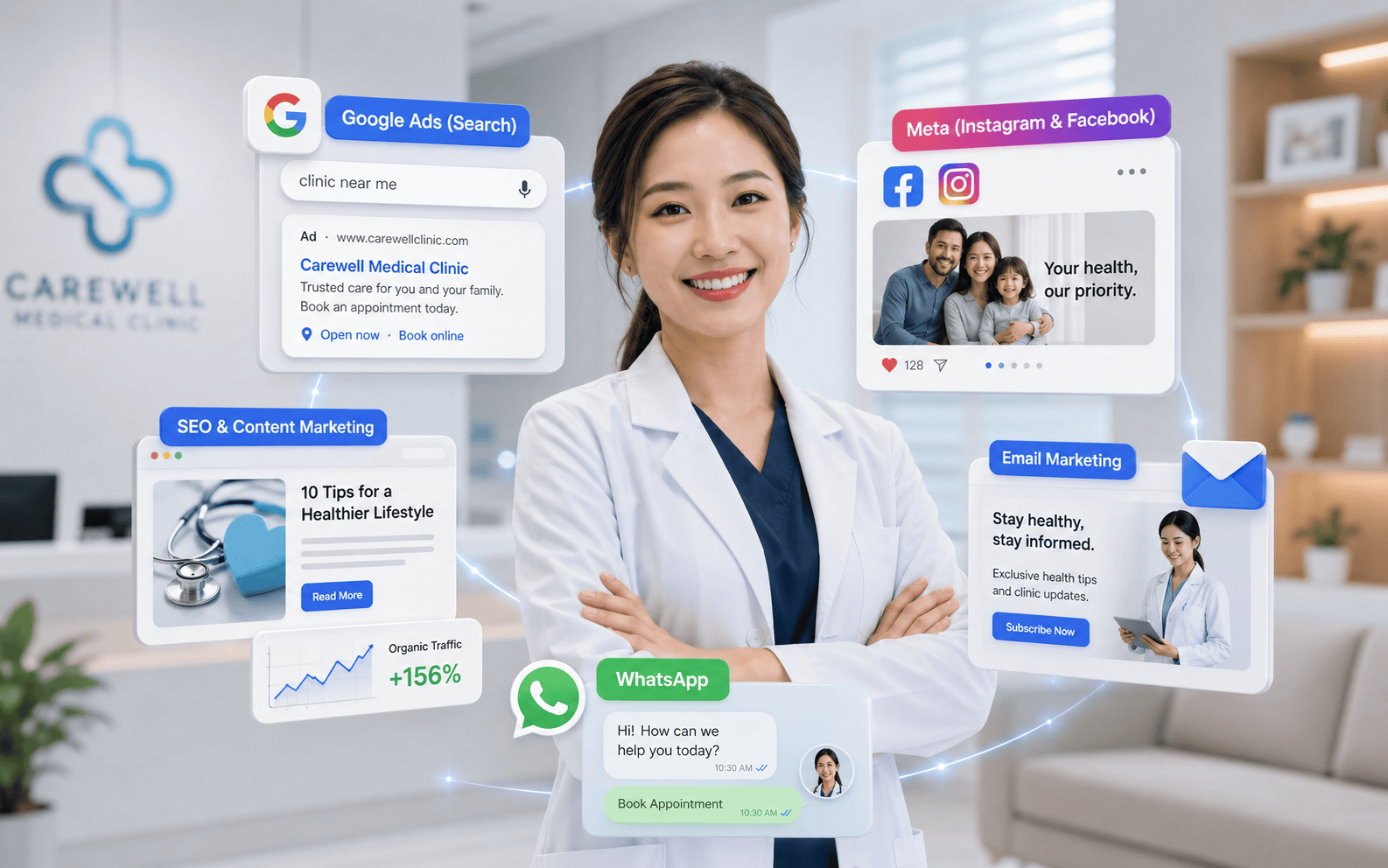
The investment hierarchy that produces measurable commercial return follows the patient journey. Google Business Profile optimization is the highest-return first investment because it determines visibility in local search at the exact moment of patient intent. Organic search optimization for the clinic’s specialty keywords produces the discovery traffic that is highest in patient intent and lowest in acquisition cost over time. Educational content authored by the clinic’s doctors builds the clinical authority that converts research into consultation inquiry. Compliant paid search advertising captures the high-intent patient who is searching today and who would not wait for organic ranking to develop. Post-appointment review generation through compliant patient communication builds the social proof that converts research into booking for every subsequent patient who finds the clinic.
This is not a complicated marketing system. It is a consistently executed one. The Singapore clinics that are growing their patient volumes through digital marketing in 2026 are not doing something sophisticated. They are doing the fundamentals correctly, consistently, and within the regulatory framework that their generalist-agency-dependent competitors are either ignoring or being paralyzed by.
The articles that follow in this series cover each dimension of Singapore medical marketing in practical depth. Our medical and aesthetics digital marketing services build compliant patient acquisition programs for Singapore clinics across aesthetics, specialist practice, and allied health, grounded in the HCSA and SMC regulatory framework that determines what is possible and profitable in this market. Our detailed guides on how aesthetic clinics can market ethically and profitably and Singapore’s medical marketing compliance playbook cover the specific execution detail for the two most commonly searched clinic types. Our SEO content strategy framework connects the educational content investment to the search visibility that makes that investment commercially productive.
If your Singapore clinic wants a marketing partner who understands both the regulatory framework and the commercial strategy that produces measurable patient acquisition within it, the Creative For More team can help. Book a discovery call to explore how we can support your practice’s growth.
Read More About Medical & Aesthetics
- How Aesthetic Clinics Can Market Ethically and Profitably in Singapore
- What Marketing Channels Work Best For Medical and Aesthetic Clinics in Singapore
- How Do You Measure the ROI of Digital Marketing for a Medical Practice?
- How Much Should a Medical Clinic Spend on Digital Marketing in Singapore?
- The Biggest Digital Marketing Mistakes Aesthetic Clinics Make (and How to Fix Them)
- What Is the SMC Advertising Code and What Does It Mean for Clinic Marketing?
- How to Build a Digital Marketing Strategy for a Medical Practice From Scratch
- What Is Medical Marketing and Why Do Clinics in Singapore Get It Wrong?
- How to Market a Medical Clinic in Singapore Without Violating MOH Guidelines

Geraldine Pang
Creative For More
Geraldine Pang is the founder of Creative For More, a cross-border digital marketing agency with offices in Singapore, Tokyo, and New York. She specializes in brand strategy, market entry, and cross-border marketing across Southeast Asia, Japan, and the United States.