
Brand Strategy vs Marketing Strategy: What’s the Difference and Which Comes First?
Brand Strategy vs Marketing Strategy: What’s the Difference and Which Comes First?
The difference between brand strategy and marketing strategy is scope and time horizon. Brand strategy defines who the company is, who it serves and why it should be chosen, and it holds for three to five years or longer. Marketing strategy decides which channels, campaigns and budgets will reach buyers this year. Brand strategy comes first, because marketing needs a fixed position to promote.
The two terms get used interchangeably in briefs, pitch decks and job titles, which is why so many companies buy one when they need the other. A business that hires a performance agency to fix weak positioning usually gets efficient ads for a message that doesn’t land. A business that commissions a brand strategy and then stops gets a well-argued document that never reaches a customer.
The distinction matters more for companies selling across markets. A New York brand entering Singapore and Japan, or an Asian brand entering the US, has to decide which parts of its strategy stay fixed in every market and which parts change. Our view is that the brand strategy should travel almost intact, while the marketing strategy should be rebuilt for each market.
What Is the Difference Between Brand Strategy and Marketing Strategy?

Brand strategy answers why a company should be chosen and what it stands for. Marketing strategy answers how, where and when the company will reach buyers and persuade them to act, within a set budget and time period.
Brand strategy is the input and marketing strategy is the plan built on top of it. The table below sets out how the two differ in practice.
| Factor | Brand strategy | Marketing strategy |
|---|---|---|
| Question it answers | Who are we, who is it for, and why should they choose us? | How do we reach those buyers and get them to act this year? |
| Time horizon | Three to five years or longer | Twelve months, reviewed quarterly |
| Owner | Founder, CEO or CMO, with leadership sign-off | CMO or head of marketing, with channel leads |
| Core deliverables | Positioning, audience definition, value proposition, messaging framework, brand personality and voice | Channel mix, campaign calendar, budget allocation, targeting, KPIs |
| How success is measured | Awareness, consideration, preference, pricing power, share of search | Leads, sales, cost per acquisition, return on ad spend, conversion rate |
| How often it changes | Rarely, usually at a rebrand, merger or major pivot | Every planning cycle, and mid-cycle when results shift |
A useful test is to ask whether a decision would still hold if the company cut its ad budget to zero for a year. Positioning, audience and promise would stay the same, so those are brand decisions. Channel choices and campaign themes would all change, so those are marketing decisions.
Which Comes First, Brand Strategy or Marketing Strategy?
Brand strategy comes first. Marketing strategy needs a defined audience, a reason to choose the company and a consistent message before channels and budgets can be planned with any accuracy.
When the order is reversed, each campaign makes up its own positioning. The paid social team writes one promise, the sales deck makes another and the website says something else. The cost of that drift is measurable: according to the Marq (formerly Lucidpress) State of Brand Consistency report, 2021, respondents estimated revenue would rise 10% to 20% if their brand were presented consistently, and 60% said their organization deals with off-brand content.
Early-stage companies can work in parallel, with a lean positioning statement written in weeks and refined as sales data arrives. What doesn’t work is skipping it and expecting campaign testing to find the positioning by accident.
What Does a Brand Strategist Do?

A brand strategist researches the market, the audience and the competition, then defines where the brand should sit and what it should say. The output is a set of decisions that the design, marketing and sales teams use as their brief.
In practice, the work splits into three stages:
- Research. Stakeholder interviews, customer interviews, competitor audits and a review of how the category talks about itself.
- Definition. Choosing the target audience, the positioning, the value proposition and the brand personality, and writing the reasoning for each.
- Translation. Turning those choices into a messaging framework, tone of voice rules and a creative brief that designers and marketers can use without the strategist in the room.
A marketing strategist starts where this work ends. They take the positioning as given and decide the channels, sequencing and spend needed to get it in front of the right buyers.
What Are the Deliverables of a Brand Strategy?
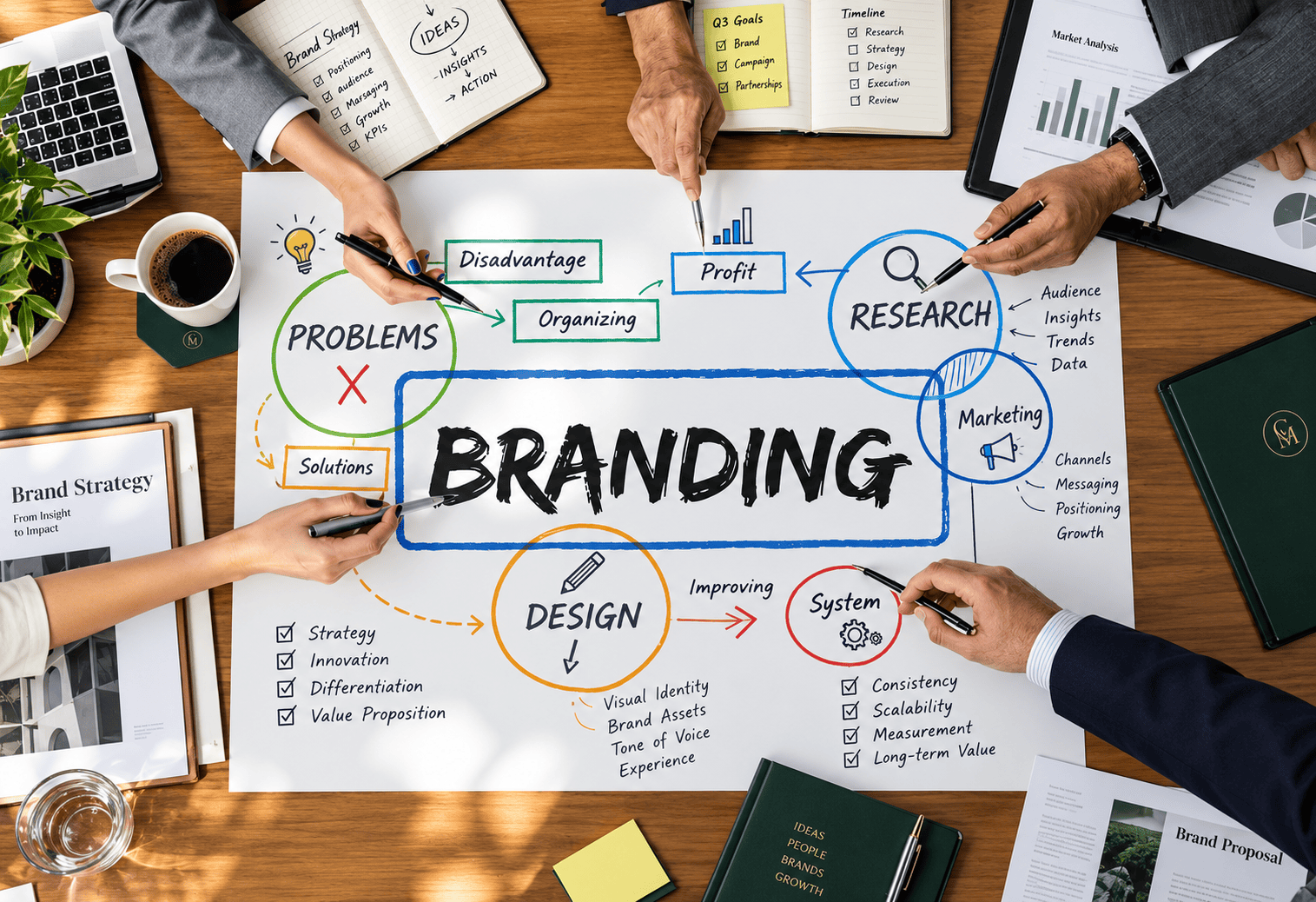
A complete brand strategy usually delivers seven documents or sections. Each one should be specific enough that two different agencies, given the same document, would produce work that feels like the same company.
- Market and competitor audit: how the category positions itself and where the gaps are.
- Audience definition: the primary buyer, their problem and how they make decisions.
- Positioning statement: the single space the brand intends to own in the buyer’s mind.
- Value proposition: the benefits, proof points and reasons to believe.
- Messaging framework: the core message, supporting pillars and key lines by audience.
- Brand personality and voice: how the brand sounds, with examples of what it would and wouldn’t say.
- Creative brief: the handover to the identity and design work.
Logos, colors and typography are not on this list. They are the visual expression of the strategy and come after it, a distinction covered in more depth in our guide to building a brand strategy framework step by step.
Which Parts of the Strategy Travel Between the US and Asia?
For a brand selling in the US and Asia, the brand strategy should travel and the marketing strategy should be localized. Positioning, values and the core promise stay fixed across markets, while channels, messaging tone, creators and offers change for each one.
The reasoning is practical. If the core promise changes by market, the company ends up running separate brands under one logo, and every new market adds another version to maintain. If the marketing stays the same across markets, the brand gets spread through channels and formats that the local audience doesn’t use.
Language shows where the line sits. According to CSA Research’s 2020 survey of 8,709 consumers in 29 countries, 76% of online shoppers prefer to buy products with information in their native language, and 40% will not buy from websites in other languages. The promise can stay the same, but the words, references and proof points need to be rebuilt for each market.
| Element | Stays fixed across markets | Changes by market |
|---|---|---|
| Positioning and core promise | Yes | No |
| Brand values and personality | Yes | Expression adjusts, for example more formal in Japan |
| Visual identity | Yes, through one set of guidelines | Local layouts, imagery and type for non-Latin scripts |
| Messaging and copy | Core message stays the same | Headlines, references and proof points are rewritten, not translated |
| Channels | No | Instagram and LinkedIn in the US; LINE and X in Japan; TikTok, Shopee and WhatsApp across Southeast Asia |
| Offers, pricing and promotions | No | Set by local competition, purchasing power and shopping seasons |
A US wellness brand entering Japan is a typical example. Its positioning as a science-backed, clean-ingredient option can stay the same.
Its marketing in Japan will rely more on LINE, detailed product information and third-party credibility than on the founder-led Instagram content that worked in New York. Our guide to cross-border brand localization covers that adaptation step in more detail.
How Should Budget Be Split Between Brand and Marketing Activity?

The most widely cited benchmark is roughly 60% brand building and 40% sales activation for B2C companies, and roughly 46% brand and 54% activation for B2B. Both figures come from long-term effectiveness research by Les Binet and Peter Field.
According to The 5 Principles of Growth in B2B Marketing, published by the LinkedIn B2B Institute in 2019, the most effective B2B campaigns allocated around 46% of budget to brand and 54% to activation, compared with a 60:40 split for consumer brands. The authors present the ratio as a guide rather than a fixed rule.
Long-term brand investment shows up in company value. According to Kantar BrandZ, 2025, the 100 most valuable global brands were worth a combined US$10.7 trillion in 2025, up 29% year on year, and Kantar reports that the world’s most valuable brands have consistently outperformed the S&P 500 and MSCI World Index over 20 years.
The ratio is a reminder that brand strategy doesn’t end when the document is signed. Some share of every year’s marketing budget should go toward reinforcing the brand position, not only toward campaigns built to convert this quarter.
Where Do Brand and Marketing Strategy Sit in Brief, Build, Lock, Scale?
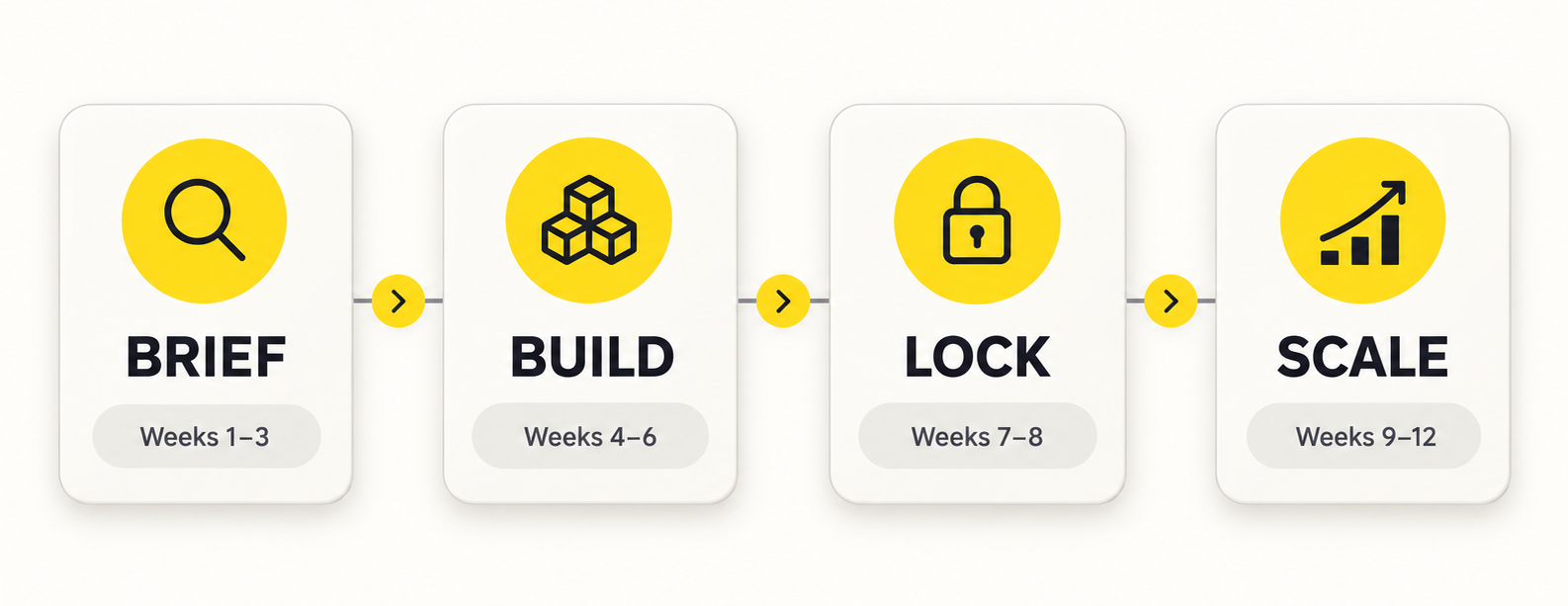
At Creative For More, we run engagements through four stages: Brief, Build, Lock and Scale. Brand strategy is set in Brief and Build, and marketing strategy takes over in Lock and Scale.
- Brief: research, audience and positioning decisions, agreed with leadership.
- Build: messaging framework, identity and guidelines, then the market-specific versions for each country.
- Lock: the channel plan, budgets and KPIs for each market, tested against the positioning before launch.
- Scale: campaigns, content and media run and optimized month by month, with the brand strategy held constant.
This order keeps the US, Singapore and Japan teams working from one positioning while each runs a different plan. It also means a weak campaign gets fixed at the marketing level instead of prompting a rebrand.
When Does a Company Need a Brand Strategy Agency?

A company needs a brand strategy agency when its positioning is unclear, inconsistent across teams or markets, or no longer matches who it sells to. Common triggers include entering a new country, a funding round, a merger and a shift from founder-led sales to a sales team.
The signs are usually visible in the work. Sales and marketing describe the company differently, each new campaign starts with a debate about the core message, or paid media performs well on clicks but poorly on conversion. In those cases, adding marketing spend tends to increase the cost of the confusion rather than fix it.
For companies operating between the US and Asia, our brand strategy agency service in New York sets the positioning once and then adapts it for each market with teams in Singapore and Tokyo. The Creative For More New York office works with US brands entering Asia and Asian brands entering the US.
If you’re planning to sell in the US and Asia and need one brand position that holds in both markets while the marketing adapts to each, start with the strategy before the campaigns. If your company is looking for a strategic marketing partner, the Creative For More team can help. Book a discovery call to explore how we can support your brand’s growth.
Read More
- Brand Strategy Framework: How to Build One Step by Step
- Brand Strategy vs Visual Identity: What Singapore Businesses Usually Confuse (And How To Fix It)
- The Complete Brand Archetype Guide: Build a Memorable Brand Identity in 2026
- When Should a Company Rebrand? A Decision Framework
- The Role of Branding Consultancy in Business Growth

Geraldine Pang
Creative For More
Geraldine Pang is the founder of Creative For More, a cross-border digital marketing agency with offices in Singapore, Tokyo, and New York. She specializes in brand strategy, market entry, and cross-border marketing across Southeast Asia, Japan, and the United States.