

Global Expansion Strategy: How to Expand Your Brand Internationally in 2026
Global Expansion Strategy: How to Expand Your Brand Internationally in 2026
To expand a brand internationally, a global expansion strategy works through ten steps in order: audit readiness at home, select markets with data, choose an entry mode, register trademarks, settle legal, tax and trade terms, localize positioning, build a multi-country website, pick channels per market, launch with stage gates, and scale with a clear team model. Testing one market before committing to a second keeps the cost of a wrong choice contained.
Most international launches that stall do so because of sequencing, not ambition. A brand that registers its trademark after launch, translates a website without changing the offer, or signs an exclusive distributor before testing demand usually pays twice: once for the launch and again for the repair.
The framework below puts those decisions in the order that protects the brand and the budget. It draws on official guidance from bodies such as WIPO, the International Chamber of Commerce, Google Search Central and Enterprise Singapore, and on what we see in cross-border work across Asia and the US.
Creative For More is a cross-border marketing and market-entry agency founded in 2019, with headquarters in Singapore, an office in Tokyo and a presence in New York. We work on the US to Asia, Asia to US, Japan to Southeast Asia and Singapore to Japan corridors, so the examples here come from those markets.
What is a global expansion strategy?

A global expansion strategy is a documented plan for taking a brand, product or service into one or more foreign markets, covering which markets to enter, in what order, through which entry mode, and with what budget and success criteria. It connects commercial goals to the legal, operational and marketing work each market requires.
The terms “international expansion strategy” and “international growth strategy” are used interchangeably with it. In practice, the plan answers four questions: where to go, how to enter, how to adapt the brand, and how to decide whether to keep going.
A good plan is also specific about what stays fixed. Brand identity, quality standards and core positioning usually travel unchanged, while messaging, pricing, channels and sometimes the product itself adapt to each market.
What are the four types of international strategy?
The four types of international strategy are international, multidomestic, global and transnational, as set out in Christopher Bartlett and Sumantra Ghoshal’s model of international business strategy. They differ in how much a company standardizes across markets versus how much it adapts to each one.
| Strategy type | Standardization | Local adaptation | Typical fit |
|---|---|---|---|
| International | High (home-market model exported) | Low | Brands with a strong home product testing early overseas demand |
| Multidomestic | Low | High (each market run separately) | Food, retail and consumer brands where taste and habits vary widely |
| Global | High (one offer, centralized decisions) | Low | Software, electronics and B2B products with uniform needs |
| Transnational | Balanced | Balanced | Brands that keep a fixed core and localize delivery in each market |
For many small and mid-sized brands entering Asia or the US, the transnational model is the practical fit. It keeps one brand identity and adapts the go-to-market approach in each country.
How do you expand a brand internationally, step by step?
Expanding a brand internationally follows ten steps, from a readiness audit through to a scaling and governance model. Each step reduces a specific risk, so skipping one tends to show up later as a cost.
We organize cross-border projects around a four-phase framework called Brief, Build, Lock and Scale. The ten steps map onto it loosely: steps 1 to 3 belong to Brief, steps 4 to 7 to Build, steps 8 and 9 to Lock, and step 10 to Scale.
Step 1: Audit readiness in the home market

A readiness audit confirms that a brand has product-market fit, healthy unit economics, team capacity and stable systems at home before it spends money abroad. If any of these is weak domestically, expansion usually magnifies the weakness.
The audit should check four areas. Product-market fit means repeat customers and referral demand rather than one-off spikes, and unit economics means contribution margin that can absorb freight, duties, platform fees and currency swings.
Team capacity and systems are the other two areas. Someone needs owned time for the new market, and positioning, reporting and sales handover need to be documented, as we set out in the five systems to build before expanding internationally.
Step 2: Select markets with data
Market selection should rank candidate countries on demand, competition, cost to serve and regulatory friction using public data, not on where a founder has contacts. A shortlist of three to five markets, scored on the same criteria, makes the trade-offs visible.
Several free sources cover the basics. According to the World Bank Open Data portal (2026), the World Bank provides free and open access to global development data, including GDP, population and internet use by economy.
The International Trade Centre’s Trade Map shows import and export flows by product and country, which helps estimate existing demand for a category. Google Trends compares search interest for a product term across countries, and local marketplace search results show price points and competitor density.
| Criterion | What to measure | Where to look |
|---|---|---|
| Demand | Category imports, search interest, marketplace sales signals | ITC Trade Map, Google Trends, local marketplaces |
| Market size and income | Population, GDP per capita, internet penetration | World Bank Open Data |
| Competition | Number of local and international competitors, price ranges | Marketplace listings, search results, trade directories |
| Cost to serve | Freight, duties, fulfillment, media costs | Logistics quotes, customs authorities, ad platform planners |
| Regulatory friction | Product registration, labeling, data and tax rules | Government agencies in the target market |
| Strategic fit | Language, time zone, existing customers, partner access | Internal sales data, trade promotion agencies |
For Asia specifically, each country deserves its own score. Our Southeast Asia market entry guide covers how Singapore, Indonesia, Malaysia, Thailand, Vietnam and the Philippines differ.
Step 3: Choose an entry mode
The entry mode is the legal and commercial structure a brand uses to sell in a new market, ranging from direct export with low cost and low control to a wholly owned subsidiary with high cost and full control. The right mode depends on budget, how much control the brand needs over pricing and customer experience, and how quickly it wants to learn.
| Entry mode | Control | Upfront cost | Speed | Risk | Best for |
|---|---|---|---|---|---|
| Direct export | Medium | Low | Fast | Low | B2B products with a few known buyers abroad |
| Cross-border ecommerce and marketplaces | Medium | Low to medium | Fast | Low to medium | Consumer brands testing demand before investing locally |
| Distributor or agent | Low | Low | Medium | Medium (dependence on one partner) | Retail and F&B brands needing shelf access and local relationships |
| Licensing or franchising | Low to medium | Low | Medium | Medium (brand dilution) | Service and hospitality concepts with a repeatable model |
| Joint venture or strategic partner | Shared | Medium to high | Medium | Medium to high | Regulated sectors or markets where local ownership helps |
| Wholly owned subsidiary | Full | High | Slow | High | Brands with proven demand and a long-term commitment to the market |
Many brands combine modes over time. A common path is a marketplace or cross-border ecommerce test, followed by a distributor once demand is proven, followed by a local entity when volumes justify it.
Distributor contracts deserve particular care. Exclusivity, territory, minimum order volumes, termination terms and who owns customer data and social accounts should be settled in writing, because these clauses decide how easily a brand can change course later.
Step 4: Protect the brand before launch

Brand protection means registering trademarks in each target market before any public launch, distributor conversation or marketplace listing. Trademark rights are territorial, so registration at home does not protect a name abroad.
According to WIPO (2026), the Madrid System lets a trademark owner file a single international application and pay one set of fees to seek protection in up to 133 countries. WIPO lists 117 Madrid System members covering those 133 countries, and each designated country decides whether to grant protection under its own laws.
To use the Madrid System, a brand needs a basic application or registration in its home office, and the home country must be a member. Brands should also secure matching domain names and social media handles in each market, and check whether the name, its translation or its transliteration carries an unwanted meaning in the local language.
Step 5: Settle legal, tax and trade basics
Legal, tax and trade basics cover how goods move across borders, which indirect taxes apply to sales, and which data protection laws govern customer information. These rules vary by country and change often, so official sources and qualified local advisers should confirm them for each market.
For physical goods, delivery terms come first. According to the International Chamber of Commerce (2020), the Incoterms 2020 rules are a set of eleven three-letter trade terms that define buyer and seller responsibilities for delivery, costs and risk in contracts for the sale of goods.
Indirect tax on cross-border online sales is the second area. According to the European Commission (2026), the One Stop Shop has applied since 1 July 2021 and lets sellers declare VAT on cross-border sales to EU consumers through three schemes, including an import scheme.
Singapore applies a comparable approach to imported goods. According to Singapore Customs (2026), GST has applied since 1 January 2023 to low-value goods worth up to S$400 imported by air or post, collected by overseas vendors registered under the Overseas Vendor Registration regime administered by IRAS.
| Area | What to check | Official source |
|---|---|---|
| Trademarks | Availability, registration and international filing | WIPO Madrid System; national IP offices such as IPOS (Singapore), JPO (Japan) and USPTO (US) |
| Customs and delivery terms | Incoterms rule, HS codes, duties, import permits | ICC Incoterms 2020; customs authority of the target market |
| Indirect tax | VAT, GST or consumption tax registration and thresholds | EU One Stop Shop; IRAS and Singapore Customs; Japan’s National Tax Agency; US state tax authorities |
| Data protection | Consent, cross-border transfer and breach rules | Singapore PDPA (PDPC); Japan APPI (Personal Information Protection Commission); EU GDPR; US state privacy laws |
| Product rules | Labeling, ingredient, safety and certification requirements | Sector regulators in each market, such as food, health or electronics authorities |
| Company setup | Entity type, local director or address requirements | ACRA (Singapore), Legal Affairs Bureau (Japan), state business registries (US) |
None of this replaces professional advice. A trade lawyer, a tax adviser with cross-border experience and a customs broker in the target market will answer questions that general guidance can’t.
Step 6: Localize positioning, not just language
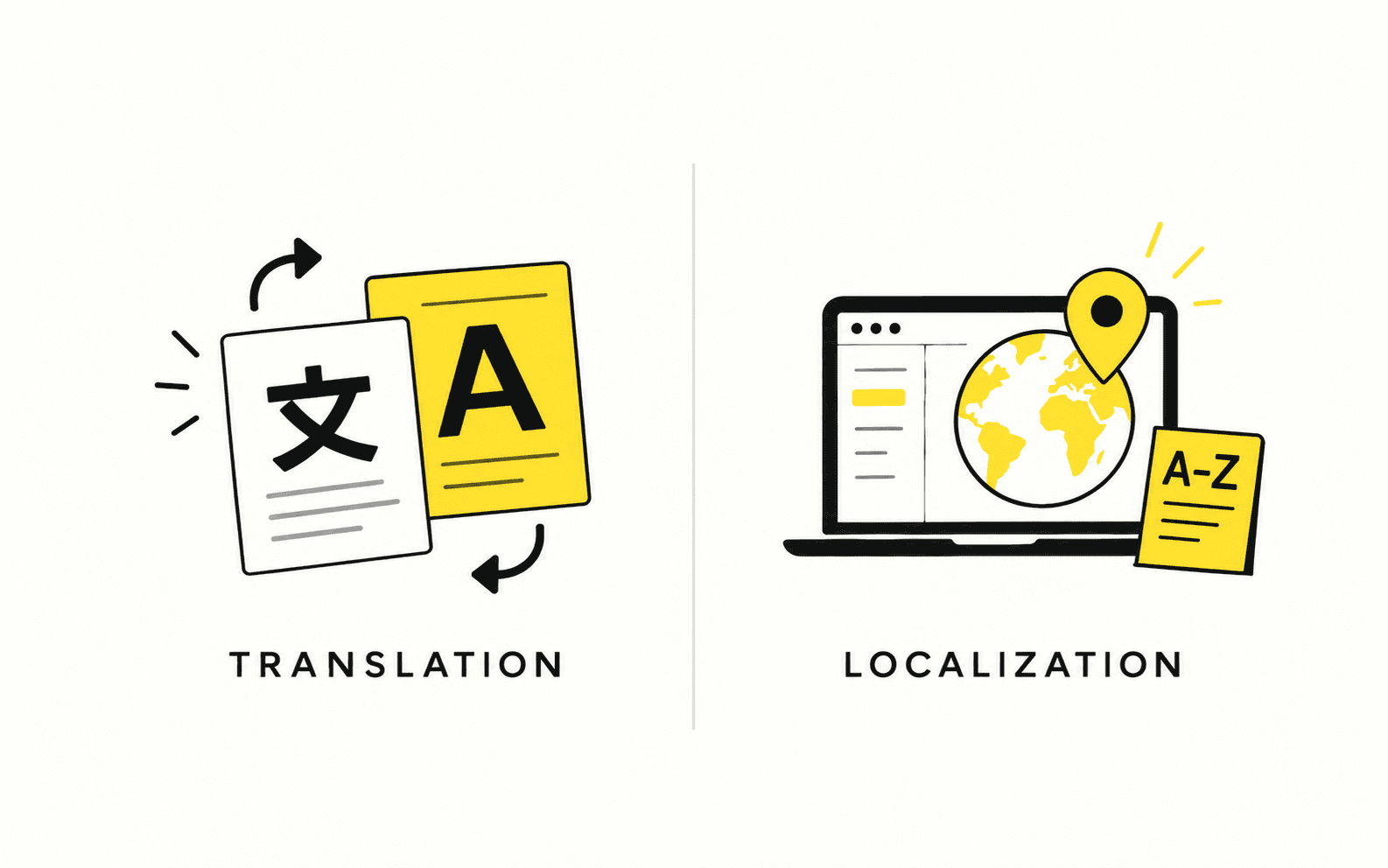
Brand localization adapts how a brand is positioned, priced, described and sold in each market, while keeping its core identity intact. Translation is only one part of it.
A practical method is to write down what is fixed and what can flex before any creative work begins. Fixed elements usually include the logo, brand values and quality promise, while flexible elements include the value proposition’s emphasis, tone, imagery, pricing architecture, payment methods and campaign timing around local holidays.
Category maturity changes the job as well. Our work with Jochu involved launching a new category of Japanese premium spirit designed for the US and European markets, where buyers had no familiar category reference. We developed a brand narrative that positions it between Japanese heritage and global relevance, and a digital experience that supports both brand building and wholesale partnerships.
For a fuller treatment of what to standardize and what to adapt, see our guide to cross-border brand localization.
Step 7: Build the digital foundation
The digital foundation for international expansion is a website structure that serves the right language and country version to each visitor, plus the analytics, payment and customer service setup behind it. Search engines and AI assistants can only surface a localized page if they can find and identify it.
According to Google Search Central (2026), sites should use different URLs for each language version rather than cookies or browser settings, and use hreflang annotations to help Google link searchers to the correct version. Google also advises against automatically redirecting users based on assumed language and against using IP analysis to adapt content.
Google’s documentation compares three main URL structures. Country-code domains such as example.de give the clearest geotargeting but cost more to run, subdomains such as de.example.com are easy to set up, and subdirectories such as example.com/de/ have low maintenance because they sit on the same host.
Beyond the site, each market needs local payment methods, prices in local currency, analytics that separate traffic and revenue by country, and a support channel that answers in the local language within local business hours.
Step 8: Choose channels market by market
Marketing channels should be chosen per market based on where local buyers search, compare and buy, rather than copied from the home market. The same brand often needs a different channel mix in each country.
| Market | Channels often in the mix | Notes |
|---|---|---|
| Japan | LINE, Instagram, X, Google and Yahoo Japan search, Amazon Japan and Rakuten | Trust signals, detailed product information and polished Japanese copy carry heavy weight |
| Southeast Asia | Shopee, Lazada, TikTok Shop, Instagram, Facebook, creator partnerships | Mobile-first; local payment methods and creators differ by country |
| United States | Google Search, Meta, Amazon, LinkedIn for B2B, retail partners | Large and competitive; state-level differences in tax and privacy |
| Singapore | Google Search, Meta, LinkedIn, Shopee, Lazada | English-speaking and small, so often used as a regional test market |
Japan is a good example of a market where the channel plan and the sales process both change. Our step-by-step framework for going to market in Japan covers the channel and partner decisions in more detail.
Search visibility now extends to AI assistants as well as search engines. Clear, well-structured pages in the local language, with consistent business information across directories and marketplaces, give both kinds of system something reliable to cite.
Step 9: Launch, measure and iterate with stage gates
Stage gates are predefined checkpoints where a brand reviews results against agreed criteria and decides whether to continue, adjust or stop investing in a market. Setting the criteria before launch keeps the decision objective.
| Stage | Purpose | Example gate criteria |
|---|---|---|
| Pilot | Test demand with limited spend | Conversion rate, cost per acquisition and qualified enquiries against targets set in advance |
| Validation | Confirm repeat demand and unit economics | Repeat purchase rate, contribution margin after local costs, partner interest |
| Commit | Invest in local presence | Payback period on acquisition spend, sales pipeline coverage, operational readiness |
| Scale | Grow share and add adjacent markets | Market share trend, brand search growth, team capacity for the next market |
Reporting should run on a fixed cadence, monthly at minimum, with the same metric definitions in every market. Without shared definitions, results from different countries can’t be compared and budget decisions become guesswork.
Step 10: Scale and govern
Scaling internationally means repeating the proven model in more markets while deciding who owns strategy, budget and execution in each one. Governance is the set of rules that keeps the brand consistent as the number of markets, partners and people grows.
Three team models are common. A centralized model keeps strategy and creative at headquarters, a hub model places a regional team in a market such as Singapore to cover several neighbors, and a local model gives each country its own team, which costs more but responds faster.
Whatever the model, governance should define who approves creative, who can move budget, how partners report, and which brand elements no market can change. A shared brand guide, a single reporting dashboard and a regular cross-market review make that workable.
Which government programs support international expansion?
Government trade and investment agencies in Singapore, the US and Japan offer grants, advisory services and practical support for companies entering or expanding in their markets. Terms change frequently, so each program’s official page is the only reliable reference.

Singapore companies should note a recent change. According to Enterprise Singapore (2026), the Market Readiness Assistance grant ceased on 29 September 2026, and from 30 September 2026 business grant support is offered under the EDGE Grant, which funds up to 70% of eligible costs for SMEs and up to 50% for non-SMEs on internationalization activities.
Enterprise Singapore also states that EDGE support is capped at S$100,000 per year across all activities, refreshed on 1 April each year, and that internationalization is one of its eight business areas. Projects already submitted under the Market Readiness Assistance grant will still be processed.
| Program | Run by | Who it serves | What it offers |
|---|---|---|---|
| EDGE Grant | Enterprise Singapore | Singapore companies, including those expanding overseas | Up to 70% of eligible costs for SMEs, up to 50% for non-SMEs, up to S$100,000 a year |
| SelectUSA | US Department of Commerce | Foreign companies investing in the US | Investment facilitation, information on state incentives, links to the US Commercial Service |
| Invest Japan Business Support Centers | JETRO | Foreign companies setting up in Japan | Free temporary office space and consultation in Tokyo, Osaka, Kobe, Nagoya, Yokohama and Fukuoka |
For US entry, SelectUSA describes itself as the US Department of Commerce program established to facilitate business investment in the United States. For Japan, JETRO offers free office space for a set period at its Invest Japan Business Support Centers in six cities.
What are the biggest mistakes in international expansion?
The biggest mistakes in international expansion are entering too many markets at once, skipping trademark registration, treating translation as localization, and signing long exclusive partner deals before demand is proven. Most of them come from compressing or skipping steps in the expansion sequence.
- Entering several markets at once. Budget and attention spread thin, and results from each market are too small to read clearly.
- Launching before registering trademarks. A local party can file the name first, which can force a rebrand or a costly dispute.
- Treating translation as localization. Copy is translated while pricing, payment, imagery and proof points stay built for the home market.
- Signing exclusive distribution too early. Long exclusive terms with weak performance clauses can lock a brand out of its own market.
- Underestimating landed cost. Freight, duties, indirect tax, platform fees and returns erode margins that looked healthy at home.
- Running one website for every country. Without separate URLs and hreflang, search engines may show the wrong version or none at all.
- Measuring with different definitions in each market. Leads, conversions and revenue mean different things in each team, so comparisons break down.
- Executing without a strategy. Campaigns launch before positioning, target segments and success criteria are agreed.
Should you hire a consultant or agency for international expansion?

Hiring a consultant or agency for international expansion makes sense when a brand lacks in-market knowledge, language capability or the team capacity to run a launch, and it makes less sense when the brand already has experienced local staff. Many companies use a mix: legal, tax and customs specialists for compliance, and a strategy or marketing partner for positioning and launch.
The useful selection criteria are concrete. A partner should have people in or from the target market, published case studies in comparable categories, clarity on which work it does in-house and which it subcontracts, and a reporting model built around stage-gate reviews.
- Does the partner have staff who speak the local language and work in the market?
- Can it show case studies from the same market and a similar category?
- Does it cover strategy and execution, or only one of them?
- Will it work alongside legal and tax advisers rather than offering advice outside its field?
- How does it define and report success at each stage?
Our go-to-market service covers market entry strategy, localization and launch for brands moving between Singapore, Southeast Asia, Japan and the US. We work with Japanese account managers based in Japan and offer support in Japanese, English and Chinese, alongside a network of more than 30 agency and business matching partners.
If you’re planning to take your brand into a new country and want a partner that works across Singapore, Tokyo and New York, we can help you sequence the steps. If your company is looking for a strategic marketing partner, the Creative For More team can help. Book a discovery call to explore how we can support your brand’s growth.
Read More
- Execution Without Strategy Is Why Global Launches Fail
- Why Most Cross-Border Expansions Feel Chaotic (And How to Avoid It)
- How to Build a Cross-Border Marketing Team
- B2B Market Entry in Asia: What Western Companies Must Know
- Japan Market Entry Consultancy: The Complete 2026 Guide for International Brands
- How to Expand Into Singapore as a Foreign Brand

Geraldine Pang
Creative For More
Geraldine Pang is the founder of Creative For More, a cross-border digital marketing agency with offices in Singapore, Tokyo, and New York. She specializes in brand strategy, market entry, and cross-border marketing across Southeast Asia, Japan, and the United States.