
How to Choose an Agency for a Multi-Country Website and Paid Media
How to Choose an Agency for a Multi-Country Website and Paid Media
To choose an agency for a multi-country website and paid media, look for one team that can build a multilingual website with correct hreflang and locale-specific URLs, and also run Google and Meta campaigns that send each market’s traffic to its own localized pages. Assess five areas: site architecture, technical international SEO, localized content, paid media across markets, and measurement per market. Splitting web and ads between unconnected vendors usually breaks landing page relevance and tracking.
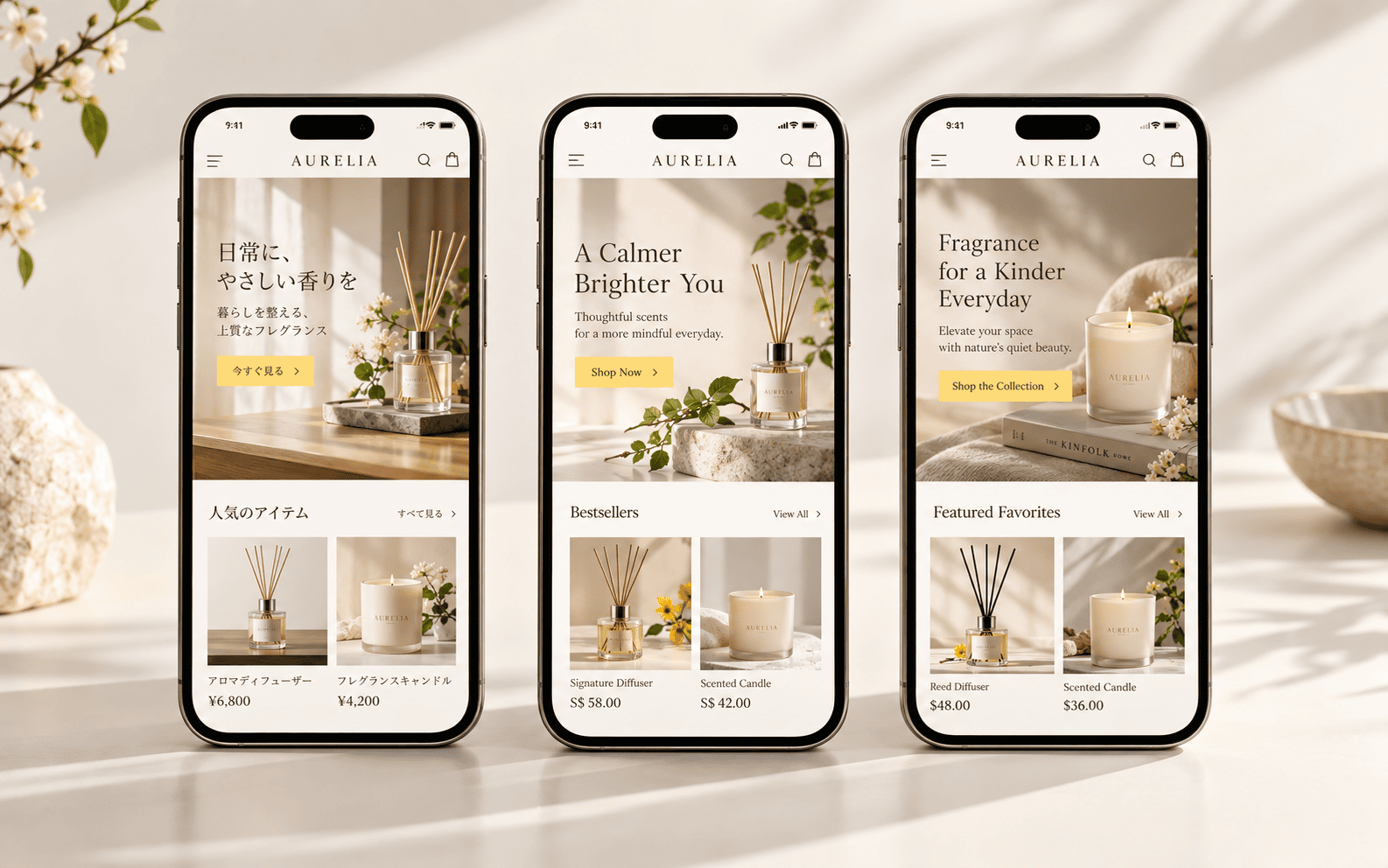
A multi-country website and the paid media that drives traffic to it behave as one system. The ad promises something in Japanese, Bahasa Indonesia, or US English, and the landing page has to deliver on that promise in the same language, currency, and context.
Many brands still hire a web developer in one country and a media buyer in another, then discover that campaigns point to the wrong language version or that conversions can’t be attributed by market. This guide sets out what the agency should handle, how to evaluate candidates, and when splitting the work makes sense.
What Should an Agency Managing a Multi-Country Website and Paid Media Do?

An agency managing a multi-country website and paid media should own the site architecture, the international SEO setup, localized content, paid campaigns in each market, and the measurement that connects them. The value comes from treating the web build and the paid growth plan as one integrated unit rather than as separate projects.
In practice, that means the same team decides which markets get their own site sections, which keywords each market’s pages target, and which of those pages receive paid traffic. It also means one measurement plan covers organic and paid performance in every market.
The scope usually includes five workstreams:
- Architecture and platform: URL structure, CMS or ecommerce platform setup, and market configuration.
- Technical international SEO: hreflang, crawlability of each version, canonical tags, and page speed by region.
- Localized content: translation and adaptation of copy, imagery, pricing, and calls to action.
- Paid media: Google Ads, Meta, and other platforms with campaigns structured by market and language.
- Measurement: analytics, conversion tracking, and consent management configured per market.
Which URL Structure Is Best for a Multilingual Website?
Subdirectories on one generic domain are the simplest and lowest-maintenance structure for most multilingual websites, while country-code domains give the clearest country signal at the highest cost. Google lists the tradeoffs for each option in its own documentation.
According to Google Search Central’s guide to managing multi-regional and multilingual sites (2025), a multilingual website offers content in more than one language, while a multi-regional website explicitly targets users in different countries. The same guide describes four URL structure options and does not recommend URL parameters.
| Structure | Example | Pros (per Google) | Cons (per Google) | Typical fit |
|---|---|---|---|---|
| Country-code domain (ccTLD) | example.jp | Clear geotargeting, server location irrelevant, easy separation of sites | Expensive, more infrastructure, strict requirements in some countries, targets one country only | Large brands with separate teams and budgets per country |
| Subdomain on a generic domain | jp.example.com | Easy to set up, allows different server locations, easy separation | Users may not recognize the targeting from the URL alone | Markets run on a separate platform or by a separate team |
| Subdirectory on a generic domain | example.com/jp/ | Easy to set up, low maintenance on the same host | Single server location, separating sites is harder | Most brands entering two to six markets |
| URL parameters | example.com?loc=jp | None listed | Not recommended, segmentation is difficult | Avoid |
Google’s guide also lists the signals it uses to determine a page’s target locale, including ccTLDs, hreflang, server location, and other signals such as local addresses, phone numbers, local currency, and links from local sites. An agency should be able to explain which of these signals each market’s pages will send.
What Technical Requirements Should the Agency Handle?

The agency should handle hreflang annotations, explicit language and country targeting, user-controlled language switching, localized URLs and content, local currency and payments, regional page speed, and per-market analytics and consent. Each of these affects both organic visibility and the performance of paid campaigns.
How Should Hreflang Be Implemented?
Hreflang should be implemented so that every language version of a page lists itself and every other version, using valid language and optional region codes. Google ignores hreflang tags that don’t point back to each other.
According to Google Search Central’s documentation on localized versions (2026), hreflang can be declared in HTML, in HTTP headers, or in a sitemap, and the three methods are equivalent from Google’s perspective. The same documentation states that hreflang values use ISO 639-1 language codes with optional ISO 3166-1 Alpha 2 region codes, such as en-US or ja-JP, and recommends an x-default value for users whose language doesn’t match any listed version.
According to the W3C Internationalization guidance on choosing a language tag (2026), language tag syntax is defined by the IETF’s BCP 47, and all valid subtags are listed in the IANA Language Subtag Registry. An agency that understands both sources will tag pages correctly in the HTML lang attribute as well as in hreflang.
What Is the Difference Between Language Targeting and Country Targeting?
Language targeting serves the right language to a searcher, while country targeting serves the right market version to a searcher in a specific country. A site serving English speakers in Singapore and the US needs country targeting, because the language is the same but prices, shipping, and offers differ.
Google states that it uses the visible content of a page to determine its language, not the lang attribute or the URL. Each page should therefore use one language for both content and navigation, and avoid side-by-side translations.
Should a Multilingual Website Redirect Visitors by IP Address?
A multilingual website should not automatically redirect visitors to a language or country version based on IP address. Google’s guidance recommends letting users switch versions through visible links instead.
Google’s multi-regional guide states that IP location analysis is difficult and generally not reliable, and that most Google crawls originate from the US, so automatic redirects can stop crawlers and users from reaching every version. A language and country selector on every page, combined with hreflang, solves the same problem without hiding content.
What Else Belongs on the Technical Checklist?
The remaining technical items are localized URLs, local currency and payment methods, page speed in each region, and analytics and consent configured per market. These items are where many multi-country sites lose conversions after launch.
- Localized URLs and content: Google’s guidance allows localized words in URLs and recommends UTF-8 encoding throughout.
- Currency and payments: prices in local currency, local payment methods, and clear duties and tax handling. The Shopify Help Center’s international sales tools documentation covers markets that target specific countries or groups of countries from a single store, with local currency pricing, international domains, translation, and duties.
- Page speed per region: hosting and content delivery configured so pages load quickly for users in Tokyo, Jakarta, and New York, not only in the market where the site is hosted.
- Analytics per market: conversion events, currencies, and reporting views separated by market so results can be compared.
- Consent management: cookie and tracking consent configured to meet the privacy requirements of each country where the site collects data.
Platform choice shapes how much of this is built in. Our comparison of Shopify and headless commerce for cross-border brands covers the tradeoffs for ecommerce sites.
Why Should the Website and Paid Media Be Run by the Same Team?

The website and paid media should be run by the same team because ad performance depends on landing page relevance, and tracking depends on how the site is built. When separate vendors own each side, neither is accountable for the result in between.
According to Google Ads Help (2026), Quality Score for Search campaigns is calculated from three components: expected clickthrough rate, ad relevance, and landing page experience, defined as how relevant and useful the landing page is to people who click the ad. A Japanese-language ad that lands on an English page, or a Singapore dollar offer that lands on a US dollar price, weakens that landing page component.
Three practical benefits follow from running both together:
- Landing page relevance: the team writing the ads also decides which localized page each ad group points to, and builds new pages when a market needs one.
- Tracking continuity: conversion tags, consent settings, and analytics events are designed once and stay consistent when pages change.
- Shared keyword data: search terms that convert in paid campaigns inform which organic pages to build in each language, and the reverse.
Our search engine marketing service covers paid search across markets, and our media buy service covers Meta, TikTok, LinkedIn, YouTube, and programmatic display.
How Do You Evaluate an Agency for a Multi-Country Website and Paid Media?
Evaluate an agency on its ability to show working multi-market sites, explain its international SEO approach in specific terms, run paid campaigns in each target language, and report results by market. The checklist below turns those criteria into steps.
- Review live multi-country sites. Ask for two or three sites the agency built that serve more than one country, then check their URL structure and language switchers.
- Inspect the hreflang setup. View the source of a page on each site and confirm that every version lists itself and all others.
- Confirm native-language capability. Ask who writes and reviews copy and ads in each target language, and whether they live in that market.
- Check paid media coverage. Confirm the agency runs campaigns on the platforms that matter in each market, such as Google, Meta, and regional platforms where relevant.
- Ask for a sample measurement plan. A strong agency can describe conversion events, currencies, and consent settings per market before the build starts.
- Clarify ownership. Confirm that the brand owns the domain, the CMS, the analytics properties, and the ad accounts.
- Agree the launch sequence. Ask how the agency would phase markets, and how paid media spend scales as each market’s pages go live.
| Criterion | What to look for | Red flag |
|---|---|---|
| Site architecture | A clear recommendation of ccTLD, subdomain, or subdirectory, with reasons tied to the brand’s markets | Same structure proposed for every client regardless of scope |
| International SEO | Correct hreflang, x-default, canonical tags, and no forced IP redirects | Plans to auto-redirect by IP or rely on a translation plugin alone |
| Localization | Native speakers adapting copy, pricing, and imagery per market | Machine translation with no in-market review |
| Paid media | Campaigns structured by market and language, pointing to matching pages | One campaign for all markets sending traffic to the home page |
| Measurement | Per-market conversion tracking, currency handling, and consent setup | Reporting only in aggregate across all countries |
| Accountability | One owner for web and paid results in each market | Web and ads handled by subcontractors the brand never meets |
| Ownership | Brand owns domains, CMS, analytics, and ad accounts | Agency holds accounts in its own name |
What Questions Should You Ask a Multilingual Website Agency Before Hiring?
Ask questions that require specific, verifiable answers about architecture, localization, paid media, and measurement. Vague answers to these questions usually predict problems after launch.
- Which URL structure would you recommend for our markets, and why?
- How will you implement hreflang, and how will you check it after launch?
- Who adapts the content in each language, and where are they based?
- How will paid campaigns map to localized landing pages in each market?
- How will conversions be tracked and reported by country and currency?
- Which platforms do you buy media on in each of our target markets?
- What happens to our accounts and data if the engagement ends?
Our web design and development service is built around these same questions for multi-market brands.
Should You Use In-House, One Agency, or Separate Vendors?
One integrated agency suits most brands entering two or more markets, an in-house team suits brands with established regional staff, and separate vendors suit brands with a strong internal coordinator. The table compares the three options.
| Option | Strengths | Weaknesses | Best for |
|---|---|---|---|
| In-house team | Full control, deep product knowledge | Hard to hire native speakers and specialists for every market | Large brands with regional marketing staff |
| One integrated agency | Web and paid media aligned, one point of accountability | Depends on the agency’s coverage of each target market | Brands entering two to six markets |
| Separate vendors | Specialist depth in each discipline | Gaps between landing pages, tracking, and campaigns | Brands with an internal lead who coordinates vendors closely |
A combined model is also common. The integrated agency owns strategy, the site, and paid media, while the in-house team owns product content and approvals.
How Does Creative For More Run Multi-Country Websites and Paid Media?

Creative For More builds websites and runs paid media for brands across Singapore, Japan, Southeast Asia, and the US from one team. Strategy, web development, and media buying sit together, so landing pages and campaigns are planned at the same time.
We are headquartered in Singapore with an office in Tokyo and a New York presence, and our team includes Japanese account managers based in Japan. We support clients in Japanese, English, and Chinese, and work with a network of more than 30 agency and business matching partners for market-specific needs.

Our services cover web design and development, ecommerce, search engine marketing, paid media, and generative engine optimization. Clients use us for corridors such as US to Asia, Asia to US, Japan to Southeast Asia, and Singapore to Japan.
If you’re planning a website that serves more than one country and want the build and the paid campaigns handled by one accountable team, we can help you map the right setup. If your company is looking for a strategic marketing partner, the Creative For More team can help. Book a discovery call to explore how we can support your brand’s growth.
Read More

Geraldine Pang
Creative For More
Geraldine Pang is the founder of Creative For More, a cross-border digital marketing agency with offices in Singapore, Tokyo, and New York. She specializes in brand strategy, market entry, and cross-border marketing across Southeast Asia, Japan, and the United States.