
PPC Agency Pricing: What a Performance Marketing Budget Under $5,000 a Month Buys
PPC Agency Pricing: What a Performance Marketing Budget Under $5,000 a Month Buys
A performance marketing agency typically costs US$100 to US$149 an hour, according to Clutch’s 2026 PPC pricing data, and about half of PPC firms set a monthly retainer minimum of US$1,000 to US$3,000, according to a 2022 Credo survey. Ad spend is billed separately from the fee. On a total budget under US$5,000 a month, that split usually leaves room for one or two paid channels.
PPC agency pricing is hard to compare because proposals bundle three different costs: the agency’s management fee, a one-off setup fee, and the ad spend paid to Google, Meta or other platforms. Two quotes that both say “US$5,000 a month” can describe very different amounts of advertising.
The sections below set out the five common pricing models, the difference between budget and fee, an example of how a budget under US$5,000 divides in practice, and the questions to settle before signing. Singapore companies expanding overseas can also offset part of the cost with Enterprise Singapore grants.
What pricing models do PPC agencies use?
PPC agencies use five pricing models: a percentage of ad spend, a flat monthly retainer, hourly billing, performance-based fees, and hybrids that combine a base fee with a percentage. Each model shifts risk differently between the brand and the agency.
According to Clutch’s PPC Pricing Guide (2026), most PPC agencies on its platform charge US$100 to US$149 an hour, and agency fees are separate from the monthly ad spend. According to Credo’s PPC pricing survey (2022), 50.97% of PPC firms have a monthly retainer minimum of US$1,000 to US$3,000, and 26% have a minimum under US$1,000.
| Model | How it works | Typical range (sourced) | Pros | Cons | Best for |
|---|---|---|---|---|---|
| Percentage of ad spend | The fee is a set share of the monthly ad budget | Credo (2022) gives 15% of spend above US$10,000 a month as a common structure | Scales with the account | Rewards higher spend rather than better results | Accounts spending well above US$10,000 a month |
| Flat monthly retainer | A fixed fee for an agreed scope, regardless of spend | 51% of firms set a minimum of US$1,000 to US$3,000 a month; 26% under US$1,000 (Credo, 2022) | Predictable cost | Scope creep if deliverables aren’t defined | Budgets under US$10,000 a month |
| Hourly | Billed by time spent | US$100 to US$149 an hour for most agencies (Clutch, 2026) | Pays only for work done | Hard to forecast monthly cost | Audits, setup and one-off projects |
| Performance-based | The fee is tied to leads, sales or revenue it produces | No reliable published range | Aligns the fee with results | Disputes over attribution and lead quality | Brands with clean conversion tracking |
| Hybrid | A base retainer plus a percentage once spend passes a threshold | US$1,000 to US$2,000 a month for one channel, US$500 to US$750 per extra channel, plus 15% of spend above US$10,000 (Credo, 2022) | Covers fixed work and growth | More complex to compare across quotes | Accounts expected to scale |
Setup fees are often charged on top of these models. Credo’s survey (2022) puts a typical setup fee at US$1,000 to US$2,500, covering research, account audits and initial ad copy.
Is a $5,000 budget the ad spend or the agency fee?
A “US$5,000 budget” can mean either the total monthly budget, including the agency fee, or the agency fee alone with ad spend on top. The two readings differ by thousands of dollars a month, so the first step in any quote is to confirm which one is meant.
Ad spend is paid to the platform, and the advertiser controls it directly. According to Google Ads Help (2026), advertisers set an average daily budget and the monthly spending limit for most campaigns is 30.4 times that figure, so a US$304 monthly budget equals a US$10 daily budget.
The management fee is paid to the agency and covers strategy, setup, optimization and reporting. A brand with US$5,000 in total therefore has less than US$5,000 to spend on ads, and the gap is largest at the smallest budgets.
What does a performance marketing budget under $5,000 a month buy?
A total budget under US$5,000 a month usually supports one paid channel at the low end and two at the top end, because each campaign needs enough spend to generate steady conversion data. The constraint is the platform’s learning process, not the agency’s capacity.
According to Meta’s Business Help Center (2026), an ad set usually exits the learning phase after about 50 results in the week after its last significant edit. Ad sets that don’t reach that volume show as “Learning limited” in Ads Manager, and Meta notes that ad sets in the learning phase usually have a higher cost per acquisition.
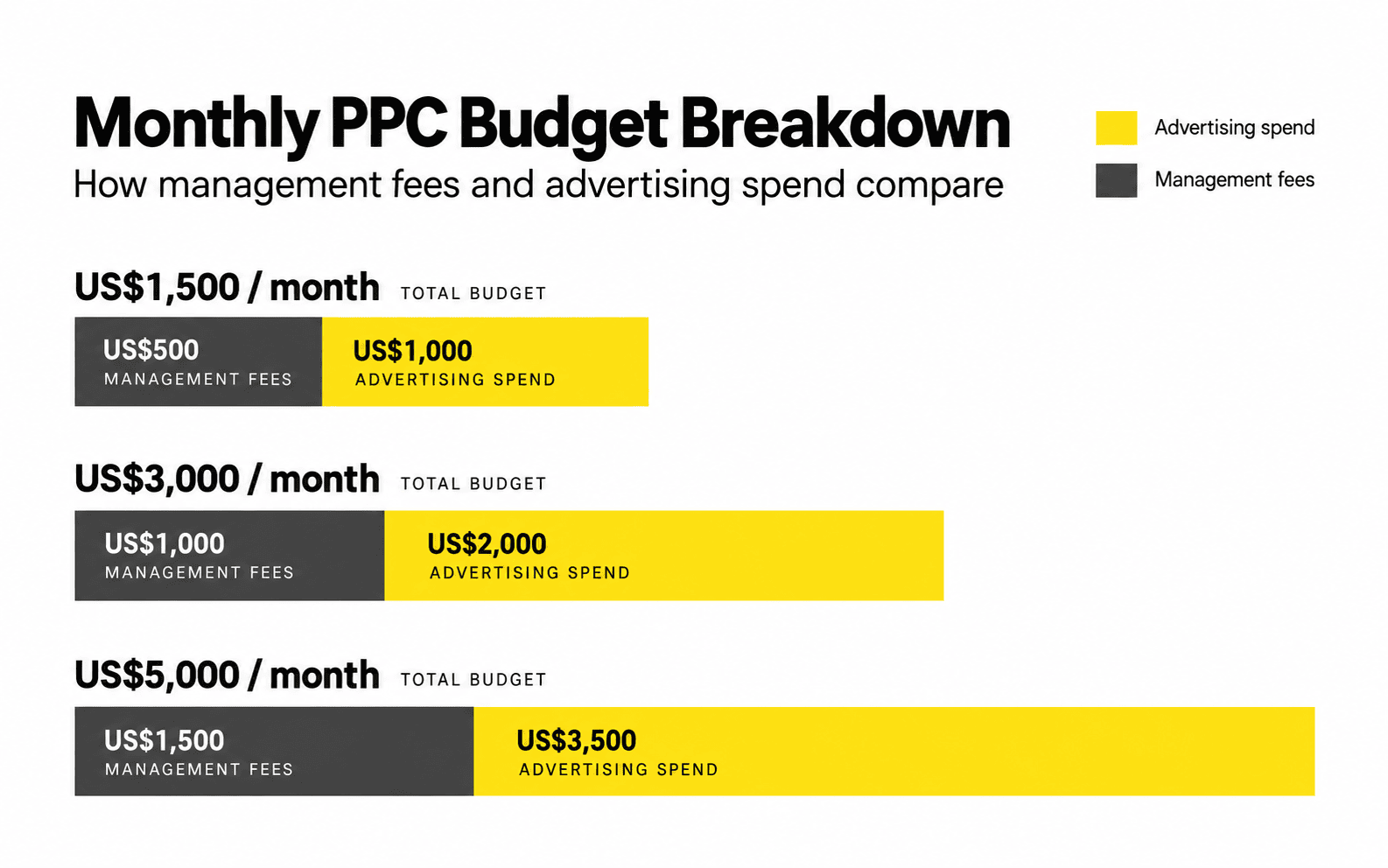
That threshold makes it possible to estimate what each budget can support. The table below is an illustrative split, not market data: the fees are example figures within the survey ranges above, weekly spend uses 4.33 weeks per month, and daily spend uses Google’s 30.4-day month.
| Total monthly budget | Example management fee | Monthly ad spend | Daily ad spend | Weekly ad spend | Highest cost per result for one ad set to reach 50 results a week | Channels it can realistically support |
|---|---|---|---|---|---|---|
| US$1,500 | US$500 | US$1,000 | US$32.89 | US$231 | US$4.62 | One channel, one campaign |
| US$3,000 | US$1,000 | US$2,000 | US$65.79 | US$462 | US$9.24 | One channel, or one channel plus a small retargeting budget |
| US$5,000 | US$1,500 | US$3,500 | US$115.13 | US$808 | US$16.17 | Two channels, such as Google Search and one Meta ad set |
The cost-per-result column shows why small budgets need narrow campaigns. If a lead costs US$20 on Meta, an ad set needs about US$1,000 a week to reach 50 results, which is more than the entire monthly ad spend in the US$1,500 example.
Three adjustments help small budgets produce usable data. Campaigns can optimize for a higher-volume event such as a landing page view or add-to-cart, consolidate audiences into fewer ad sets, or start with Google Search, where spend follows existing demand.
How much ad spend does a PPC campaign need?
Google Ads and Meta don’t set a fixed minimum spend, but a campaign needs enough budget to generate the conversion volume its bidding system learns from. On Meta, that benchmark is about 50 results per ad set per week, as described above.
Google states on its Google Ads budget page (2026) that advertisers decide how much they spend and can adjust the average daily budget at any time. The practical floor therefore depends on cost per click and conversion rate in each market rather than on a platform rule.
Market choice affects that floor as much as budget size. A brand running the same budget across Singapore, Malaysia and Japan splits its conversion data three ways, which is one reason to phase multi-market campaigns on small budgets one market at a time.
What should you ask a PPC agency before signing?

Before signing, a brand should confirm the agency’s minimum fee and ad spend, the contract length, who owns the ad accounts, what setup costs apply, and how often results are reported. Each one changes the real cost of the engagement.
- Is there a minimum ad spend? Some agencies only take accounts above a set monthly spend, which rules out budgets under US$5,000 regardless of the fee.
- What is the minimum contract length? According to Credo (2022), 30.52% of PPC providers require a minimum engagement of 6 to 12 months, while 26.3% have no minimum contract length.
- Who owns the ad accounts? The brand should own its Google Ads, Meta Business and analytics accounts, with the agency added as a user, so data and history stay with the brand if the contract ends.
- Are there setup or onboarding fees? Ask what the setup fee covers, such as tracking, account restructuring or new creative, and whether it is refundable.
- How often are results reported? Agree on a reporting cadence, the metrics included, and whether results are split by channel and market.
- How does the fee change as spend grows? Hybrid and percentage models raise the fee automatically once spend passes a threshold.
- Who produces the creative? Confirm whether ad design, copy and video are included in the fee or billed separately.
Comparing quotes on the answers to these questions is more reliable than comparing headline fees. For a wider view of when outside help pays off, see our guide on whether digital marketing agencies are worth it.
Can Singapore companies get grants for overseas performance marketing?
Singapore companies may be able to offset part of their overseas expansion costs through Enterprise Singapore’s EDGE Grant. EDGE replaced the Market Readiness Assistance (MRA) grant, the Enterprise Development Grant (EDG) and the Productivity Solutions Grant on 30 September 2026, and applications submitted under the old schemes before that date are still assessed under their original terms.

According to Enterprise Singapore’s EDGE Grant page (2026), EDGE supports up to 70% of eligible costs for SMEs and up to 50% for non-SMEs on internationalization activities, within a company cap of S$100,000 a year across all eligible activities. Enterprise Singapore’s EDGE FAQ lists overseas market expansion activities such as market entry setup, overseas business development staff, overseas trade fairs and identifying overseas partners.
The published activity list does not name paid media management as a standalone item, so companies should confirm whether a specific performance marketing engagement qualifies before budgeting around the grant. Our grants overview explains how Singapore’s grant schemes apply to marketing projects.
How does Creative For More approach smaller paid media budgets?
Creative For More plans paid media around the markets a brand is entering, and a smaller budget is best focused on one market and one or two channels before expanding. We run campaigns from Singapore and Tokyo, with Japanese account managers based in Japan, across Singapore, Japan, Southeast Asia and the US.

Our media buying service covers Meta, Google, TikTok, LinkedIn and YouTube, with transparent reporting on where spend goes. Search campaigns run through our search engine marketing team, which combines paid search with SEO for brands targeting Singapore, Japan or the US.
If you’re working with a paid media budget under US$5,000 a month and want it spent where it can produce enough data to improve, a scoped plan per market is the place to start. If your company is looking for a strategic marketing partner, the Creative For More team can help. Book a discovery call to explore how we can support your brand’s growth.
Read More

Geraldine Pang
Creative For More
Geraldine Pang is the founder of Creative For More, a cross-border digital marketing agency with offices in Singapore, Tokyo, and New York. She specializes in brand strategy, market entry, and cross-border marketing across Southeast Asia, Japan, and the United States.