
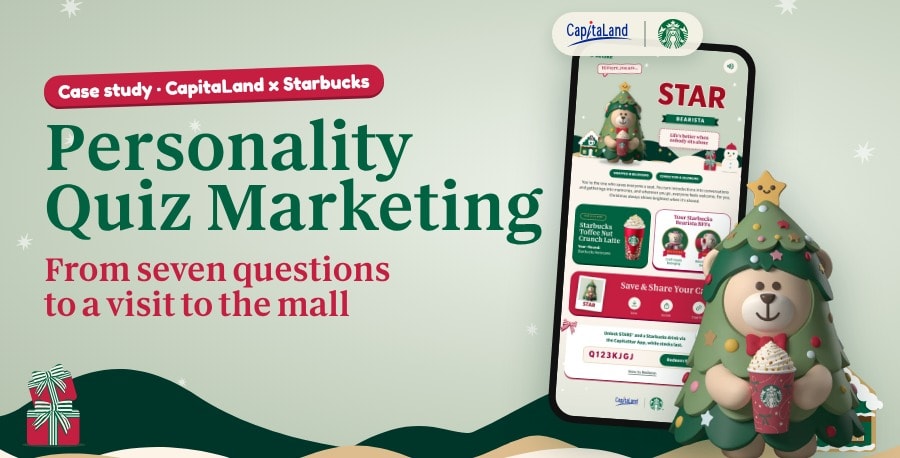
Personality Quiz Marketing: How the CapitaLand x Starbucks Bearista Quiz Turns Clicks Into Mall Visits
Personality Quiz Marketing: How the CapitaLand x Starbucks Bearista Quiz Turns Clicks Into Mall Visits
‘Personality quiz marketing’ works by matching each participant to a result that feels personal, then giving them a reason to act on it. Short quizzes with a shareable result and a clear next step tend to perform best, and Interact’s 2026 benchmark puts the average quiz start-to-lead rate at 40.1%. For CapitaLand and Starbucks, we built a seven-question quiz that ends with a reward claimed in the mall.
Most quiz campaigns are judged on completions and shares. Those numbers matter, but they stop at the screen, and a retail client needs people at the counter. The quiz we built for CapitaLand and Starbucks this Christmas was designed backwards from that outcome.
This article explains how personality quizzes work as a marketing format, what the research says about their performance, and how the Discover Your Inner Starbucks Bearista quiz connects a one-minute online experience to a physical visit.
What Is a Personality Quiz in Marketing?
A personality quiz in marketing is a short set of questions that sorts each participant into one of several branded results. The result works as a personalised recommendation, a piece of shareable content and a source of zero-party data at the same time.
The format differs from a trivia quiz because there are no wrong answers. Every participant finishes with an outcome that describes them, which gives people a reason to finish and a result they’re happy to share. Brands use the result to recommend a product, start an email sequence or, in this case, issue a reward.
Do Personality Quizzes Work for Marketing?
Personality quizzes work well when the result is specific and the next step is clear. Interact’s quiz platform reports a 40.1% average start-to-lead rate and a 65% start-to-finish rate across its lead-generation quizzes, figures it says have held steady since 2014.
According to Interact’s Quiz Conversion Rate Report (September 2026), 40.1% of people who start a lead-generation quiz go on to submit their contact details. The same report puts ecommerce quizzes at 37.6% start-to-lead and 55.5% start-to-finish. These are vendor-reported figures, so they work best as a directional benchmark rather than a guarantee.
The appeal also reflects wider consumer expectations. According to McKinsey’s research on personalisation (2021), 71% of consumers expect companies to deliver personalised interactions, and 76% get frustrated when that doesn’t happen. A quiz delivers personalisation that the participant can see and has chosen to take part in.
How Did the CapitaLand x Starbucks Bearista Quiz Work?
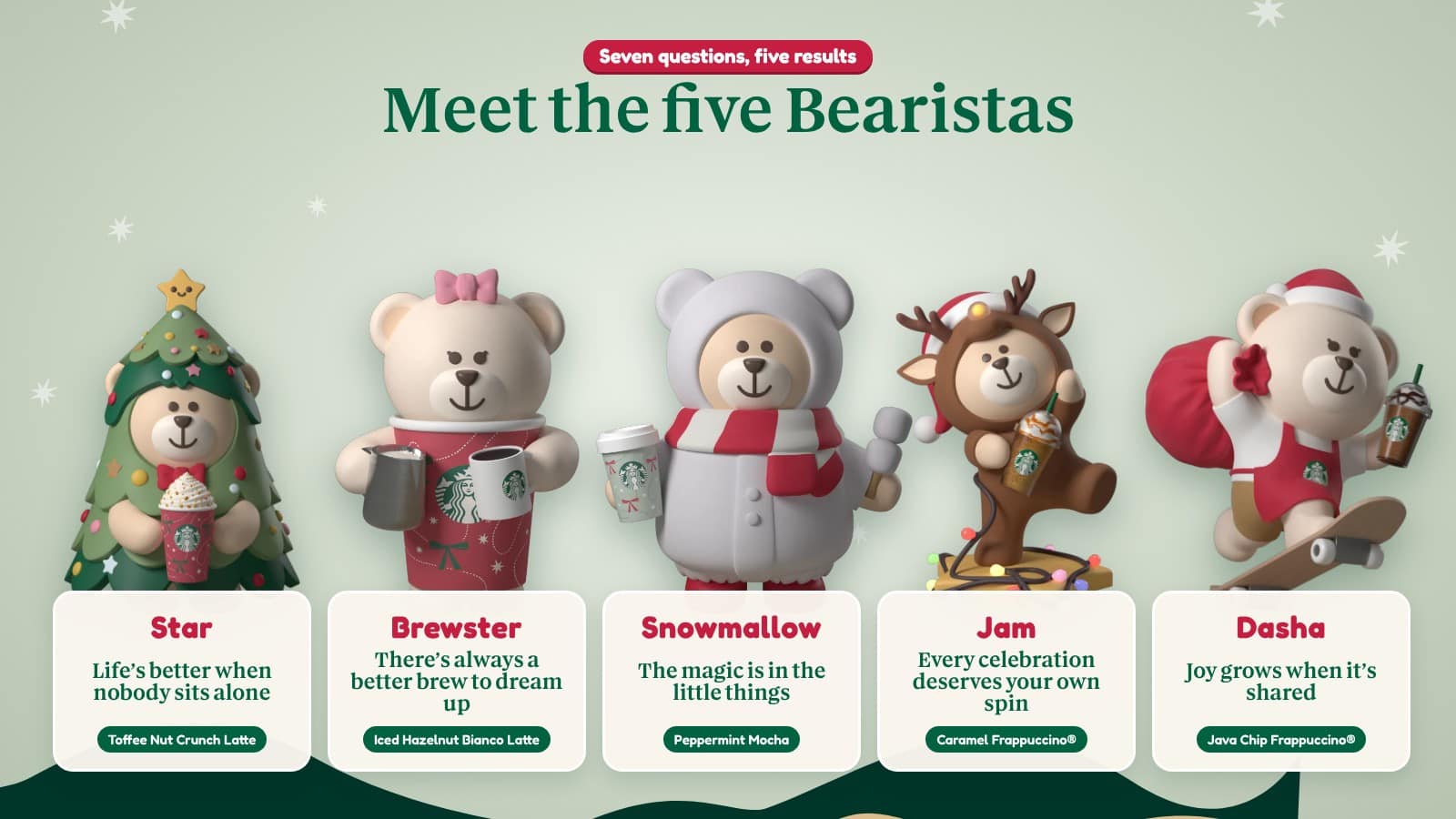
The Bearista quiz asks seven questions and matches each person to one of five Starbucks Bearistas: Star, Brewster, Snowmallow, Jam and Dasha. Each result comes with a drink pairing, a set of Bearista “BFFs”, a story-sized share card and a reward code for use at CapitaLand malls.
The campaign, Brewing Up Starbucks Christmas Magic at CapitaLand Malls, runs from 11 November to 31 December 2026. It builds on the Bearista character that Starbucks Singapore already uses across its collectibles, so the quiz starts with an audience that knows the bears.
The quiz flow
The flow is built for one-handed use on a phone. Participants enter their name, answer seven festive scenario questions with one tap each, and land on a result page that greets them by name.
The questions describe situations rather than traits, for example a person’s role at a Christmas party or their approach to wrapping gifts. We chose scenarios over self-assessment questions because they’re quicker to answer and keep the tone light.
The result page
Each result page is designed to give the participant something to keep, something to share and something to do. The table below shows how each element maps to a campaign goal.
| Result page element | What it gives the participant | Campaign goal |
|---|---|---|
| Named Bearista with personality traits | A result that feels written for them | Completion and recall |
| Go-to drink pairing | A specific Starbucks drink to try | Product discovery |
| Bearista BFFs | A reason to compare results with friends | Organic sharing |
| 1080 x 1920 share card | A ready-made Instagram Story | Social reach |
| CapitaStar reward code | A reward to claim in person | Mall footfall |
The reward
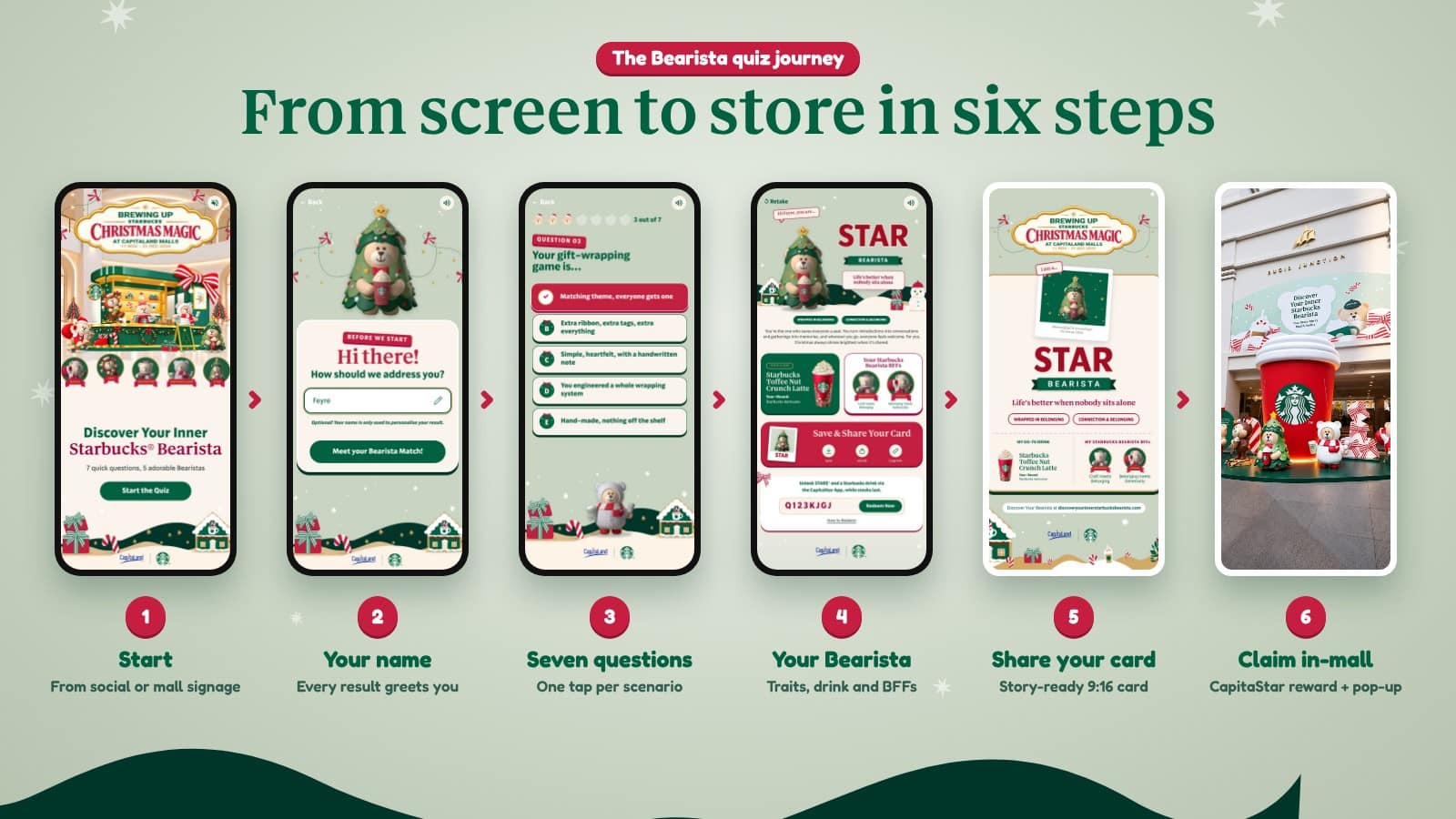
The reward is what connects the quiz to the mall. Every result shows a code that the participant redeems through the CapitaStar app for STAR$ and a Starbucks drink, while stocks last.
CapitaStar already has a large base to build on. According to the CapitaStar app listing on the Apple App Store, the programme has more than 1.8 million members and covers more than 3,400 participating stores across CapitaLand malls and workspaces in Singapore. Routing the reward through an app shoppers already use removes a sign-up step that would otherwise lose people.
How Many Questions Should a Marketing Quiz Have?
A marketing quiz should have enough questions to make the result feel earned, and few enough that people finish on a phone without effort. The Bearista quiz uses seven questions, which keeps the whole flow under a minute.
Interact’s 2026 report notes that a low start-to-finish rate can signal a quiz that is too long or repetitive. We set seven as the ceiling for this campaign because the audience arrives from social media and mall signage, often mid-errand, and the whole flow needed to fit inside a minute.
Question count matters less than question quality. Seven well-written scenarios produce a more convincing result than twelve generic ones, because each answer visibly shapes the outcome.
How Do You Turn Quiz Results Into Visits?
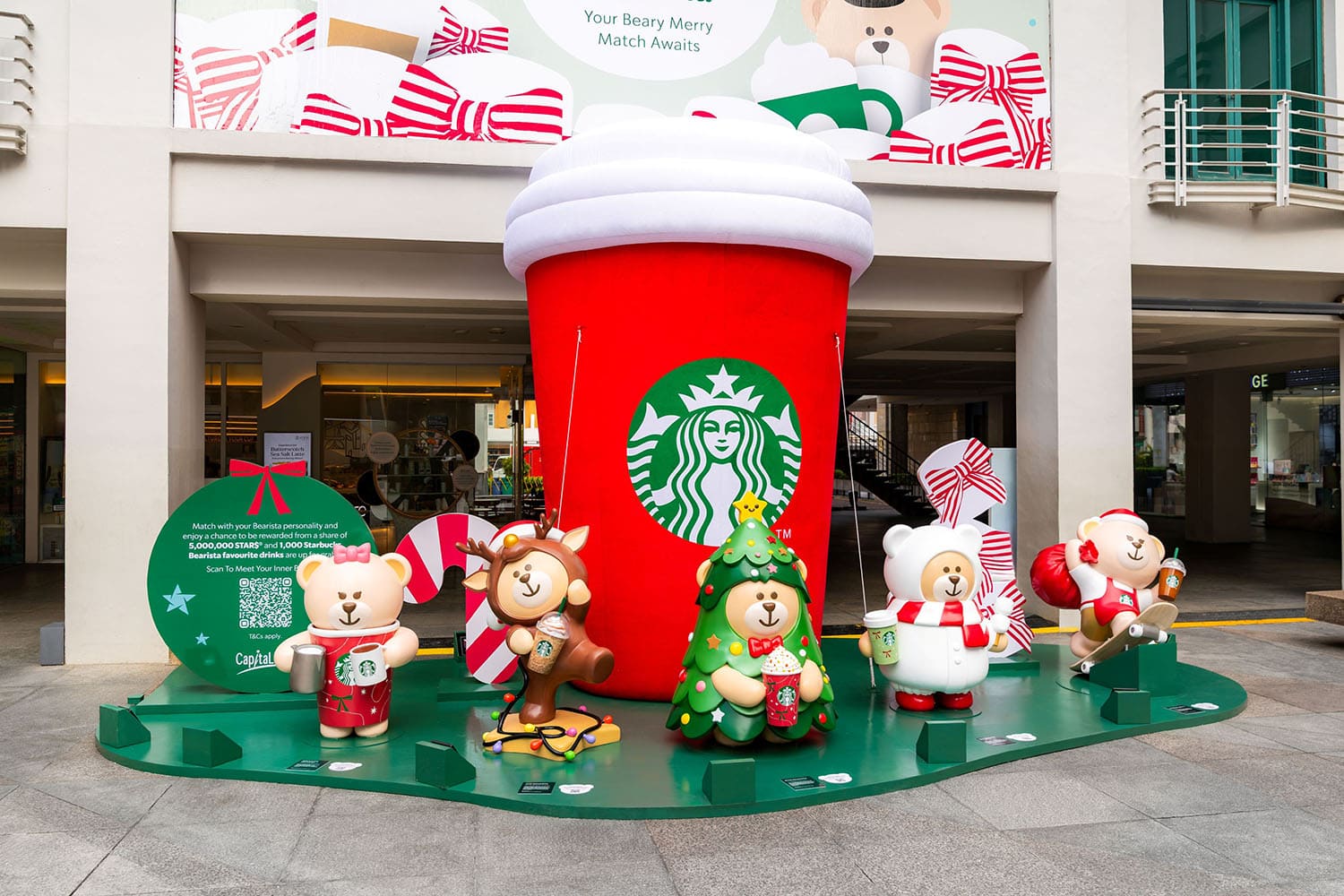
Image by Capitaland
Quiz results turn into store visits when the result carries a reward that can only be used in person. The reward has to be specific, easy to redeem and tied to a channel the shopper already uses.
The Bearista campaign applies four connected steps:
- Personalise the result. The participant’s name and Bearista make the reward feel earned rather than handed out.
- Attach a physical reward. STAR$ and a Starbucks drink give a concrete reason to visit a CapitaLand mall.
- Use existing infrastructure. Redemption runs through the CapitaStar app, so there is no new account to create.
- Give the characters a physical home. A Bearista pop-up at Bugis Junction lets participants meet their match in real life, which turns the result into a reason to go.
The same structure applies outside retail. A clinic can attach a consultation offer to a skin-type result, and an F&B brand can attach a tasting to a flavour-profile result. In both cases the quiz does the qualifying, and the offer does the converting.
When Is a Personality Quiz the Wrong Format?
A personality quiz is the wrong format when the buying decision depends on hard specifications rather than taste or identity. A buyer comparing software plans or insurance cover needs a calculator or a comparison table, not a character.
The format also struggles without a recognisable world to draw on. The Bearista quiz works partly because the characters already exist and people already collect them. A brand without established characters or a clear point of view has to build that first, or the results will feel interchangeable.
A quiz without a next step is entertainment. If the result doesn’t lead to a product, an offer or a conversation, the campaign will produce shares without producing customers.
What Should a Brand Measure in a Quiz Campaign?
A brand should measure each stage of the quiz separately, from starts to in-store redemptions. Measuring only completions hides where people drop off and whether the campaign changed real behaviour.
| Stage | Metric | What it tells you |
|---|---|---|
| Entry | Start rate (visitors who begin the quiz) | Whether the landing page and hook work |
| Quiz | Start-to-finish rate | Whether the quiz length and questions hold attention |
| Result | Share card saves and shares | Whether the result is worth posting |
| Reward | Codes issued vs codes redeemed | Whether the online result drives an offline visit |
| Distribution | Results by persona | Whether the questions are balanced across outcomes |
The redemption rate is the number that matters most to a retail client, because it is the closest measure of footfall. For the Bearista quiz, issued and redeemed codes are tracked separately, so the campaign can be judged on visits as well as views once it closes on 31 December 2026.
What Makes a Personality Quiz Worth Sharing?
A personality quiz is worth sharing when the result says something flattering and specific about the person, and when sharing it takes one tap. Characters with distinct traits make results easy to compare, which turns individual results into group conversations.
The Bearista results each carry a short line of personality, such as Star’s “Life’s better when nobody sits alone”, plus two trait tags. The share card is pre-sized for Instagram Stories, so participants don’t have to screenshot, crop or design anything. Our earlier piece on interactive trends on Instagram covers why low-effort sharing formats outperform posts that ask for more work.
Building a quiz like this sits across several disciplines: content, design, front-end development and campaign mechanics. That mix is why we approach quizzes as a joint web design and development and social media marketing project, and more of our retail and F&B work is on our case studies page.
If you’re planning a seasonal campaign and want it to bring people into a store, not just onto a page, a personality quiz is worth considering. If your company is looking for a strategic marketing partner, the Creative For More team can help. Book a discovery call to explore how we can support your brand’s growth.
Read More

Geraldine Pang
Creative For More
Geraldine Pang is the founder of Creative For More, a cross-border digital marketing agency with offices in Singapore, Tokyo, and New York. She specializes in brand strategy, market entry, and cross-border marketing across Southeast Asia, Japan, and the United States.