
ChatGPT Ads: How They Work, What They Cost and Where They Run in 2026
ChatGPT Ads: How They Work, What They Cost and Where They Run in 2026
ChatGPT ads are sponsored listings that appear below ChatGPT’s answers, matched to the topic of the conversation and clearly labeled as sponsored. They show only to logged-in adults on the Free and Go plans. Advertisers buy on a CPM or CPC basis through OpenAI’s Ads Manager, its sales team or agency partners, and the ads now run in over 60 countries, including the US, Japan and Singapore.
OpenAI began testing ads in the US in February 2026 and turned them into a global ad platform within eight months. Pricing has dropped sharply since launch, self-serve buying has opened up, and the list of markets keeps growing. For a brand selling across the US and Asia, ChatGPT is now a paid channel that can be planned alongside search and social.
The format is still new, and several details are changing month to month. This guide covers what OpenAI has confirmed: how the ads are matched and shown, what they cost, where they’re live, which categories are blocked, and how paid placements differ from organic visibility in ChatGPT answers.
How Do ChatGPT Ads Work?
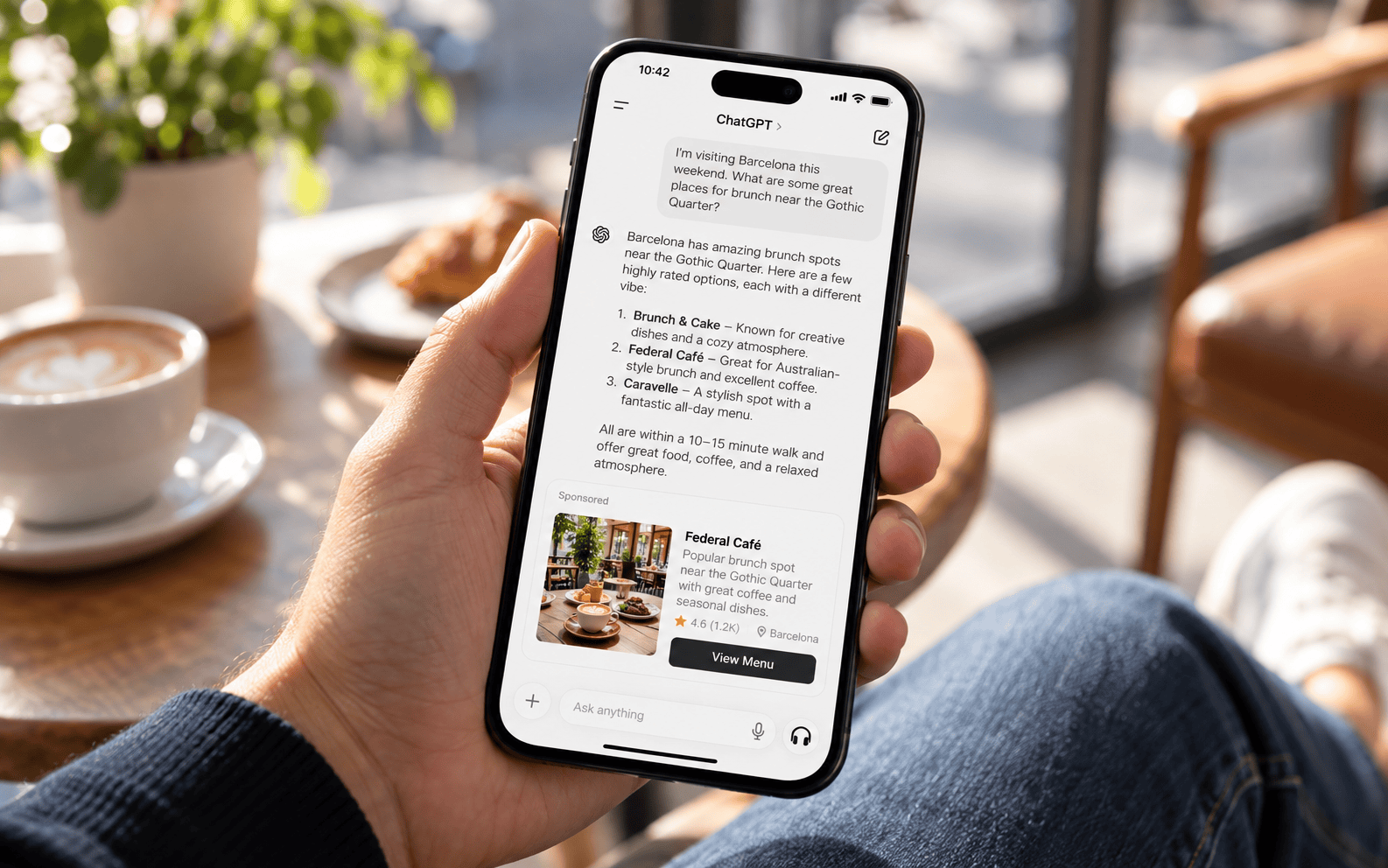
ChatGPT ads are matched to the topic of a user’s conversation and shown as a labeled sponsored unit below the answer, visually separate from it. The ad doesn’t change what ChatGPT says, and advertisers never see the conversation itself.
According to OpenAI’s announcement of the ads test (2026), ads are matched by comparing submitted ads with the topic of the conversation, and past chats and past ad interactions can also factor in. Users can manage ad personalization in their settings.
OpenAI’s published commitments set the boundaries of the format:
- Plans: ads appear only for logged-in adults on the Free and Go plans. Plus, Pro, Business, Enterprise and Education accounts are ad-free.
- Age: OpenAI won’t show ads to accounts where the user says, or OpenAI predicts, that they’re under 18.
- Answer independence: OpenAI states that ads do not influence the answers ChatGPT gives.
- Data: advertisers can’t access chats, chat history, memories or personal details, and receive only aggregate performance data such as views and clicks.
- Sensitive topics: ads aren’t eligible to appear near conversations about health, mental health or politics.
Each ad contains an advertiser name, favicon, title, description, image and landing page URL. According to PPC Land’s report on the Ads Manager launch (2026), OpenAI recommends headlines of about 16 characters and descriptions of about 32 characters, which is shorter than a typical search ad.
Where Are ChatGPT Ads Available?
ChatGPT ads are live in over 60 countries as of September 2026, including the US, Japan and Singapore. The US came first in February 2026, Japan launched by August 2026, and Singapore joined with six other Southeast Asian and East Asian markets in September 2026.
According to OpenAI’s Southeast Asia and Taiwan expansion announcement (September 2026), ChatGPT Ads launched in Indonesia, Malaysia, the Philippines, Singapore, Thailand, Vietnam and Taiwan, following earlier Asia Pacific launches in Australia, New Zealand, Japan, South Korea and India.
| Market | Status | Timing |
|---|---|---|
| United States | Live, first market | Test began 9 February 2026 |
| Japan | Live | Confirmed in OpenAI’s 11 August 2026 update |
| South Korea, UK, Mexico, Brazil | Live | Confirmed in OpenAI’s 11 August 2026 update |
| Singapore and Southeast Asia | Live | Announced 23 September 2026 |
| Total coverage | Over 60 countries | As of 23 September 2026 |
Availability isn’t the same as full feature parity. Self-serve access, bidding options and eligible ad categories have reached markets at different times, so a campaign planned across the US, Japan and Singapore needs a market-by-market check before launch.
How Much Do ChatGPT Ads Cost?
ChatGPT ads launched at a $60 CPM with a $250,000 minimum commitment, and both have fallen. CPMs have been reported as low as $25, the minimum spend was removed for self-serve advertisers in May 2026, and OpenAI recommends starting CPC bids at $3 to $5.
According to Digiday (April 2026), the minimum commitment dropped from $250,000 at launch to $50,000, and CPMs have been reported as low as $25. According to Axios (May 2026), OpenAI then removed the $50,000 testing threshold when it opened self-serve buying and added cost-per-click pricing alongside CPM.
| Cost element | At launch | Current position |
|---|---|---|
| CPM | $60 | Reported as low as $25 (Digiday, April 2026) |
| Minimum commitment | $250,000 | $50,000 in April 2026, then removed for self-serve (Axios, May 2026) |
| CPC | Not available | Available, with a recommended starting maximum bid of $3 to $5 (PPC Land, May 2026) |
| Measurement | Views and clicks | Pixel and Conversions API for purchases, leads and sign-ups |
These figures come from US campaigns. OpenAI hasn’t published local pricing for Japan or Singapore, so costs in those markets should be treated as unconfirmed until a campaign runs and real auction data comes back.
How Do You Buy ChatGPT Ads?
Advertisers can buy ChatGPT ads in three ways: self-serve through Ads Manager, thrugh OpenAI’s Ads Solutions team, or through agency and technology partners. Self-serve opened to US businesses in May 2026 and is available to eligible businesses in the newer markets.
The Ads Manager runs at ads.openai.com. Accounts must be verified before campaigns deliver, and campaigns are set up around a Reach objective (CPM) or a Clicks objective (CPC). UTM parameters on landing page URLs carry through, so ChatGPT traffic can be tracked in existing analytics alongside paid search and social.
Which Businesses Can’t Advertise on ChatGPT?
OpenAI prohibits ads for adult content and dating, alcohol and tobacco, gambling, recreational drugs, political content, weight loss products and several financial products such as credit repair and debt settlement. Financial, health and legal services are restricted to the US and approved case by case.
According to OpenAI’s ad policies (updated September 2026), financial, health and legal services are generally prohibited outside the US, and ads are primarily limited to consumer categories during the initial period. A US fintech or clinic brand can apply to run ads at home but can’t currently run the same campaign in Singapore or Japan.
What Is the Difference Between ChatGPT Ads and Organic Visibility in ChatGPT?
ChatGPT ads are paid placements shown below an answer, while organic visibility means the brand is named or cited inside the answer itself. Ads deliver traffic as soon as a campaign launches. Organic visibility takes months to build through content and third-party mentions, but it costs nothing per click once it’s in place.
| Factor | ChatGPT Ads | Organic visibility (GEO) |
|---|---|---|
| What it is | Labeled sponsored unit below the answer | Brand mentioned or cited within the answer |
| Cost model | CPM or CPC bidding | Content, PR and technical work, no media cost |
| Time to result | Days, once the account is verified | Typically several months |
| Control | Full control of copy, image and landing page | No control over how the model describes the brand |
| Who sees it | Free and Go users only | All users, including paid plans |
| Measurement | Impressions, clicks, conversions via pixel or API | Mention and citation tracking tools, referral traffic |
The two channels cover different users. Plus, Pro and Enterprise subscribers never see ads, so a B2B brand whose buyers use paid ChatGPT plans at work can only reach them through organic answers. Our guide to how brands get cited in ChatGPT search covers the organic side in detail, and SEO vs GEO vs AEO explains where each discipline fits.
How Should a Brand Prepare a ChatGPT Ads Campaign?
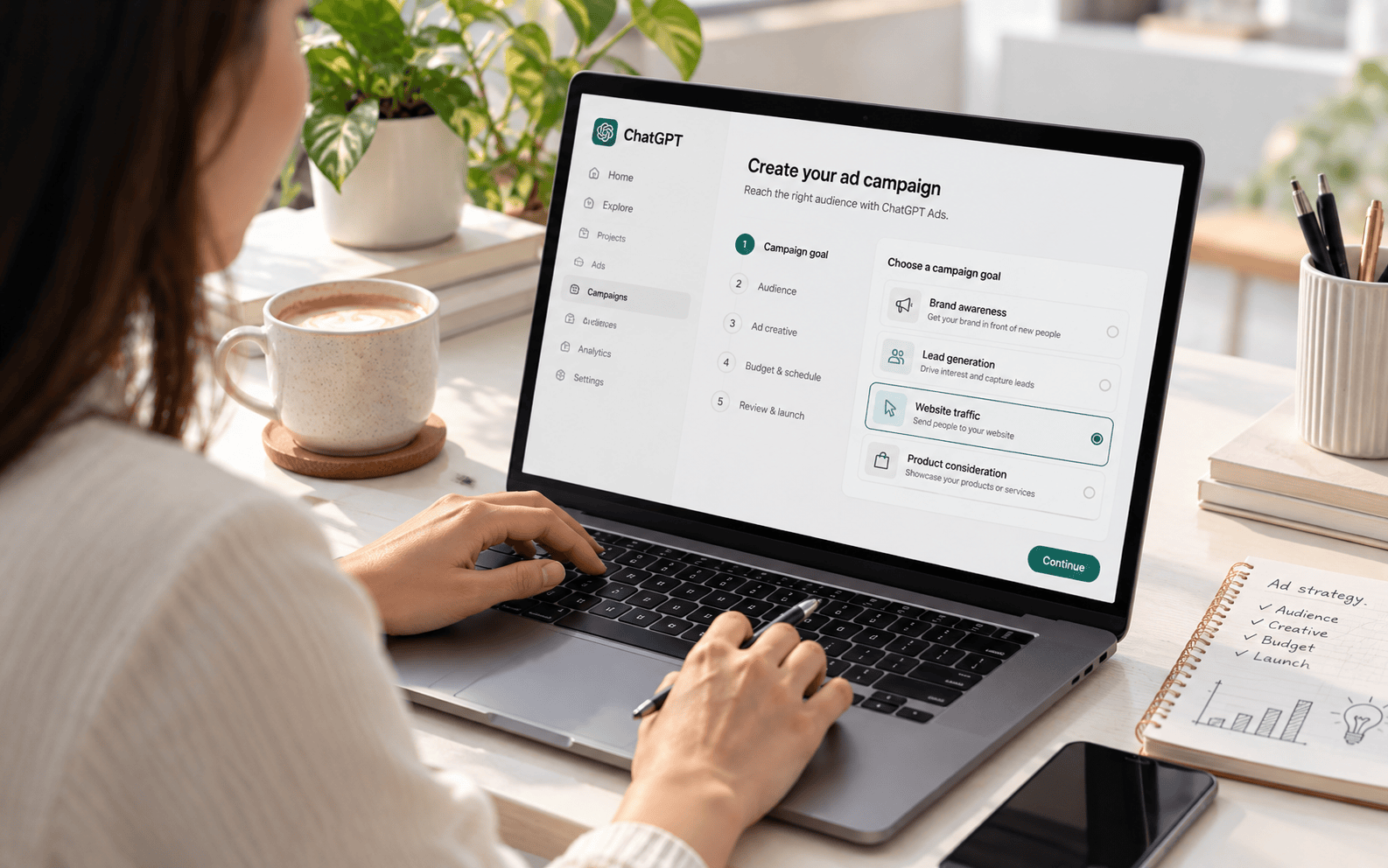
A brand should confirm category eligibility and market availability first, then build short ad copy, a matching landing page and conversion tracking before spending. The steps below follow that order.
- Check the ad policy for the category. Confirm the product isn’t prohibited, and check whether it’s restricted outside the US.
- Confirm each market. Verify availability, self-serve access and bidding options in every country the campaign targets.
- Map the conversations. List the questions buyers ask ChatGPT before purchasing, since ads match to conversation topics rather than keywords.
- Write to the format. Draft headlines near 16 characters and descriptions near 32, with an image that isn’t just a logo.
- Build market-specific landing pages. A Japanese user clicking from a Japanese conversation needs a Japanese page, not a translated US page.
- Install measurement. Set up the pixel or Conversions API and UTM tags before launch so results can be compared with search and social.
- Start with a capped test. Run a small CPC test per market, then shift budget toward the conversation topics that convert.
Do You Need a ChatGPT Ads Agency?

A brand running ChatGPT ads in one market with an in-house paid media team can manage the self-serve Ads Manager directly. An agency adds the most value when campaigns span several markets, because policy rules, availability and landing page requirements differ between the US, Japan and Singapore.
Creative For More runs ChatGPT Ads and GEO from New York for brands selling across the US, Japan and Singapore, with paid and organic AI search planned as one program. The New York office works with the Singapore and Tokyo teams so each market’s campaigns, copy and landing pages are built locally rather than translated from a single US version.
If you’re planning to test ChatGPT ads in the US or Asia and want paid placements and organic visibility handled by one team, Creative For More can help. Book a discovery call to explore how we can support your brand’s growth.
Read More
- Generative Engine Optimisation, an AI-focused Marketing Agency
- What Is Generative Engine Optimisation (GEO)?
- How LLMs Are Changing Search and What That Means for Your PPC Strategy
- GEO and AEO Tools Compared: What Each One Actually Measures
- Best AI Visibility Tools in 2026: A Comparison From an Agency That Doesn’t Sell One

Geraldine Pang
Creative For More
Geraldine Pang is the founder of Creative For More, a cross-border digital marketing agency with offices in Singapore, Tokyo, and New York. She specializes in brand strategy, market entry, and cross-border marketing across Southeast Asia, Japan, and the United States.