

Japan vs Southeast Asia: Which Market Should European Brands Enter First?
Japan vs Southeast Asia: Which Market Should European Companies Enter First?

For European brands expanding into Asia, one question comes up early: should we enter Japan first, or Southeast Asia? Both regions offer growth, though they differ sharply in cost structure, timelines, buyer behavior, and execution complexity.
There is no universal answer. The right choice depends on business model, risk tolerance, pricing strategy, and internal resources. This guide compares Japan and Southeast Asia through a market entry lens, helping EU companies decide which region fits their expansion goals first.
Market Size and Revenue Potential

Japan: High Value, Slower Build
Japan remains one of the world’s largest consumer economies with strong purchasing power. Buyers are cautious, though once trust is established, lifetime value is high.
For European brands, Japan works well when:
- Average order value or contract value is high
- Long-term retention matters more than fast volume
- Brand positioning leans premium or specialist
Revenue builds steadily rather than quickly.
Southeast Asia: Faster Volume, Mixed Price Sensitivity
Southeast Asia is not one single market. Singapore, Indonesia, Vietnam, Thailand, and the Philippines each have different buyer behaviors, purchasing power, and digital habits. That said, when viewed as a region, Southeast Asia offers strong scale potential and often delivers faster early traction compared to Japan.
For many European brands, Southeast Asia can lead to quicker initial adoption, especially for products and services that are easy to understand and purchase online. Price sensitivity tends to be higher in most markets outside of Singapore, which can affect positioning and margin strategy. At the same time, consumer behavior across the region is strongly mobile-first, making performance marketing, social platforms, and fast-loading localized landing pages especially important.
Overall, growth in Southeast Asia often moves faster, but the profitability picture depends heavily on which countries you enter and how you adapt your pricing and go-to-market approach for each one.
Cost of Market Entry

Japan Entry Costs
Japan requires higher upfront investment. Costs rise due to:
- Deep localization of content and websites
- Local customer support expectations
- Platform setup such as LINE and domestic media
Paid media costs are also higher than most Southeast Asian markets.
Southeast Asia Entry Costs
Entry costs in Southeast Asia are generally lower, and the region gives European brands more flexibility to test and scale gradually. Many companies start with one or two priority markets, validate demand, and then expand into additional countries once the go-to-market approach is working.
In many Southeast Asian markets, media spend is typically more affordable than Japan, and content production cycles can move faster due to fewer layers of approval and shorter localization lead times. Early-stage localization is also often simpler, especially when brands begin with English-first assets in Singapore or adapt lightweight local versions for markets like Indonesia, Vietnam, and Thailand.
That said, Singapore sits closer to Japan in terms of cost expectations, particularly for paid media and premium positioning. Even so, launch timelines are usually faster and market testing remains easier compared to entering Japan from day one.
Example Southeast Asia Entry Costs (Indicative)
| Cost Category | What It Covers | Typical Range (Southeast Asia) | Notes |
|---|---|---|---|
| Website / landing page localization | Light translation, market-specific messaging tweaks, basic UX edits | €300–€2,000 | Higher if multiple languages or full site rebuild is needed |
| Creative production (ads + social assets) | Static banners, short-form videos, simple design adaptations | €500–€3,000 | Faster turnaround vs Japan in most markets |
| Paid media testing budget (monthly) | Meta, Google, TikTok test campaigns for 1 market | €1,000–€8,000 | Singapore tends to sit at the higher end |
| Influencer / KOL collaborations | Micro to mid-tier creators | €200–€5,000 per campaign | Varies widely by country and category |
| Local market setup + community channels | Setup for WhatsApp/LINE equivalents, social pages, basic response templates | €300–€2,500 | Often lightweight at the start |
| Ongoing content support (monthly) | Social content, blog support, basic localization updates | €800–€5,000 | Depends on output volume and number of markets |
Timeline to Traction
Japan Requires Patience
Japan rewards consistency and commitment. Traction takes longer, especially for unknown European brands. Buyers need repeated exposure and reassurance before converting.
Timelines typically involve:
- Longer decision cycles
- Slower early conversion
- Stronger long-term stability
Southeast Asia Moves Faster
Southeast Asia typically offers quicker feedback loops compared to Japan. Campaigns often start showing performance signals earlier, which makes it easier for European brands to learn what messaging, pricing, and channels are working—then adjust quickly based on real market response.
This faster pace is especially valuable for companies that want early proof of demand, need quicker ROI indicators to guide investment decisions, or prefer an iterative approach to market entry where they test, refine, and scale step by step.
Localization Complexity
Japan Has the Highest Localization Barriers

Japan demands more than translation. Brands must adapt:
- Messaging order and tone
- Website structure and information depth
- Visual hierarchy and trust indicators
Misalignment often leads to high bounce rates even with strong traffic.
Southeast Asia Varies by Market
Localization complexity depends on the country. English works in Singapore. Indonesia, Vietnam, and Thailand require local language and cultural nuance, though expectations are more forgiving than Japan.
ROI Profiles for European Brands
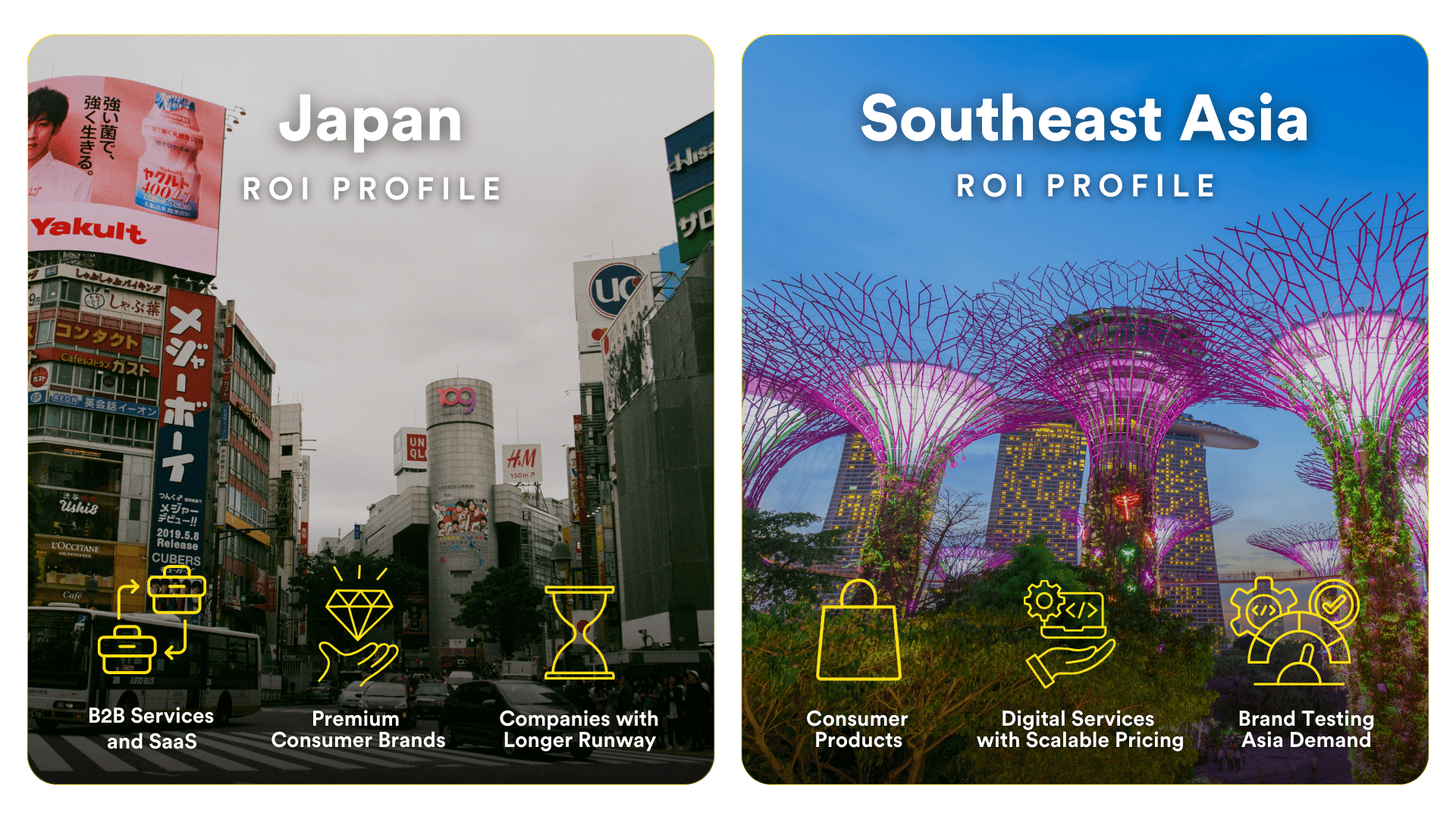
Japan vs Southeast Asia: Market Entry Comparison
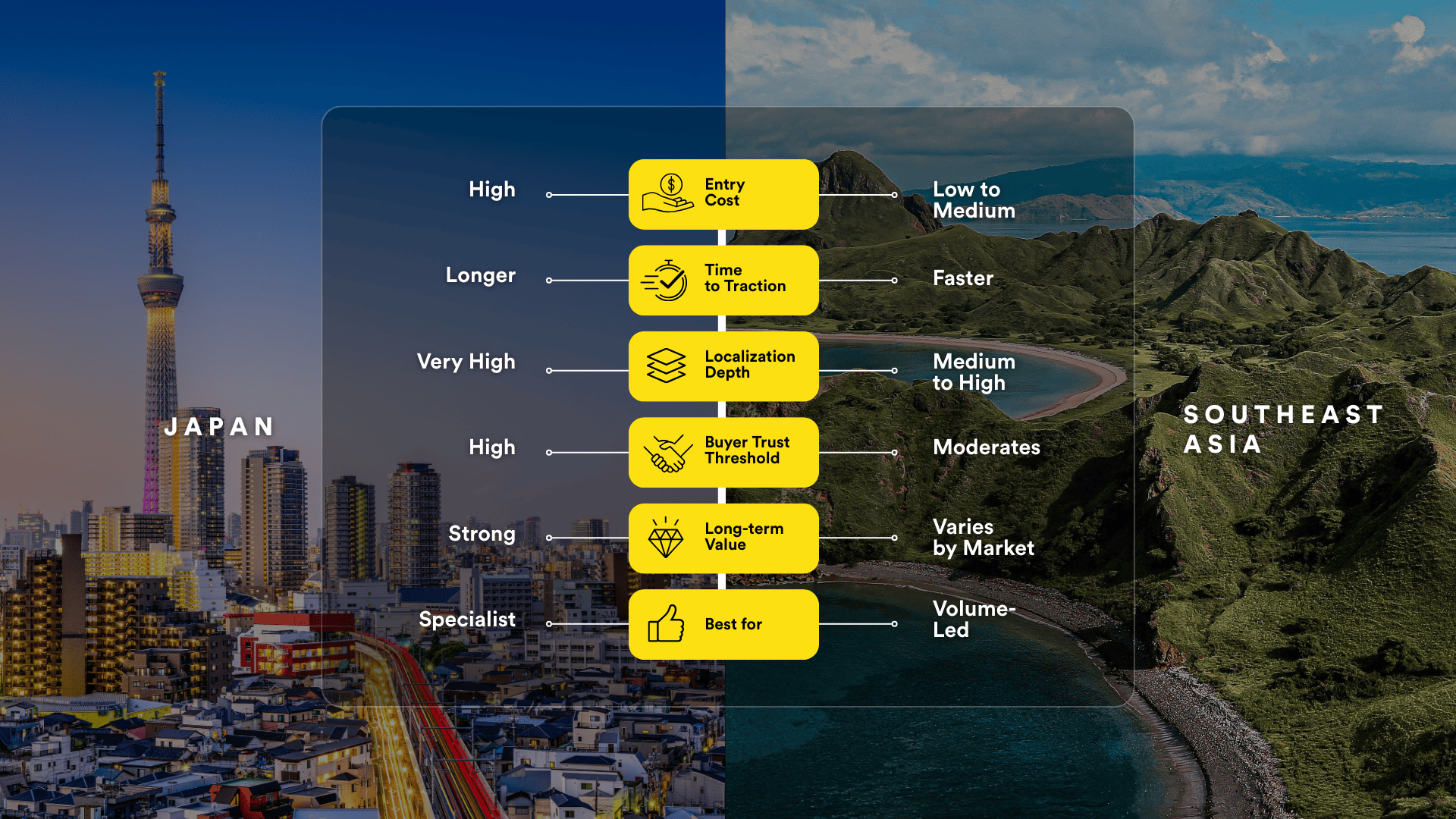
| Factor | Japan | Southeast Asia |
|---|---|---|
| Entry cost | High | Low to medium |
| Time to traction | Longer | Faster |
| Localization depth | Very high | Medium to high |
| Buyer trust threshold | High | Moderate |
| Long-term value | Strong | Varies by market |
| Best for | Premium, B2B, specialist | Volume-led, testing, growth |
Which Market Should European Companies Enter First?

Choose Japan First If:
- Your brand relies on trust and credibility
- Pricing sits at the premium end
- You can invest in long-term market development
Choose Southeast Asia First If:
- You need faster validation
- Your model supports price flexibility
- You plan to test and learn before deeper investment
Some European brands adopt a hybrid path, using Southeast Asia for early traction and Japan for long-term stability.
Planning Asia Market Entry from Europe

Creative For More helps European brands decide where and how to enter Asia through strategy-led market entry planning, localization, and execution. With teams in Singapore and Japan, we support EU companies launching in Japan, Southeast Asia, or both—based on business reality, not assumptions.
Market Entry Services Include:
- Japan-first or Southeast Asia-first strategy
- Brand and website localization
- Platform and channel planning
- Content and paid acquisition setup
If you’re deciding between Japan and Southeast Asia for your first Asia expansion move, don’t guess—plan it with clarity. Creative For More helps European brands map the right entry market, localization approach, and go-to-market strategy based on your business model, pricing, and internal resources. Book a discovery call and we’ll walk through your best-fit market entry path (Japan-first, Southeast Asia-first, or hybrid), along with the channels and execution roadmap to launch with confidence.

Geraldine Pang
Creative For More
Geraldine Pang is the founder of Creative For More, a cross-border digital marketing agency with offices in Singapore, Tokyo, and New York. She specializes in brand strategy, market entry, and cross-border marketing across Southeast Asia, Japan, and the United States.