

Veterinary Marketing Ideas: 12 Proven Ways to Grow a US Practice
Veterinary Marketing Ideas: 12 Proven Ways to Grow a US Practice in 2026
The best veterinary marketing ideas for a US practice in 2026 are a complete Google Business Profile, a steady review process, online booking, automated reminders, and reactivation campaigns for lapsed clients. Local visibility brings new pet owners in, and retention keeps them returning. Most practices get the fastest return by fixing their weakest point first, whether that’s visibility, booking, or client retention.

Veterinary marketing works differently from most local service marketing because the relationship runs for the life of the pet. A practice that wins a new client but loses them after one visit has spent its acquisition budget for a single invoice. The ideas below are ordered around that reality, covering both how pet owners find a practice and how a practice keeps them.
The stakes are large. According to the American Pet Products Association’s 2026 State of the Industry Report, US pet owners spent $41.0 billion on veterinary care and product sales in 2025, with $42.4 billion projected for 2026.
What Are the Best Veterinary Marketing Ideas?

Image from Bond Vet
The best veterinary marketing ideas focus on local search, reviews, booking, and retention, because those four areas decide whether a pet owner finds a practice and comes back. The twelve ideas below cover new client acquisition and client retention together.
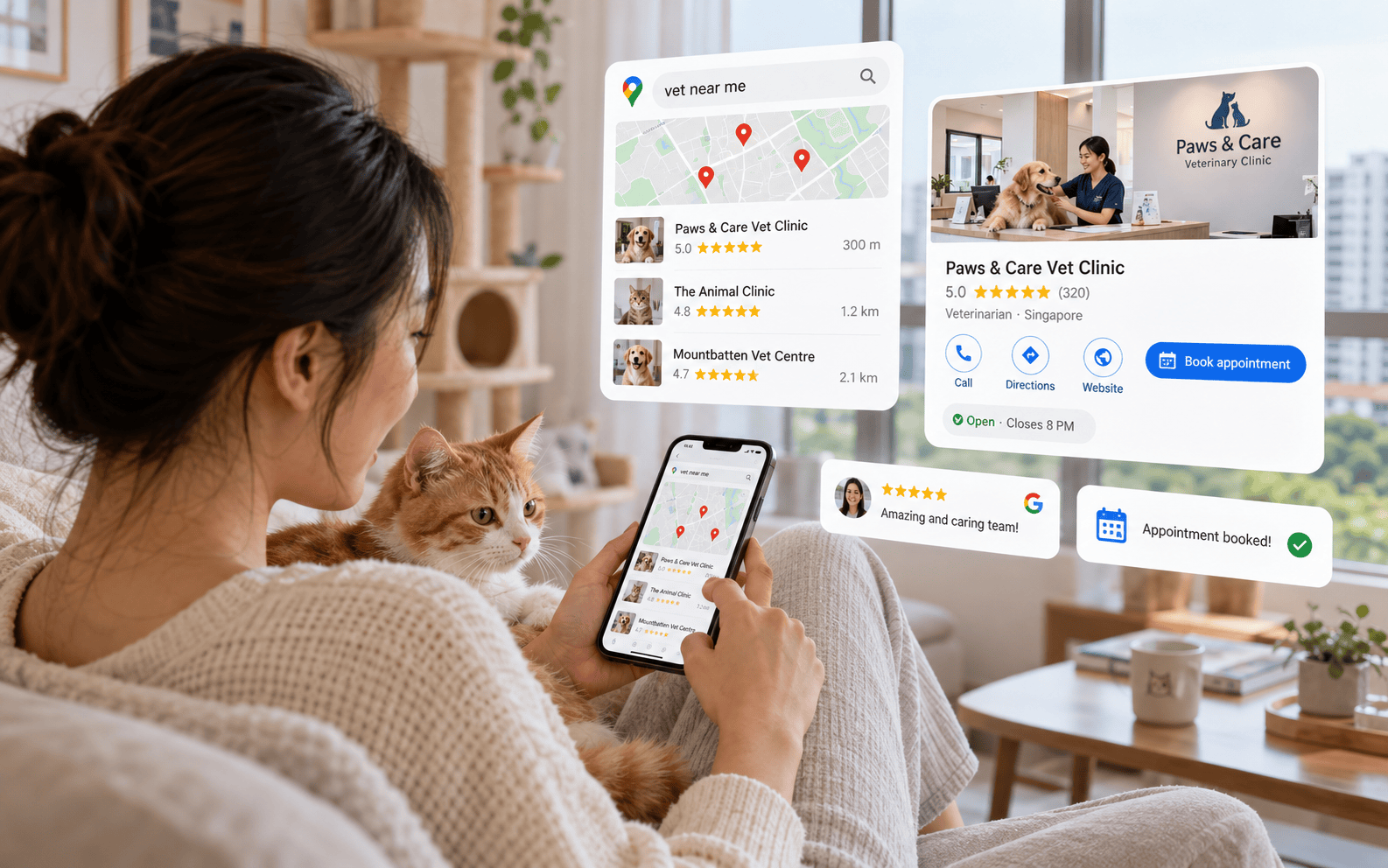
- Complete your Google Business Profile. Most pet owners choose a vet through local search, so accurate hours, services, and photos are the first thing to fix.
- Build a systematic review process. Ask every satisfied client for a review by text or email within a day of the visit.
- Keep your listings consistent. Matching name, address, and phone details across directories supports map rankings.
- Offer online booking. Pet owners increasingly expect to book outside phone hours, and a booking form that only collects requests loses them.
- Answer the phone fast. A worried owner who reaches voicemail usually calls the next practice on the list.
- Target “near me” and service searches. Service pages for dental care, vaccinations, and emergencies capture the highest-intent local searches.
- Automate appointment reminders. Reminders for vaccines, wellness exams, and dental checks protect the visit schedule that keeps clients active.
- Run a new-client welcome sequence. A short onboarding email series turns a first visit into an ongoing relationship.
- Build a reactivation campaign. Automated outreach to clients who haven’t visited in over a year recovers revenue from relationships the practice already has.
- Publish pet-health content. Clear answers to common owner questions build trust and visibility in search and AI answers.
- Use social media to show your team. Staff introductions, clinic tours, and patient stories shared with permission give owners a reason to trust the practice before they visit.
- Track your cost per new client. Measuring what each new client costs shows which of these ideas are paying for themselves.
Which Veterinary Marketing Ideas Bring in New Clients?

A complete Google Business Profile, a strong review profile, and online booking bring in the most new clients. These three reach pet owners at the moment they’re choosing a practice, which is when marketing has the most influence.
Start With Your Google Business Profile
A complete profile is the highest-return acquisition idea because it costs time rather than ad budget. According to Google’s Business Profile Help Center, customers are 2.7 times more likely to consider a business reputable when its profile on Search and Maps is complete, and 70% more likely to visit it.
Completing a profile means filling in hours, services, appointment links, and current photos of the clinic and team. Posting updates once a week and answering questions in the profile keeps it active between visits.
Make Reviews a Routine
Reviews influence nearly every local choice, including the choice of a vet. According to BrightLocal’s Local Consumer Review Survey 2026, 97% of consumers read reviews for local businesses, and the average consumer checks six different review sites before choosing.
The practical step is a review request sent automatically after each completed appointment. Replying to every review, positive or negative, shows prospective clients how the practice treats people when something goes wrong.
Remove Friction From Booking
Booking friction loses clients who were ready to commit. According to PetDesk’s 2025 Pet Parent Research Report, a survey of 1,000 North American pet owners, 78% say booking at any time on any device is important, while 24% say their own clinic offers no online booking.
Online scheduling also captures demand outside opening hours. Practices that add it should make sure the system books a real appointment slot rather than collecting a request that staff confirm the next day.
Which Veterinary Marketing Ideas Improve Client Retention?
Automated reminders, a new-client welcome sequence, and reactivation campaigns improve retention the most. They keep clients engaged in the months between visits, which is where most veterinary relationships quietly end.
The retention problem is measurable. According to AVMA News (2023), veterinary practice revenue rose 5.7% between August 2021 and August 2023 while client visits fell 2.7%, and the number of lapsing patients, those unseen for 14 to 18 months, rose significantly per practice.
Automate Reminders
Reminders are the simplest retention tool because they act on visits the client already needs. Vaccine due dates, annual wellness exams, and dental checks can all trigger a text or email without staff involvement.
Welcome New Clients Properly
A welcome sequence sets expectations after the first visit. Three or four emails covering what to expect at the next appointment, how to book, and how to reach the team after hours make a second visit more likely. The same lifecycle logic sits behind most effective email marketing programs.
Reactivate Lapsed Clients
Reactivation is the cheapest revenue most practices leave untouched, because the trust is already built. According to Otto’s 2025 Client Engagement Report, reminder campaigns brought 15% of lapsed clients back to rebook within 90 days.
Applied to a practice with 400 lapsed patient records, a 15% response would mean 60 rebooked visits from one campaign. At an illustrative average invoice of $200, that is $12,000 in recovered revenue, and each practice should substitute its own average invoice to get a real figure.
How Should a Veterinary Practice Use Content and Social Media?
A veterinary practice should use content to answer pet owners’ questions and social media to show the people behind the practice. Content builds search visibility over time, while social content builds the familiarity that makes a first visit feel less risky.
Pet-health content now reaches owners through AI tools as well as search results. BrightLocal’s 2026 survey found that AI search engines have become the third most-used source of local business recommendations, which means clear, well-structured answers on a practice’s website can surface in AI responses too. This is the focus of generative engine optimisation.
Social content works best when it shows the team and the clinic rather than promotions alone. When Creative For More relaunched Gentle Oak Veterinary Clinic in Singapore after a renovation, the work paired doctor features and clinic tour reels with Meta lead ads targeting pet owners within 6km and Google Search ads for terms such as puppy vaccinations. Engagement on boosted content and reels grew threefold, and cost per lead fell.
How Do You Choose the Right Veterinary Marketing Ideas?
The right veterinary marketing ideas depend on where the practice is losing the most clients: visibility, booking, or retention. Most practices don’t need all twelve ideas at once and get faster results by fixing the biggest gap first.
A practice that’s hard to find should start with its profile and reviews. A practice that gets calls but loses bookings should fix scheduling and phone response, and a practice with a shrinking active client list should start with reminders and reactivation.
| Biggest gap | Ideas to start with | Number to watch first |
|---|---|---|
| Hard to find | Google Business Profile, reviews, “near me” service pages | Map ranking and calls from search |
| Losing bookings | Online booking, faster phone response | Booking conversion rate |
| Losing clients | Reminders, welcome sequence, reactivation | Active client count and lapsed patient count |
Our pet marketing work follows the same order: diagnose the gap, fix the highest-return idea, then measure before adding more channels.
How Do You Measure Veterinary Marketing Results?

Veterinary marketing results are measured by cost per new client, booking conversion rate, and visit frequency, not by follower counts or likes. Those three numbers show whether marketing is paying for itself.
Cost per new client is total monthly marketing spend divided by the new clients that month brought in. A practice spending $3,000 in a month and gaining 15 new clients has a cost per new client of $200.
That figure only means something next to what a client is worth. VetSource data presented by the AVMA puts the average patient at 2.39 visits per year, so at an illustrative $200 average invoice a new client generates about $478 in the first year, and the $200 acquisition cost pays back within that year.
The trend matters more than any single month. A cost per new client that falls over a quarter shows the ideas are compounding, while a rising figure is an early signal to change the mix.
If you run a veterinary practice and want local search, booking, and retention working as one system, the Creative For More team can help. Book a discovery call to explore how we can support your brand’s growth.
Read More

Geraldine Pang
Creative For More
Geraldine Pang is the founder of Creative For More, a cross-border digital marketing agency with offices in Singapore, Tokyo, and New York. She specializes in brand strategy, market entry, and cross-border marketing across Southeast Asia, Japan, and the United States.