

Veterinary Marketing: How US Practices Attract and Keep Clients
Veterinary Marketing: How US Practices Attract and Keep Clients in 2026
Veterinary marketing is how a practice attracts new clients and keeps existing ones through local search, online reviews, content, email, and client communication. In 2026, the practices that grow fastest win the local search moment when a pet owner is choosing a vet, then keep that client through reminders and steady contact. Retention matters as much as acquisition, because one long-term client is worth several years of visits.
When a pet gets sick, the owner rarely browses for long. They search, read reviews, and call the practice that earns their trust first, which means much of veterinary marketing is decided in a short and urgent window.
The market behind that window is large. According to the American Pet Products Association’s 2026 State of the Industry Report, 95 million US households own a pet, and spending on veterinary care and product sales reached $41.0 billion in 2025, with $42.4 billion projected for 2026.
What Is Veterinary Marketing?
Veterinary marketing is the set of activities a practice uses to win new clients and retain existing ones. It covers local SEO, online reviews, the practice website, social media, email, and day-to-day client communication.
The work is unusually local and trust-driven. Pet owners usually choose a vet close to home and weigh reputation heavily, so visibility in local search and the strength of a practice’s reviews carry most of the weight.
It also differs from general retail marketing because the relationship runs for the life of the pet. A client who stays for years brings repeat wellness visits, additional pets, and referrals, so marketing that keeps clients is as valuable as marketing that finds them.
What Rules Apply to Veterinary Advertising in the US?
Veterinary advertising in the US must be truthful and free of misleading claims. The professional standard comes from the AVMA’s ethics principles, and testimonials also fall under federal endorsement rules.
Section 3.2.d of the AVMA Principles of Veterinary Medical Ethics states that advertising by a veterinarian is ethical only when it contains no false, deceptive, or misleading statements. The same section treats testimonials as advertising and asks veterinarians to limit them to claims that can be verified.
Practices that feature client reviews or pet stories in ads should also follow the Federal Trade Commission’s guidance on endorsements and reviews. In practice, this means no invented outcomes, no selectively edited reviews, and clear disclosure when a featured client received anything in return.
Why Does Local Search Matter So Much for Veterinary Practices?
Local search matters because it’s the main way pet owners find a veterinarian. Searches such as “vet near me” and “emergency vet near me” carry urgent intent, and the owner usually books with one of the first practices they see.
Reviews Decide Who Gets the Call
Reviews shape the final choice between nearby practices. According to BrightLocal’s Local Consumer Review Survey 2026, a survey of 1,002 US adults, 97% of consumers read reviews for local businesses and 85% say positive reviews make them more likely to use one.
Responding matters as much as collecting. The same BrightLocal survey found that 89% of consumers expect business owners to respond to reviews, so an unanswered review page signals a practice that isn’t paying attention.
Accurate Listings Are the Foundation
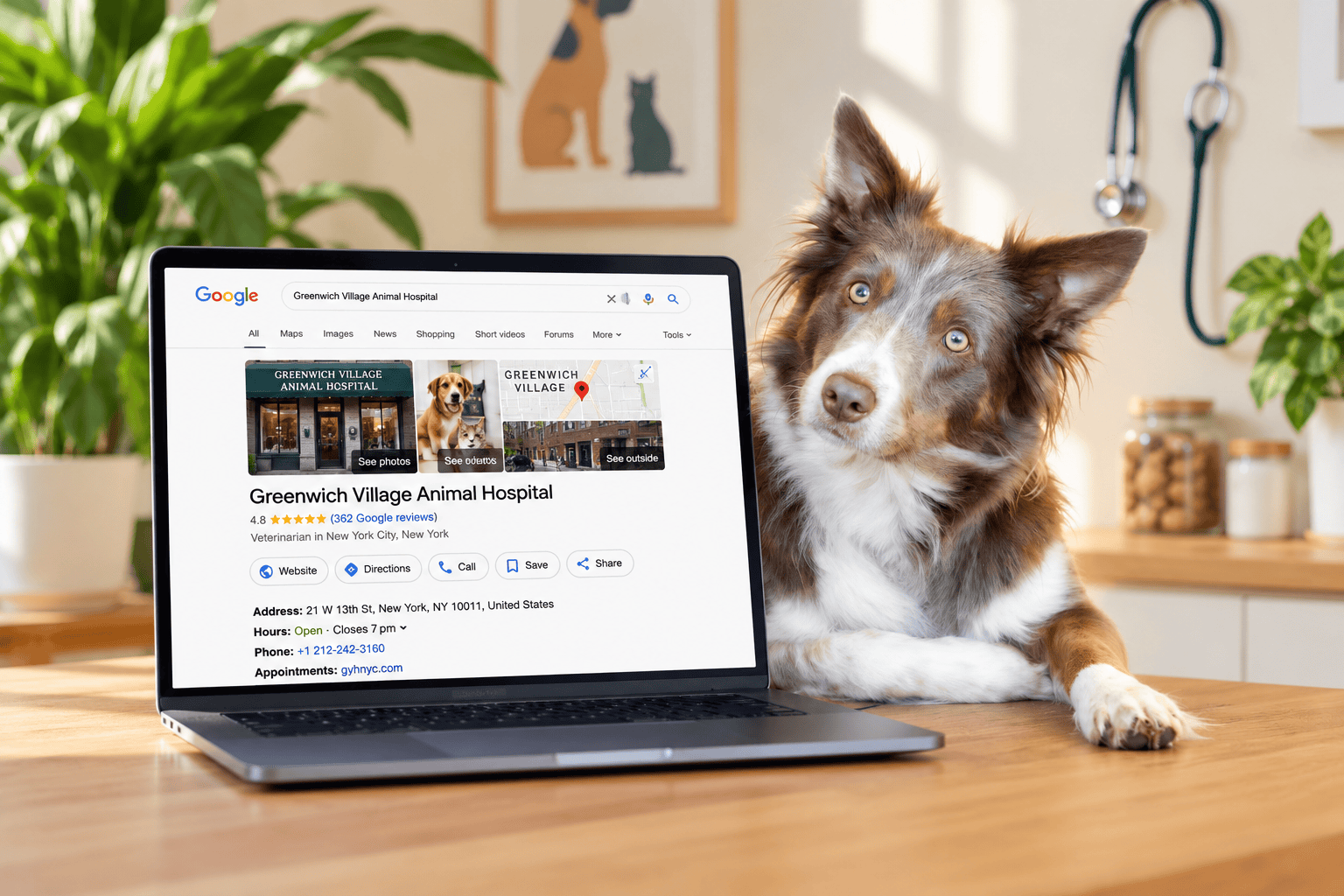
A complete Google Business Profile is what makes a practice visible in local map results at all. According to Google’s Business Profile Help Center, customers are 2.7 times more likely to consider a business reputable when its profile is complete, and 70% more likely to visit it.
Consistent name, address, and phone details across directories support those rankings. A practice that has moved, changed its number, or added a second location should audit every listing, because conflicting details weaken the trust signals search engines rely on.
Why Is Client Retention So Important in Veterinary Marketing?
Client retention is important because a client who returns for years is worth far more than one who visits once, and winning a replacement costs more than keeping the original. Retention is where most of a practice’s marketing return is earned.
The risk of losing clients is measurable. According to AVMA News (2023), practice revenue rose 5.7% between August 2021 and August 2023 while client visits fell 2.7%, and the number of lapsing patients, those unseen for 14 to 18 months, rose significantly per practice.
Automated reminders are the main defense. Vaccine due dates, annual wellness exams, and dental checks can each trigger a text or email, and a short welcome sequence after the first visit sets up the second, using the same lifecycle approach behind effective email marketing.
How Do You Measure the Return on Veterinary Marketing?
The return on veterinary marketing is measured by comparing the cost of winning a new client with what that client spends over the years they stay. When client value sits well above acquisition cost, the marketing is paying for itself.
Cost per new client is total monthly marketing spend divided by the new clients that spend brought in. A practice spending $2,000 a month that gains 10 new clients has a cost per new client of $200.
Client value depends on visit frequency and tenure. VetSource data presented by the AVMA puts the average patient at 2.39 visits per year, so at an illustrative average invoice of $200, a client generates about $478 a year and roughly $2,390 over an illustrative five-year relationship. Each practice should replace those illustrative inputs with its own invoice and retention data.
| Metric | How to calculate it | What it tells you |
|---|---|---|
| Cost per new client | Monthly marketing spend divided by new clients that month | Whether acquisition spend is efficient |
| Annual client value | Visits per year multiplied by average invoice | What one active client is worth each year |
| Lapsed patient count | Patients with no visit in 14 to 18 months | Whether retention is slipping |
| Booking conversion rate | Booked appointments divided by calls and booking-page visits | Whether demand is lost at the booking step |
A practice that loses clients after one or two visits never reaches the multi-year value. That gap is why retention metrics belong in the same report as acquisition metrics.
What Marketing Channels Work Best for Veterinary Practices?

The channels that work best for veterinary practices are local SEO, reviews, social media, and email. Each plays a distinct role, with search and reviews driving acquisition and email driving retention.
| Channel | Primary role | Stage |
|---|---|---|
| Local SEO and Google Business Profile | Getting found in “vet near me” searches | Acquisition |
| Reviews and reputation | Winning the call and building trust | Acquisition |
| Social media | Showing the team, educating owners, building familiarity | Acquisition and retention |
| Email and reminders | Preventive-care visits and reactivating lapsed clients | Retention |
Social media suits veterinary practices because pet content is easy to share and shows the people behind the clinic. In our pet marketing work, social content performs best when it features doctors and the clinic itself rather than promotions alone.
Paid campaigns can speed up results when they’re tightly targeted. When Creative For More ran the relaunch of Gentle Oak Veterinary Clinic in Singapore, Meta lead ads targeted pet owners within 6km of the clinic and Google Search ads covered preventive-care terms. Engagement on boosted content and reels grew threefold, and cost per lead dropped.
What Common Mistakes Slow Veterinary Practices Down?
The most common mistake is treating marketing as occasional advertising rather than a steady system. Practices that post sporadically and run one-off promotions rarely build the local visibility that compounds over time.
- Running marketing in bursts. Local rankings and review profiles grow from consistent activity, so long gaps undo earlier progress.
- Leaving reviews unanswered. Replying to every review, positive or negative, shows prospective clients how the practice handles concerns.
- Letting client data sit idle. A practice that never sends reminders or contacts lapsed clients leaves retention to chance.
- Measuring the wrong numbers. Follower counts and likes don’t show whether marketing pays for itself, while cost per new client and lapsed patient counts do.
How Is AI Search Changing Veterinary Marketing?

AI search is adding a new step to how pet owners research local services, sitting alongside traditional search and review sites. Practices with clear, well-structured website content are more likely to appear in AI-generated answers.
Adoption is already significant. BrightLocal’s 2026 survey found that 45% of consumers now use ChatGPT and similar generative AI tools for local business recommendations.
The practical response is content that answers common owner questions directly, such as what a wellness exam includes, how often a senior dog needs bloodwork, or what counts as an emergency. That structured, answer-first approach is the focus of generative engine optimisation, and it supports traditional search rankings at the same time.
If you run a veterinary practice and want a marketing system that wins local search and keeps clients coming back, the Creative For More team can help. Book a discovery call to explore how we can support your brand’s growth.
Read More

Geraldine Pang
Creative For More
Geraldine Pang is the founder of Creative For More, a cross-border digital marketing agency with offices in Singapore, Tokyo, and New York. She specializes in brand strategy, market entry, and cross-border marketing across Southeast Asia, Japan, and the United States.