
Asia vs U.S. Marketing: Key Differences Every Startup Should Know Before Expanding
Asia vs U.S. Marketing: Key Differences Every Startup Should Know Before Expanding
What founders and startup teams must understand before taking their brand from the U.S. into Asia.
Expanding from the U.S. into Asia can unlock massive growth for startups—but only if marketing strategies evolve along with geography. Many early-stage companies struggle not because their product lacks demand, but because they apply U.S.-centric marketing assumptions to markets that operate very differently.
Asia is not a “faster-growing version” of the U.S. market. It has distinct cultural norms, platform ecosystems, buying behaviors, and trust dynamics that startups must understand before launching.
This guide breaks down the key differences between Asia and U.S. marketing every startup should know before expanding.
1. Asia Is Not One Market—The U.S. Largely Is
The U.S. functions as a largely unified market. One language dominates, cultural references are shared nationwide, and campaigns scale efficiently across states. A single creative direction can often perform well across the country with minor adjustments.
Asia works differently. Each country operates as its own market, with distinct languages, social norms, and platform preferences. Singapore, Indonesia, Thailand, and Japan may sit in the same region on a map, yet they require separate strategies, creative styles, and channel choices. A campaign that performs well in Indonesia may fall flat in Japan without clear reasons on the surface.
For startups, scaling in Asia means repeating localization across markets rather than replicating a single winning playbook.
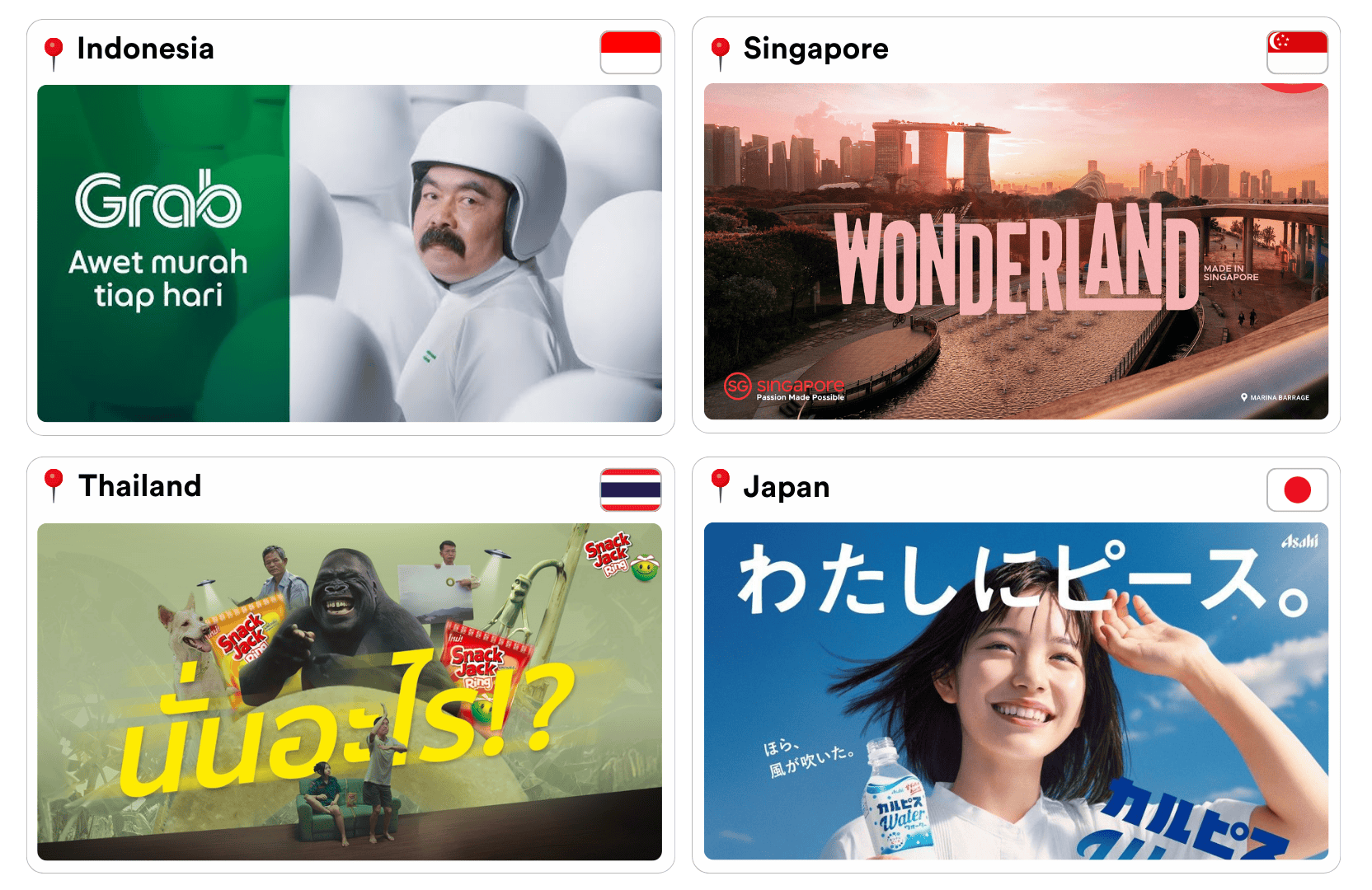
Startup takeaway: Growth in Asia comes from country-by-country execution, not regional shortcuts.
2. Trust Is Built Differently in Asia
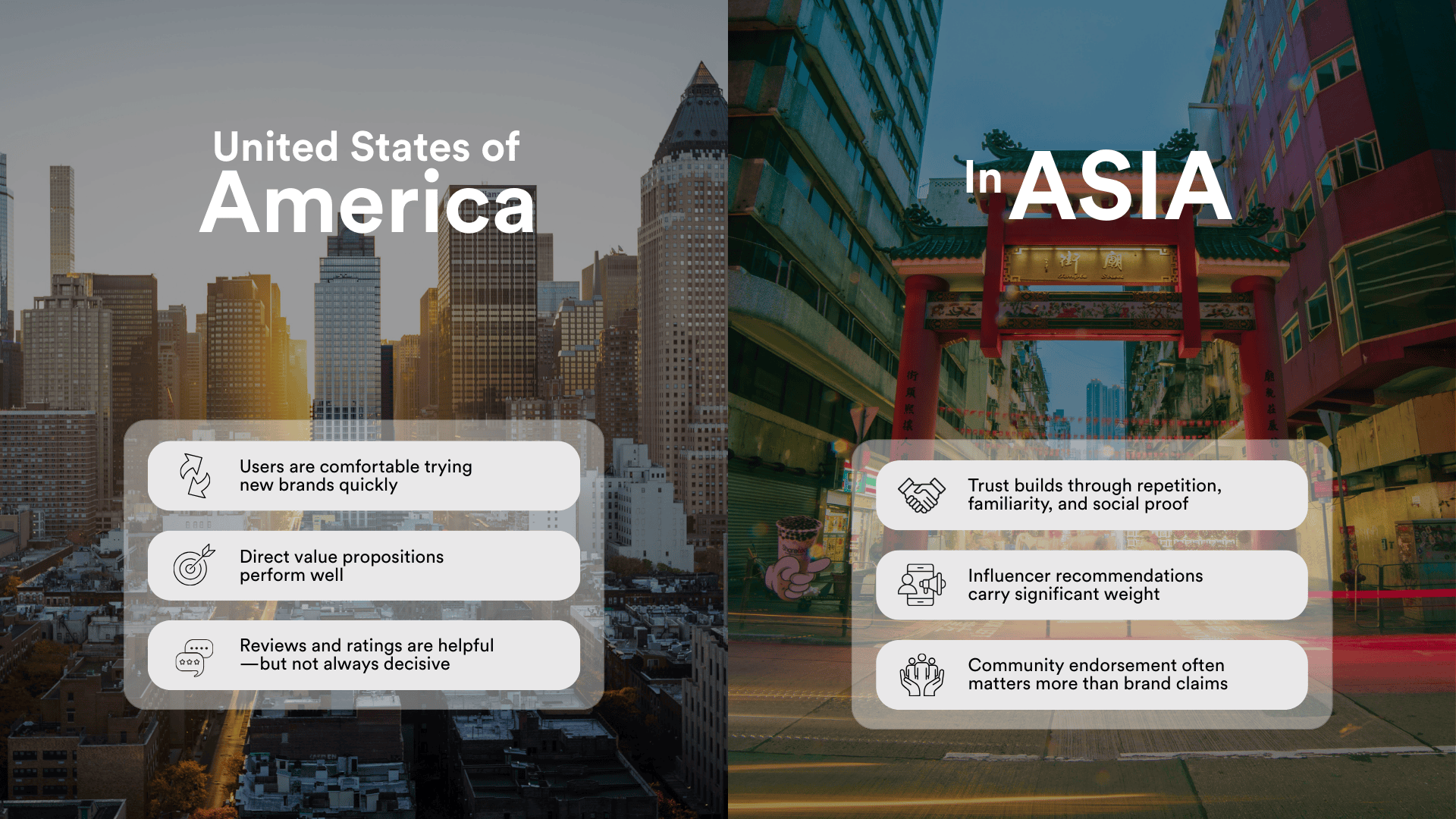
| Aspect | United States of America | Asia |
|---|---|---|
| Openness to New Brands | Users are comfortable trying new brands quickly | Trust builds through repetition and familiarity |
| Primary Decision Drivers | Direct value propositions perform well | Social proof and repeated exposure matter more |
| Role of Reviews | Reviews and ratings are helpful but not always decisive | Influencer recommendations carry significant weight |
| Influence of Community | Individual decision-making is more common | Community endorsement often outweighs brand claims |
| Trust-Building Mechanism | Clear benefits and convenience | Familiarity, social validation, and peer influence |
U.S. startup marketing often favors speed. Direct value propositions, aggressive calls to action, and rapid experimentation tend to perform well. Users show comfort testing new brands quickly, especially when pricing or features stand out.
Across many Asian markets, trust develops through familiarity. Repeated exposure, social proof, and third-party validation carry significant weight. Influencer recommendations, community feedback, and peer endorsement frequently drive decisions more than brand-led claims.
This explains the strength of creator-led content, social commerce, and long-term brand presence across Asia.
Startup takeaway: Credibility comes first in many Asian markets, with performance following later.
3. Platform Ecosystems Work Very Differently

In the U.S., a familiar stack dominates. Google handles search intent, Meta and TikTok manage paid social, YouTube supports long-form discovery, and e-commerce often sits on separate platforms.
Asia operates through fragmented platform ecosystems. Platform dominance shifts by country, and social, messaging, and commerce blend into a single user journey. Discovery, conversation, and purchase often happen inside the same app.
TikTok Shop drives commerce across Southeast Asia. LINE supports CRM, promotions, and customer communication in Japan. Shopee and Lazada act as both marketplaces and paid media channels.
Startup takeaway: U.S. channel mixes rarely translate directly. Platform planning must be rebuilt for each market.
4. Marketing Is More Community-Driven in Asia

U.S. marketing often speaks to the individual. Messaging highlights personal gain, speed, and efficiency. Purchase decisions lean heavily on personal preference.
Many Asian consumers make decisions through group influence. Family, friends, colleagues, and online communities shape trust and validation. Messaging that reflects shared value, collective benefit, or social belonging tends to outperform purely individual-focused narratives.
Startup takeaway: Messaging in Asia works best when it reflects shared outcomes, not just personal wins.
5. Content Tone and Storytelling Must Change
U.S. startup content often leans bold, disruptive, and urgent. Clear differentiation and strong calls to action take priority.
In Asia, tone varies widely by country. Thai audiences respond strongly to emotional, story-driven content. Japanese audiences favor clarity, structure, and subtle delivery. Southeast Asian markets show high engagement with relatable, creator-driven storytelling.
Translation alone rarely works. Story structure, pacing, and emotional cues must change.
Startup takeaway: Content requires cultural adaptation, not word-for-word translation.
6. Mobile-First Is Not a Trend in Asia—It’s the Default

| Aspect | United States of America | Asia |
|---|---|---|
| Primary Device Usage | Mixed desktop and mobile usage | Mobile-first or mobile-only behavior |
| Role of Desktop | Desktop is still commonly used for research and purchases | Desktop usage is minimal or secondary |
| Social Media Usage | Often accessed across devices | Social, commerce, and messaging all happen on mobile |
| E-commerce Behavior | Users frequently browse on desktop and purchase later | Shopping, discovery, and checkout happen within mobile apps |
| Content Format Dominance | Horizontal and static formats still relevant | Vertical video dominates user attention |
| User Attention Patterns | Longer consideration cycles | Fast-scrolling, real-time engagement |
Desktop usage still plays a meaningful role in the U.S., especially for research-heavy purchases. Mobile supports discovery, with desktop often closing the sale.
Across much of Asia, mobile dominates the full journey. Social discovery, shopping, payment, and customer service all happen on phones. Vertical video leads attention, and friction shows quickly when experiences feel desktop-first.
Startup takeaway: Asia highlights weaknesses in mobile experience fast.
7. Speed vs Precision: Different Growth Expectations
U.S. startups often favor rapid testing and iteration. Early traction metrics carry strong weight.
Asia expansion often calls for patience. Markets like Japan reward consistency and quality over fast experimentation. Southeast Asia values agility, though cultural misalignment still leads to wasted spend.
Startups that balance measured speed with cultural accuracy reduce long-term costs.
Startup takeaway: Asia rewards thoughtful execution over rushed rollout.
8. How Creative For More Helps Startups Bridge the Gap
At Creative For More U.S.A., we help startups navigate the differences between U.S. and Asia marketing with a structured, cross-border approach.
Our support includes:
- Market prioritization and entry strategy
- Brand localization and messaging adaptation
- Platform and channel planning by country
- Influencer and creator strategy
- Ongoing campaign optimization
With teams in New York, Singapore, and Tokyo, we bridge U.S. startup thinking with on-the-ground Asia execution—so growth feels intentional, not experimental.
Conclusion: Asia Expansion Requires a New Marketing Mindset

Expanding into Asia isn’t about doing more marketing—it’s about doing different marketing.
Startups that succeed understand that:
- Asia is not one market
- Trust precedes conversion
- Platforms shape behavior differently
- Community matters more than hype
- Localization is a growth lever, not a cost
Creative For More U.S.A. helps startups rethink marketing for Asia—so expansion is strategic, culturally aligned, and built to scale. If Asia is on your roadmap, understanding these differences is the most important first step. If you’d like to learn more, book a discovery call with our team today!
Further Reading
Explore more guides for U.S. brands expanding into Asia:
- How to Localize Your Brand for Asian Audiences: A U.S. Founder’s Guide
- The Most Effective Social Media Platforms for Brand Marketing in Asia
- Top E-Commerce Channels in Southeast Asia for U.S. Brands
- How Western Brands Successfully Adapt Their Marketing for Asian Audiences
- Cultural Factors U.S. Brands Must Understand Before Marketing in Asia
- Influencer Marketing in Asia: The Complete Guide for U.S. Brands
- Common Mistakes U.S. Companies Make When Launching in Asia
- How to Build a Marketing Budget for Your Asia Expansion
- How to Choose a Brand Marketing Agency for Asia Expansion
- Asia vs. U.S. Marketing: Key Differences Every Startup Should Know
- What U.S. Founders Misunderstand About Southeast Asia
- The Rise of TikTok Shop in Southeast Asia: What U.S. Brands Should Prepare For
- How to Validate Product-Market Fit in Southeast Asia Before You Launch
- A Guide to Cross-Border Brand Localization for Global Growth
- How to Launch in Asia Without a Local Team

Geraldine Pang
Creative For More
Geraldine Pang is the founder of Creative For More, a cross-border digital marketing agency with offices in Singapore, Tokyo, and New York. She specializes in brand strategy, market entry, and cross-border marketing across Southeast Asia, Japan, and the United States.