
Google Ads International Expansion: How to Set Up Google Ads and Meta Ads for New Markets
Google Ads International Expansion: How to Set Up Google Ads and Meta Ads for New Markets
Google Ads international expansion works best as an eight-step setup: pick an account structure by currency, set location and language targeting per market, localize keywords and ads, split Shopping feeds by country, configure Meta country targeting and languages, fix consent-aware measurement, check local ad rules, and launch in one or two markets first. Currency and time zone are permanent in a Google Ads account, so structure comes before everything else.
Most international paid media problems start in setup, not in bidding. A brand that copies its home-market campaigns into a new country usually inherits the wrong currency, the wrong targeting defaults and measurement that breaks under local consent rules. Those errors are slow to spot because the campaigns still spend.
The steps below follow the order we use when we plan cross-border campaigns from our offices in Singapore, Tokyo and New York. Each step draws on current Google Ads Help, Merchant Center and Meta developer documentation, because platform settings and their names change often.
How Should You Structure Google Ads Accounts for Multiple Countries?
Most brands should use one Google Ads account per billing currency, with separate campaigns for each country inside it. Brands with very different markets, budgets or local teams often add separate accounts under a manager account.
Currency drives the decision because it can’t be changed later. According to Google Ads Help (2026), an account’s currency and time zone are permanently set when the account is created. A US brand billing in USD can run campaigns in Japan, but reporting will stay in USD and day boundaries will follow the US time zone.
| Structure | Best for | Currency and billing | Main drawback |
|---|---|---|---|
| One account, campaigns per country | Two to four markets with one central team | One currency and one invoice | Reports and schedules follow one time zone |
| Separate account per country | Large markets with local budgets or local entities | Local currency and local invoicing | More setup, more audiences to rebuild |
| Manager account over regional accounts | Brands grouping markets by currency or region | One account per currency group | Needs strict naming and reporting rules |
Whichever structure is chosen, campaign names should carry country, language and campaign type. A name like “JP_JA_Search_Brand” keeps cross-market reporting readable when several people manage the account.
Which Google Ads Location Targeting Setting Should International Campaigns Use?
International campaigns should use “Presence” when only people physically in a country can buy, and “Presence or interest” when people elsewhere can also convert. Google sets “Presence or interest” as the default for most campaigns, so the choice has to be made deliberately.
According to Google Ads Help (2026), “Presence” reaches people who are in, or regularly in, the targeted locations, while “Presence or interest” also includes people who have shown interest in them. Exclusions now always use “Presence,” and the older search-interest-only option can no longer be set on Search, Display or Shopping campaigns.
The difference matters most for retailers with country-specific shipping. A Singapore skincare brand selling only to Japanese addresses gains little from clicks by people in Seoul researching Tokyo. A hotel or a university recruiting students, by contrast, benefits from reaching people abroad who are interested in the destination.
How Does Google Ads Language Targeting Work Across Markets?
Google Ads now matches Search ads mainly on the language of the search and the ad, not on a campaign setting alone. Writing ads in each market’s main language is therefore the most reliable way to control who sees them.
According to Google Ads Help (2026), Google reads the search term language, the user’s language settings and other preferences to decide which languages a person understands. The same page states that the campaign-level language setting for Search campaigns is being removed, with Search ads matched on the language of the ad instead. Display, YouTube and other Performance Max channels still follow the language settings the advertiser chooses.
Multilingual markets need separate ad groups or campaigns per language. Singapore searches run in English and Chinese, and many Japan campaigns need English ads for expatriate and business audiences alongside Japanese ones.
Should You Translate or Transcreate Keywords and Ads?
Keywords should be researched fresh in each market, and ad copy should be transcreated rather than translated word for word. Direct translation tends to miss the terms local buyers actually type.
Search behavior differs even inside one language. Japanese searchers mix kanji, katakana and English loanwords for the same product, and American and British English use different terms for many categories. A keyword list built from translated home-market terms usually misses high-volume local phrases and includes terms nobody searches.
Ads also need local assets. Sitelinks should point to localized pages, callouts should show local delivery terms, and prices should appear in local currency with the correct tax treatment. Our search engine marketing team builds these per market because a single global asset set rarely fits every country.
How Do You Set Up Google Shopping Campaigns in Multiple Countries?
Shopping campaigns in new countries need each target country added in Merchant Center, product data in the local language, and prices and shipping in a matching currency. Countries that share a language can reuse one product data source.
According to Google Merchant Center Help (2026), merchants can add countries to an existing data source when those countries share its language, and Google offers automatic currency conversion when local prices aren’t available. The same page warns that landing pages must not switch language or currency automatically based on a visitor’s location.
Currency conversion carries a tax rule that catches many exporters. Merchant Center Help states that a merchant using converted prices must follow the price and tax rules of the country whose currency is used. For larger markets, a dedicated local-currency feed and storefront is usually cleaner.
How Do You Target Multiple Countries With Meta Ads?

Meta ads can target several countries in one ad set, but markets with different languages, prices or margins usually perform better in separate ad sets or campaigns. Separate ad sets keep spend from flowing to the cheapest country by default.
Meta’s delivery system tends to push budget toward the lowest-cost results. In a combined ad set covering Singapore, Malaysia and the Philippines, spend often concentrates in the market with the lowest cost per result, which may not be the market with the highest order value.
How Does Advantage+ Audience Handle Country Targeting?
Advantage+ audience treats location as a fixed limit and expands other targeting inputs. Brands can rely on it to stay inside the chosen countries while it finds people beyond the suggested interests.
Meta’s Marketing API documentation lists location, minimum age, language and custom audience exclusions as constraints that Advantage+ audience does not expand. This makes country-level control safe to keep even when the rest of the targeting is broad.
How Do Multi-Language Ads Work on Meta?
Meta lets one ad carry several language versions and shows each person the version that matches their language. A default version covers viewers whose language isn’t in the set.
Meta’s developer documentation for Multi-Language Ads describes a default rule that serves people whose locale matches none of the provided languages. Meta also tests automatic translation of ad text under Advantage+ creative, but machine translation should be reviewed by a native speaker before it runs in a market like Japan.
What Account Setup Does Meta Require Before Launch?
Meta ads for new markets should run from a verified business portfolio, with Facebook and Instagram accounts linked through Accounts Center. Verification and clean account ownership reduce the risk of restrictions after launch.
Like Google, a Meta ad account carries a currency and time zone, so many brands open one ad account per billing currency. Pages, Instagram accounts, pixels and catalogs should sit in the brand’s own business portfolio rather than an agency’s, which keeps ownership clear if partners change.
How Should You Measure Conversions Across Countries?
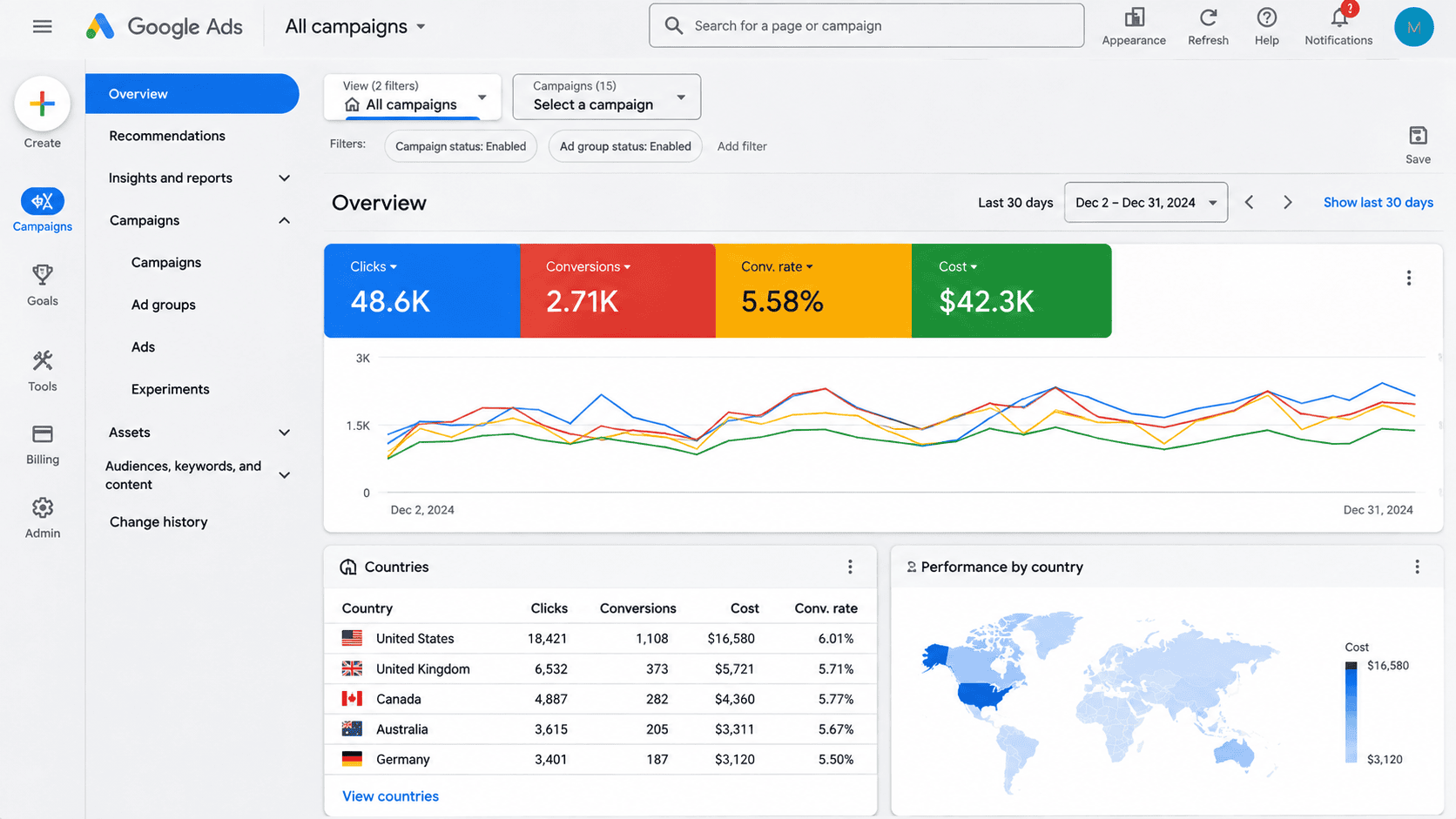
Cross-border measurement needs the Google tag with consent mode, the Meta Pixel paired with the Conversions API, and a consent banner that follows each market’s privacy law. Without all three, conversion data will be incomplete in the strictest markets.
According to Google Ads Help (2026), consent mode passes users’ cookie consent choices to Google tags, which then adjust their behavior. The same page notes that consent mode doesn’t provide a banner itself, so a consent management platform is still required.
On Meta, the Conversions API sends events from the server, which recovers conversions lost to browser restrictions. According to Meta for Developers (2026), Meta recommends running the Conversions API alongside the Pixel and deduplicates events when their event name and event ID match.
| Market | Main privacy law | What it means for ad tracking |
|---|---|---|
| EU and UK | GDPR and UK GDPR | Opt-in consent before ad cookies; consent signals passed to Google and Meta |
| Singapore | Personal Data Protection Act (PDPA) | Consent and notification of purpose for collecting personal data |
| Japan | APPI and the Telecommunications Business Act | Rules on third-party data transfers and on disclosing data sent out through tags |
| United States | State laws such as California’s CCPA | Opt-out rights for the sale or sharing of personal data |
This table is a starting point, not legal advice. Each brand should confirm its obligations with local counsel before launch, especially when collecting health or financial data.
Which Ad Policies and Local Rules Change by Country?
Google and Meta policies for categories such as healthcare, alcohol, financial services and gambling vary by country, and local advertising laws add another layer. A campaign approved in one market can be disapproved or unlawful in the next.
Japan is a common example. Claims for cosmetics, supplements and health products are restricted under the Pharmaceutical and Medical Device Act, and Japan’s rules on undisclosed sponsored content have applied since October 2023. Search ads on Yahoo! JAPAN are bought through LINE Yahoo Ads, a separate platform with its own editorial review.
Singapore’s medical and aesthetic clinics face similar limits on testimonials and claims. A pre-launch check of each platform’s country-specific policy pages and local rules usually costs less than relaunching after disapprovals.
How Many Markets Should You Launch First, and How Should You Budget?
Most brands should launch paid media in one or two markets first and set separate KPIs for each. A focused start produces clean data before budget spreads across countries.
Google’s Market Finder tool, still available in October 2026, can help shortlist countries before any spend. A practical testing order looks like this:
- Launch branded and high-intent Search campaigns in the first market.
- Add Shopping or Performance Max once the product feed and measurement are stable.
- Run Meta prospecting with two or three localized creative concepts per market.
- Set per-market targets for cost per acquisition, return on ad spend and conversion rate.
- Expand to the next market only after the first one meets its targets for a full buying cycle.
Targets should reflect each market’s economics rather than home-market averages. Our Asia ecommerce benchmarks show how conversion rates and order values differ by country, and our media buying team uses that kind of data to set budgets market by market.
If you’re planning to run Google Ads and Meta Ads across the US and Asia and want one team to set up accounts, tracking and localized campaigns, we can map the first markets with you. If your company is looking for a strategic marketing partner, the Creative For More team can help. Book a discovery call to explore how we can support your brand’s growth.
Read More
- How to Choose a Paid Media Agency for Campaigns Across the US and Asia
- How to Choose a Performance Marketing Agency for Cross-Border Expansion
- How to Choose a Google Ads Agency in Singapore: What to Check Before You Sign
- How to Choose an Agency for a Multi-Country Website and Paid Media
- Paid Social Media Advertising in Singapore: What Brands Need to Know Before Spending

Geraldine Pang
Creative For More
Geraldine Pang is the founder of Creative For More, a cross-border digital marketing agency with offices in Singapore, Tokyo, and New York. She specializes in brand strategy, market entry, and cross-border marketing across Southeast Asia, Japan, and the United States.