

How U.S. Brands Can Successfully Enter the Southeast Asian Market
How U.S. Brands Can Successfully Enter the Southeast Asian Market
If you’re a U.S. brand or startup contemplating Southeast Asia, this piece gets straight into how you can make it work—step by step. We’ll walk you through what readiness looks like, how to localise effectively, and how to test campaigns with agility. No fluffy generic “go global” advice—just practical guidance you can act on.
1. Assess Readiness: Before You Book the One-Way Ticket

Firstly, you need to ask: Are we truly ready?
- Define your market ambition: Which country or countries in Southeast Asia? Each has its own ecosystem, so don’t treat the region as a monolith. (Market Research S.E.A)
- Perform a market audit: Size, growth prospects, digital adoption, competition, regulatory environment. Understanding this is central to any Southeast Asia market entry consulting-oriented strategy. (SIS International Research)
- Decide on your entry model: Will you start with exports, a local distributor, a joint venture, or a fully-owned entity? The choice has big cost, control and risk implications. (People Development Magazine)
- Evaluate internal readiness: Do you have the team, budget, localisation mindset and digital infrastructure to move fast and adjust when needed?
2. Choose Your Target(s) & Localisation Strategy
Once you’re confident on readiness, the next step is picking your initial target market(s) and gearing up for localisation.
- Pick one or two markets to start. For many U.S. brands, markets like Singapore serve as an excellent launchpad due to their robust infrastructure and suitability for testing. (Incite)
- Develop your localisation plan: Adapt not just language, but brand tone, pricing, payment methods, logistics, visuals. For example: platforms used in the U.S. may be less relevant; mobile-first, social-first behaviours might dominate in Southeast Asia. (AccelerAsia)
- Build local partnerships: A trusted local partner or distributor can provide on-ground insight, connections and credibility. Especially useful when you’re early in the region.
- Prepare your go-to-market strategy: With your target defined and localisation in place, define your channel mix, digital vs offline, key performance indicators (KPIs), budget and launch timeline.
3. Test, Learn, Iterate: The Go-To-Market Execution
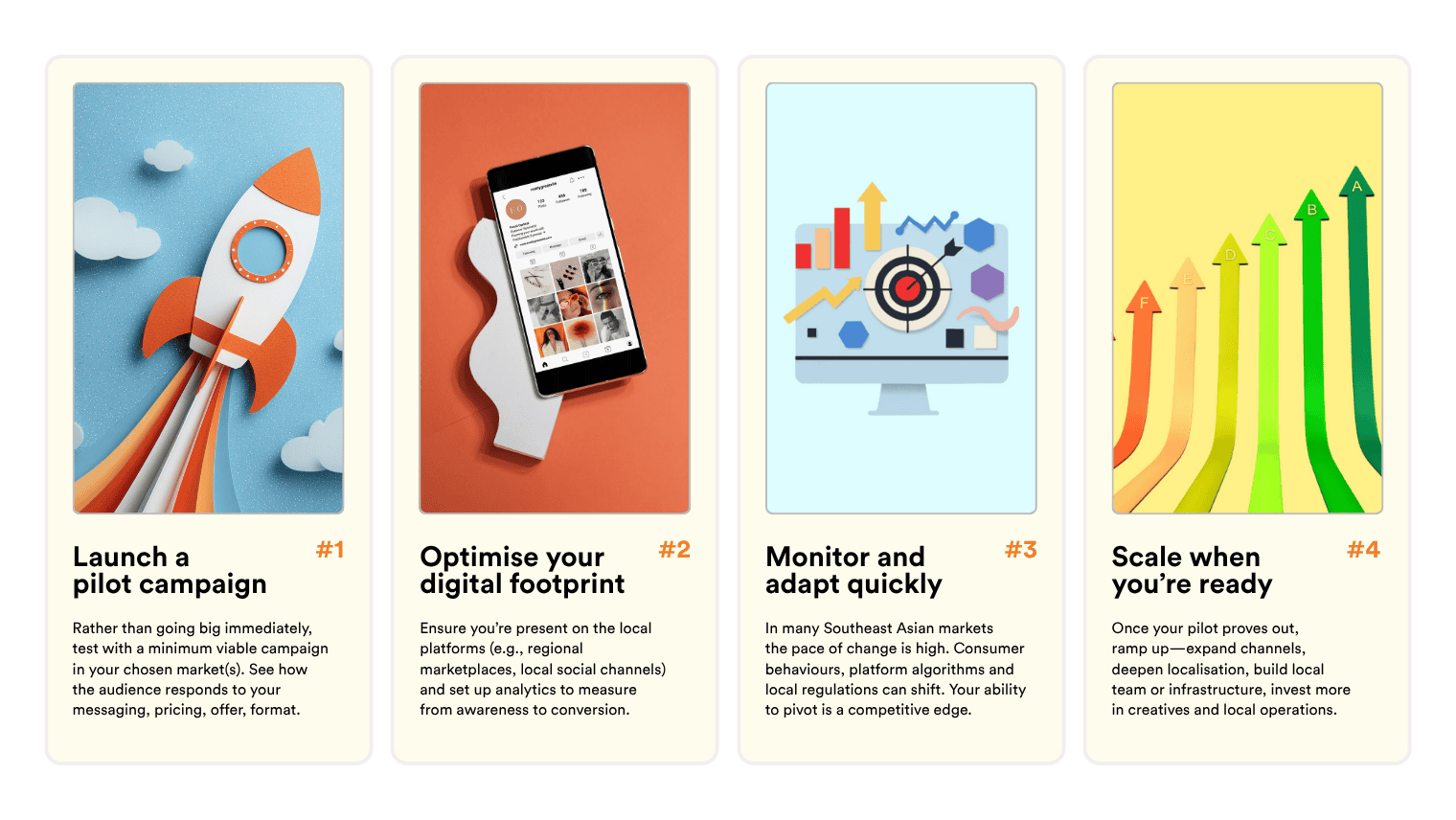
Now you’re ready to execute—but remember: entry into Southeast Asia demands agility and a test-and-learn mindset.
- Launch a pilot campaign: Rather than going big immediately, test with a minimum viable campaign in your chosen market(s). See how the audience responds to your messaging, pricing, offer, format.
- Optimise your digital footprint: Ensure you’re present on the local platforms (e.g., regional marketplaces, local social channels) and set up analytics to measure from awareness to conversion.
- Monitor and adapt quickly: In many Southeast Asian markets the pace of change is high. Consumer behaviours, platform algorithms and local regulations can shift. Your ability to pivot is a competitive edge.
- Scale when you’re ready: Once your pilot proves out, ramp up—expand channels, deepen localisation, build local team or infrastructure, invest more in creatives and local operations.
4. Infrastructure, Compliance & Ops: The Foundation

Don’t underestimate the “boring” stuff. Your marketing will only succeed if the foundation is solid.
- Legal & regulatory compliance: Foreign investment rules, entity set-up, employment and tax – these vary across countries in Southeast Asia and ignoring them is risky.
- Local logistics, payments & fulfilment: Especially for consumer brands, your ability to deliver, accept local payment methods and provide customer service is key.
- Local talent & culture: Hire or partner with local teams who understand the market nuances. Western marketing instincts may misfire if not adapted. (Inc.com)
- Continuous learning: Set up feedback loops so you can incorporate local insights into your creative, messaging and operations.
5. Measurement & Iteration: Your Growth Loop

Your success isn’t just launch, it’s ongoing optimisation.
- Define clear metrics: Awareness (reach, impressions), engagement (click-throughs, time), conversions (sales, leads), and longer-term brand health (repeat purchase, referrals).
- Compare across markets: For each market you enter, track which tactics are working and which aren’t. Use that insight to refine before expanding further.
- Maintain localised content cadence: Local consumer behaviours and digital trends evolve rapidly in SEA—fresh content and culturally attuned campaigns matter.
- Plan for scale: Ensure your budget, team, and technology stack allow for scaling once you’ve identified winning tactics.
In Summary
Entering Southeast Asia is a high-opportunity move for U.S. brands—but only if done with discipline, local insight and strategic execution. With the right Southeast Asia market entry consulting approach, a robust go-to-market strategy from New York, and a localisation-first mindset supported by an international marketing agency New York, your brand can position itself to win in the region.
Let’s talk about how your brand can get this right—step by step.
Further Reading
Explore more guides for U.S. brands expanding into Asia:
- How to Localize Your Brand for Asian Audiences: A U.S. Founder’s Guide
- The Most Effective Social Media Platforms for Brand Marketing in Asia
- Top E-Commerce Channels in Southeast Asia for U.S. Brands
- How Western Brands Successfully Adapt Their Marketing for Asian Audiences
- Cultural Factors U.S. Brands Must Understand Before Marketing in Asia
- Influencer Marketing in Asia: The Complete Guide for U.S. Brands
- Common Mistakes U.S. Companies Make When Launching in Asia
- How to Build a Marketing Budget for Your Asia Expansion
- How to Choose a Brand Marketing Agency for Asia Expansion
- Asia vs. U.S. Marketing: Key Differences Every Startup Should Know
- What U.S. Founders Misunderstand About Southeast Asia
- The Rise of TikTok Shop in Southeast Asia: What U.S. Brands Should Prepare For
- How to Validate Product-Market Fit in Southeast Asia Before You Launch
- A Guide to Cross-Border Brand Localization for Global Growth
- How to Launch in Asia Without a Local Team

Geraldine Pang
Creative For More
Geraldine Pang is the founder of Creative For More, a cross-border digital marketing agency with offices in Singapore, Tokyo, and New York. She specializes in brand strategy, market entry, and cross-border marketing across Southeast Asia, Japan, and the United States.