

What Marketing Channels Work Best for Medical and Aesthetic Clinics in Singapore?
What Marketing Channels Work Best for Medical and Aesthetic Clinics in Singapore?
The channel question for Singapore medical and aesthetic clinics is not simply which channels produce the most patient inquiries. It is which channels produce the right patient inquiries, at what cost, within Singapore’s HCSA and SMC ECEG compliance framework, and in the right sequence for the practice’s current stage of development. A channel that produces 200 inquiries per month from patients whose clinical profile does not match the practice’s specialty is producing activity, not revenue. A channel that produces 30 highly specific inquiries from patients actively researching the exact treatment category the practice offers is producing commercial outcomes.
Singapore’s private clinic market has over 1,800 GP clinics and a growing number of specialist and aesthetic centres, according to Terris Digital’s Singapore healthcare marketing analysis. Patients are no longer booking appointments without prior research: most now search symptoms online, compare clinics, read reviews, and assess a provider’s digital presence before making a decision, according to Fiture Health’s 2026 Singapore healthcare digital marketing guide. The channel that is present at the right moment of that research journey is the channel that earns the consultation booking.
This article covers the five primary digital marketing channels available to Singapore medical and aesthetic clinics, their specific performance characteristics, compliance considerations, and how they fit together into a coherent patient acquisition and retention system.
How Do the Five Channels Compare Across the Dimensions That Matter?
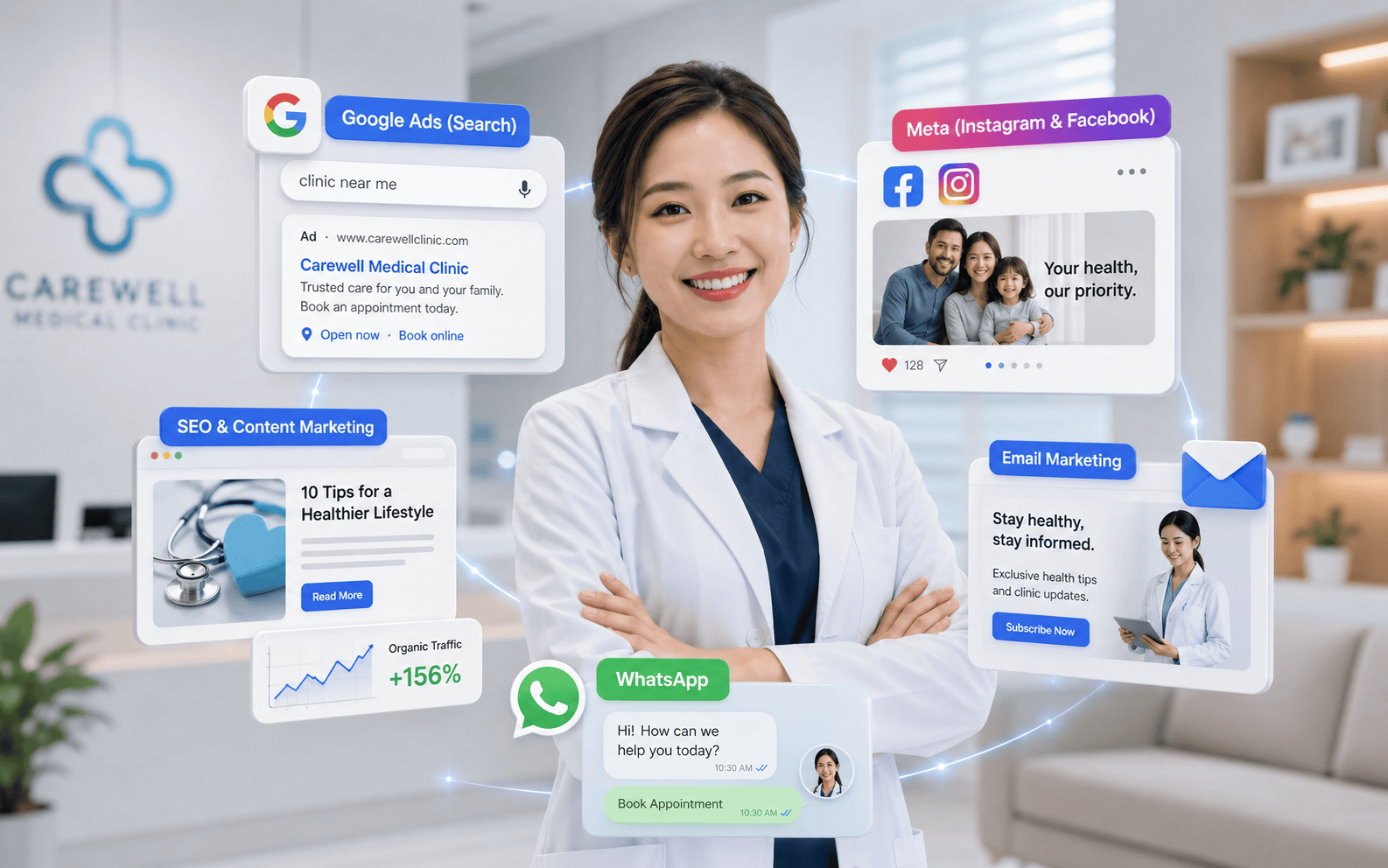
The comparison table below evaluates Google Ads, Meta, SEO, email, and WhatsApp across the dimensions that determine each channel’s commercial value for a Singapore medical or aesthetic clinic. The ratings reflect typical performance for a well-managed program in each channel, not theoretical maximums.
| Channel | Patient Intent Level | Speed to First Result | Cost Structure | Compliance Complexity | Best For | Weakest For |
|---|---|---|---|---|---|---|
| Google Ads (Search) | Very high: patient is actively searching | Fast: 2 to 4 weeks to first bookings | Pay-per-click; SGD 1.50 to 15+ per click depending on specialty | Medium: outcome-based keywords prohibited; copy must be factual | New patient acquisition, specialty keyword capture, immediate volume | Brand building, trust development, retention |
| Meta (Instagram and Facebook) | Low to medium: patient is browsing, not necessarily searching | Medium: 4 to 8 weeks for meaningful engagement data | CPM or CPL; CTR 0.8% to 1.8% for feed placements in Singapore | High: before-and-after prohibited, outcome claims prohibited, testimonials restricted | Doctor authority content, educational trust building, brand awareness | High-intent immediate acquisition, older patient demographics |
| SEO and content marketing | Variable: high for transactional queries, medium for informational | Slow: 3 to 6 months for ranking improvements | Fixed monthly investment; compounding return over time | Medium: E-E-A-T requirements mean content must demonstrate genuine medical expertise | Long-term patient acquisition, authority building, educational trust, AI search visibility | Immediate patient volume, new clinic with no domain authority |
| Email marketing | Very high for existing patients: opt-in, known relationship | Immediate: first campaign results within days | Very low; platform cost SGD 200 to 500 per month | Low: PDPA consent required; same content standards as other channels | Patient reactivation, recall, existing patient upsell, retention | New patient acquisition, brand discovery |
| Very high: direct opted-in patient relationship | Immediate: message delivery is instant | Very low; WhatsApp Business API cost for larger volumes | Low to medium: PDPA consent required; same content standards; no promotional pressure | Appointment reminders, existing patient communication, recall, post-appointment follow-up | New patient acquisition, cold audience reach |
Google Ads: The Highest-Intent Patient Acquisition Channel
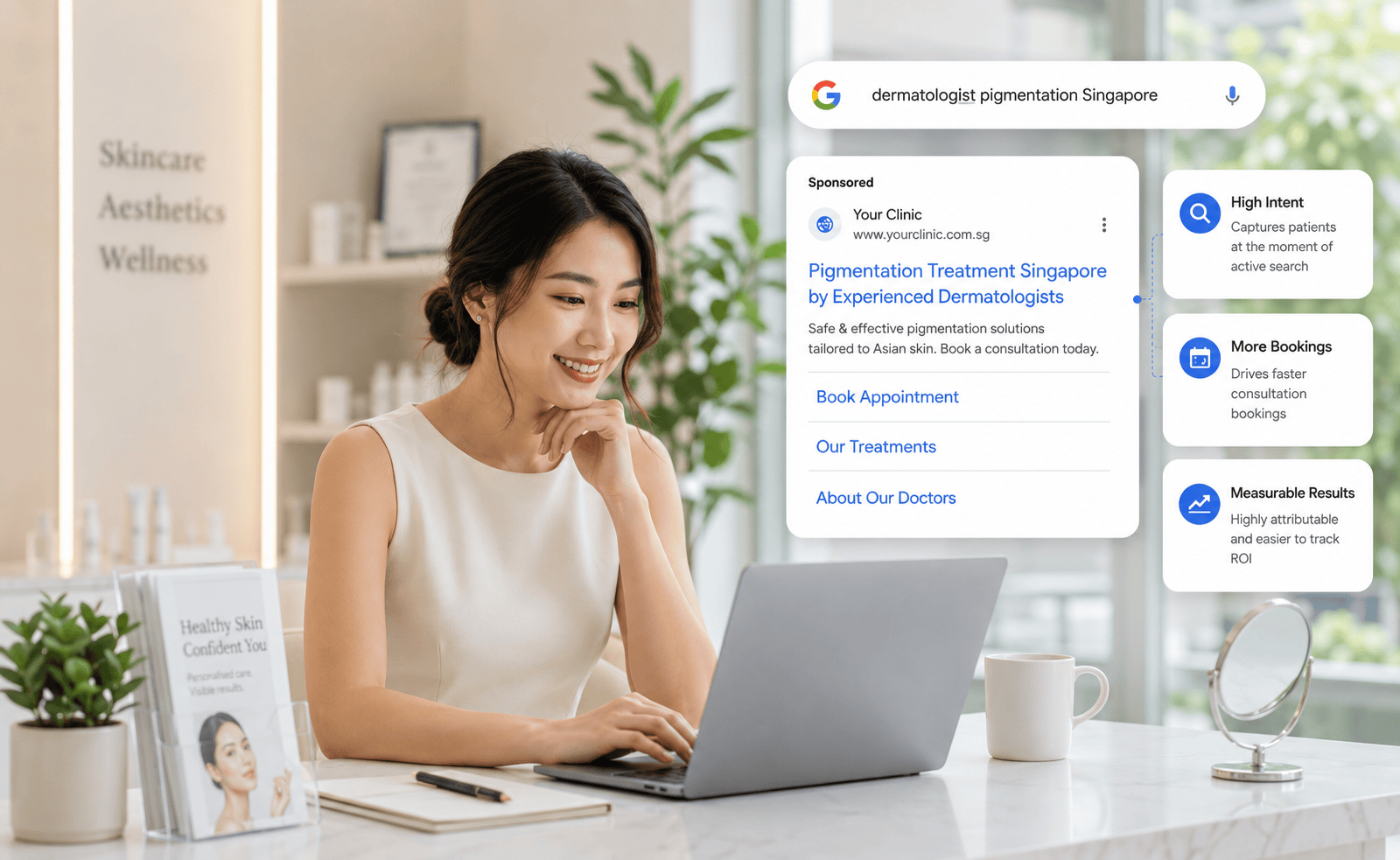
Google Search Ads are the most commercially direct patient acquisition channel available to Singapore medical and aesthetic clinics because they capture the patient at the moment of active search intent. A patient typing “dermatologist pigmentation Singapore” into Google has already identified their concern and is actively looking for a provider. The Google Ad that appears for that query is present at the highest-intent moment in the patient’s decision journey, which is why Google Search Ads consistently produce the fastest and most attributable consultation booking results of any digital channel.
Singapore’s healthcare and wellness sector shows moderate CPCs of SGD 1.50 to SGD 5.00 and CTRs of 3.5% to 6% for well-structured campaigns, according to Marketing Agency Singapore’s 2026 benchmark analysis. Competitive aesthetic and cosmetic dentistry keywords exceed this range, with peak CPCs for terms like “filler Singapore” or “dental implant Orchard” running materially higher given the category’s commercial density. The typical conversion rate for a well-structured healthcare Google Search campaign in Singapore runs 2.5% to 5.5% of clicks to inquiry, producing a cost per inquiry that is commercially justifiable when evaluated against the patient’s lifetime value.
The compliance boundaries that apply to Google Ads for Singapore medical clinics are: keywords must be condition and specialty-based rather than outcome-based (not permitted: “cure acne,” “remove wrinkles permanently”), ad copy must not include testimonials with specific health claims, and landing pages must meet the same HCSA compliance standards as the ad copy itself. Display advertising and YouTube pre-roll are restricted channels for Singapore healthcare providers, making Search the primary paid Google channel available. Remarketing to website visitors, which shows ads to patients who have visited the clinic’s website without booking, is permitted for Singapore medical practices when the remarketing content is compliant and the visitor data was collected with appropriate PDPA consent.
The Google Business Profile, while not a paid advertising product, functions as the highest-return Google presence for most Singapore clinics and should be treated as part of the Google channel investment. The GBP appears in local search results prominently for location-qualified queries and generates patient calls, website visits, and direction requests from patients with the highest local intent. A clinic that manages Google Ads without managing its GBP is investing in the paid channel while underinvesting in the organic local presence that Google’s algorithm supplements paid results with.
Meta (Instagram and Facebook): The Trust and Authority Channel
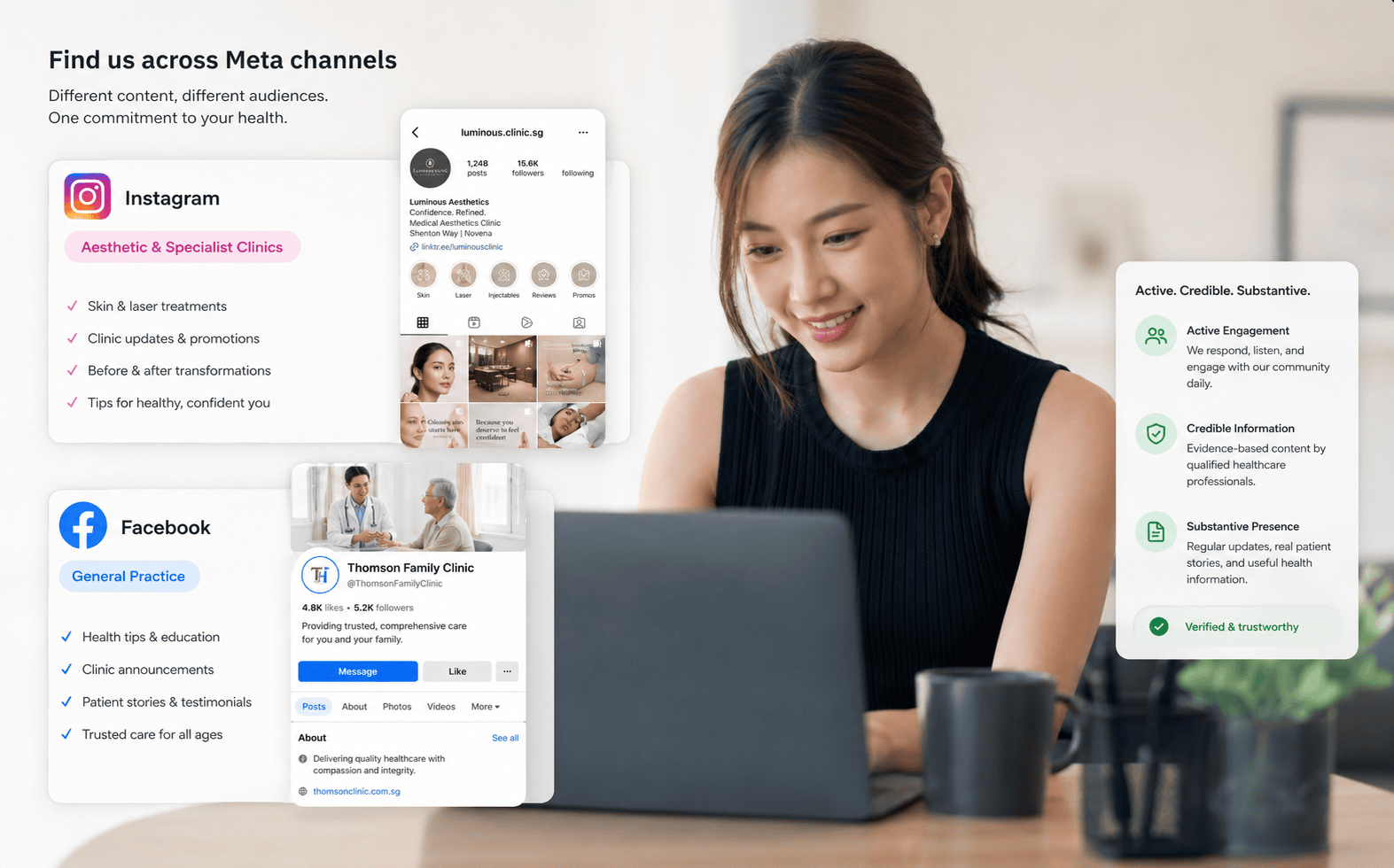
Meta channels, primarily Instagram for aesthetic and specialist clinics and Facebook for general practice and older patient demographics, serve a different function from Google Search Ads in the medical clinic channel mix. They are not primarily patient acquisition channels at the individual campaign level. They are trust and authority channels that make every other acquisition channel more commercially efficient by ensuring that the patient who discovers the clinic through search or referral finds a credible, active, and substantive social media presence when they investigate further.
Instagram is the primary Meta channel for Singapore aesthetic clinics because its visual format suits the category, its core demographic of 25 to 40-year-old Singapore residents matches the aesthetic patient profile, and its save behavior means that educational content about skin conditions and treatments is bookmarked for later reference in a way that resembles active research rather than passive consumption. Facebook remains commercially relevant for general practice and for specialties serving older patient demographics, where Facebook’s 44% of users in their 30s demographic concentration aligns with primary care and chronic condition management patient profiles.
The compliance constraints on Meta are the most significant of any channel for Singapore medical clinics. Before-and-after photographs are prohibited in advertising content. Patient testimonials with specific health outcome claims are prohibited. Outcome guarantees, superlatives, and promotional pricing mechanics are prohibited. Display and YouTube advertising are restricted. What remains is educational content, doctor authority content, clinic culture content, and condition explanation content, all of which are fully compliant and all of which are the content types that the sophisticated Singapore healthcare consumer actually engages with and responds to. The constraint is commercially significant but does not prevent Meta from being a productive trust-building channel when the content strategy is designed around what the platform permits rather than what it prohibits.
Meta CPCs for Singapore healthcare sit in a moderate range for feed placements, with CTRs of 0.8% to 1.8% for feed ads, according to Marketing Agency Singapore’s 2026 Singapore benchmarks. The investment case for Meta in a medical clinic’s channel mix is not cost per click compared to Google Ads. It is the long-term trust architecture that consistent educational social media presence builds, which cannot be measured in a single campaign’s CPL but shows up in the conversion rate improvement of every other acquisition channel as the clinic’s social media authority compounds.
SEO: The Compounding Long-Term Channel
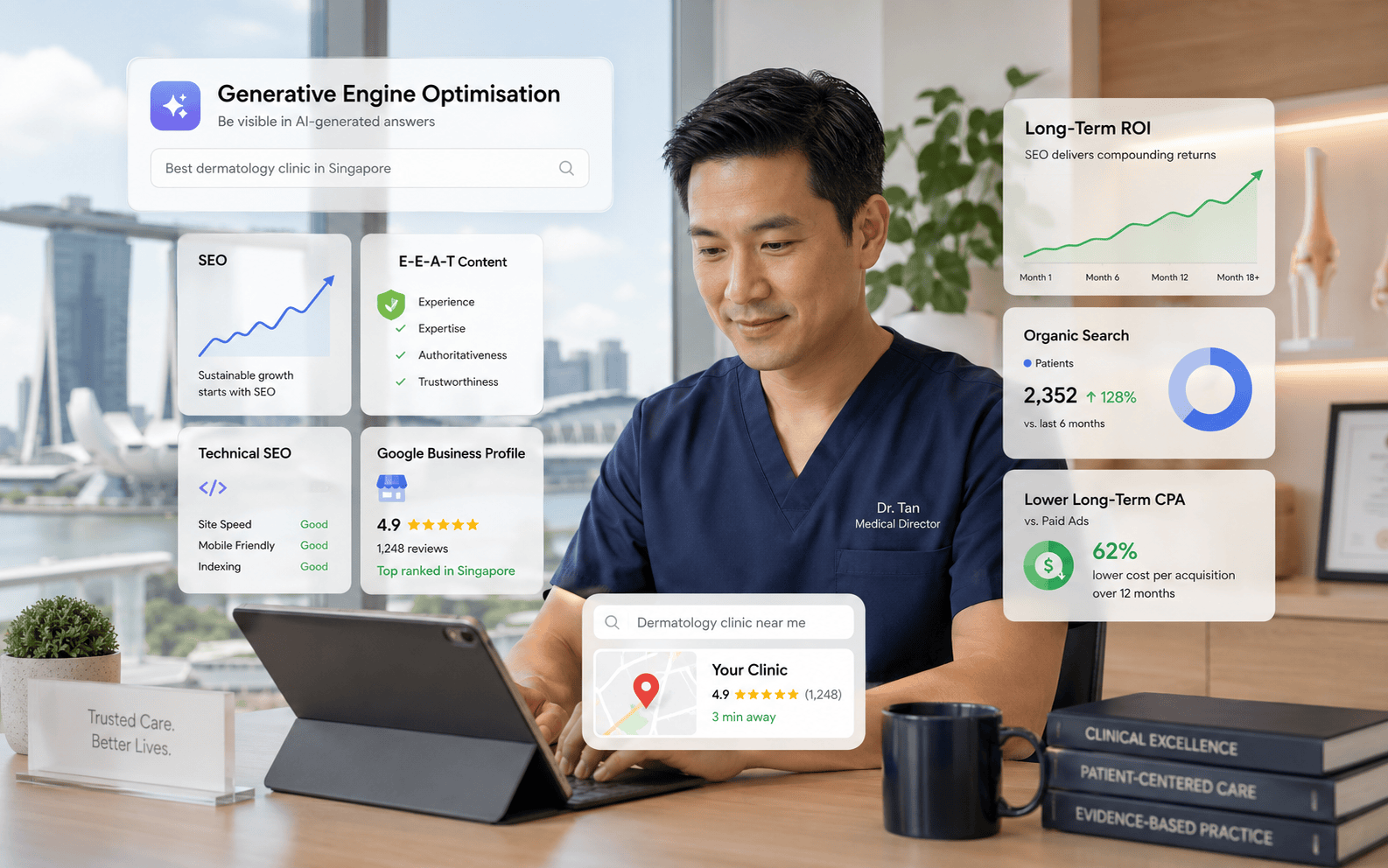
Search engine optimisation is the channel with the longest time-to-return and the strongest long-term ROI of any digital marketing investment a Singapore medical clinic can make. The clinic that consistently produces educational, E-E-A-T-compliant content about its specialty conditions and treatments, optimizes its technical SEO, and builds the Google Business Profile authority that local search requires, will acquire patients from organic search at near-zero incremental cost per acquisition in year three and beyond. The same clinic that does not invest in SEO will continue paying for every new patient at paid search CPC rates indefinitely.
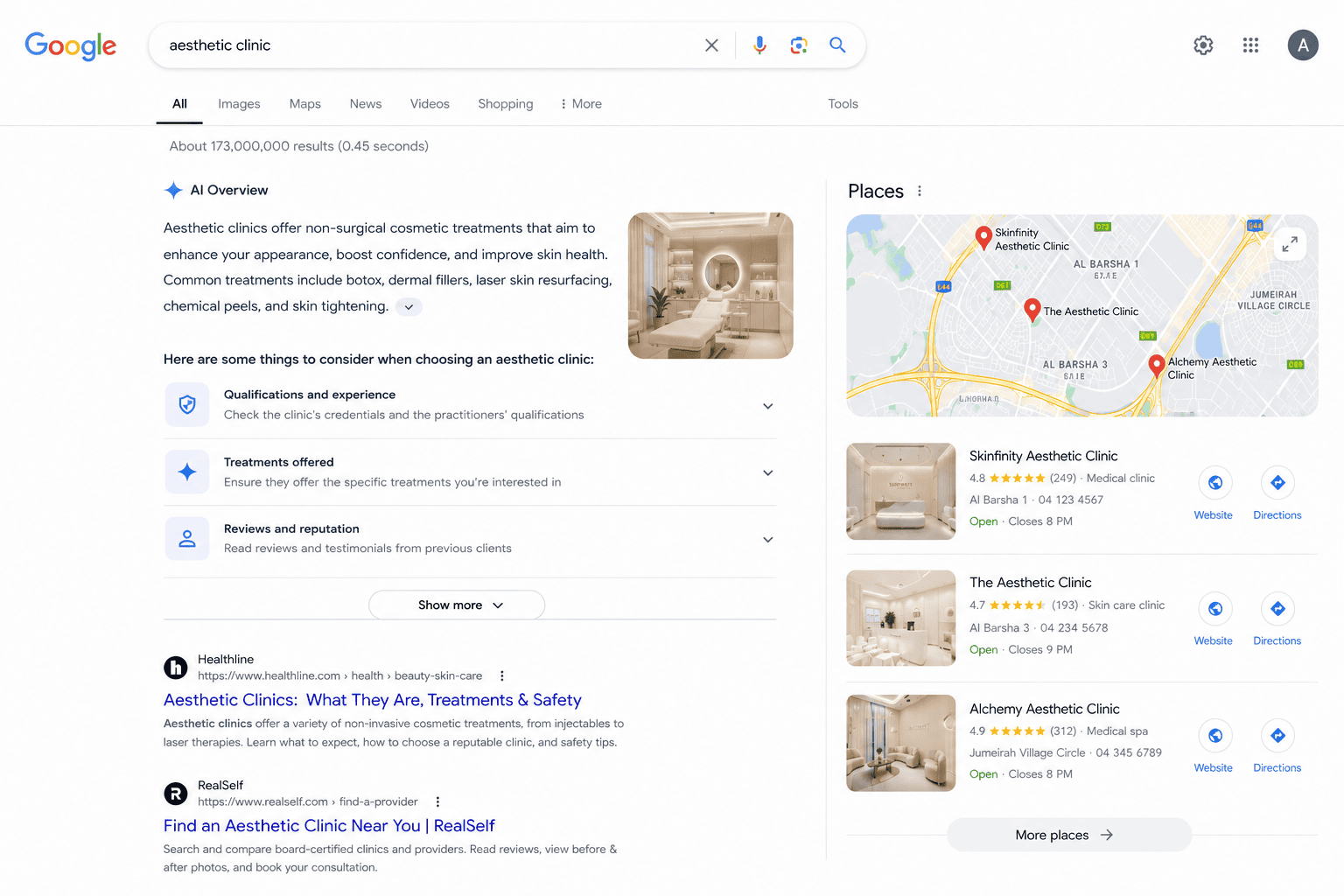
Google’s position one captures 28% to 32% of clicks for informational queries and 18% to 24% for commercial queries where ads occupy above-fold positions, according to Marketing Agency Singapore’s 2026 Singapore benchmark data. For a specialist clinic that achieves first-page organic ranking for its primary specialty and location keyword combinations, the monthly organic traffic value, calculated as the paid search cost that would be required to generate the same click volume, typically exceeds the monthly SEO investment within 18 to 24 months of program initiation. A well-executed SEO strategy in Singapore should target 15% to 30% year-over-year organic traffic growth for an established website, according to the same benchmarks.
Healthcare and wellness SEO has a specific requirement that general business SEO does not: E-E-A-T (Experience, Expertise, Authoritativeness, Trustworthiness) signals are particularly important because medical content falls under Google’s Your Money or Your Life category, where quality standards are highest. This means clinic SEO content that is authored or reviewed by a named registered doctor, that cites clinical evidence accurately, and that demonstrates genuine medical knowledge rather than generic content-marketing-style writing, consistently outperforms content that meets keyword requirements but lacks practitioner credibility signals. The SEO investment and the doctor authority content investment are not separate activities for a Singapore medical clinic. They are the same activity.
Generative Engine Optimisation is the emerging SEO dimension that forward-looking Singapore clinics should be building toward. According to Best Marketing Singapore’s 2026 digital marketing trends analysis, GEO and AI answer engine optimisation is moving from experimental to essential in Singapore’s digital marketing landscape. AI search engines including Google AI Overviews, ChatGPT Search, and Perplexity are increasingly appearing in patient research journeys, and the clinic whose educational content is structured to be cited by AI answers, through clear answer-first structure, self-contained factual claims, and attributed external citations, is building discovery infrastructure for the AI search era alongside the traditional search era. Our Generative Engine Optimisation services cover this dimension specifically.
Email Marketing: The Underused Retention Channel
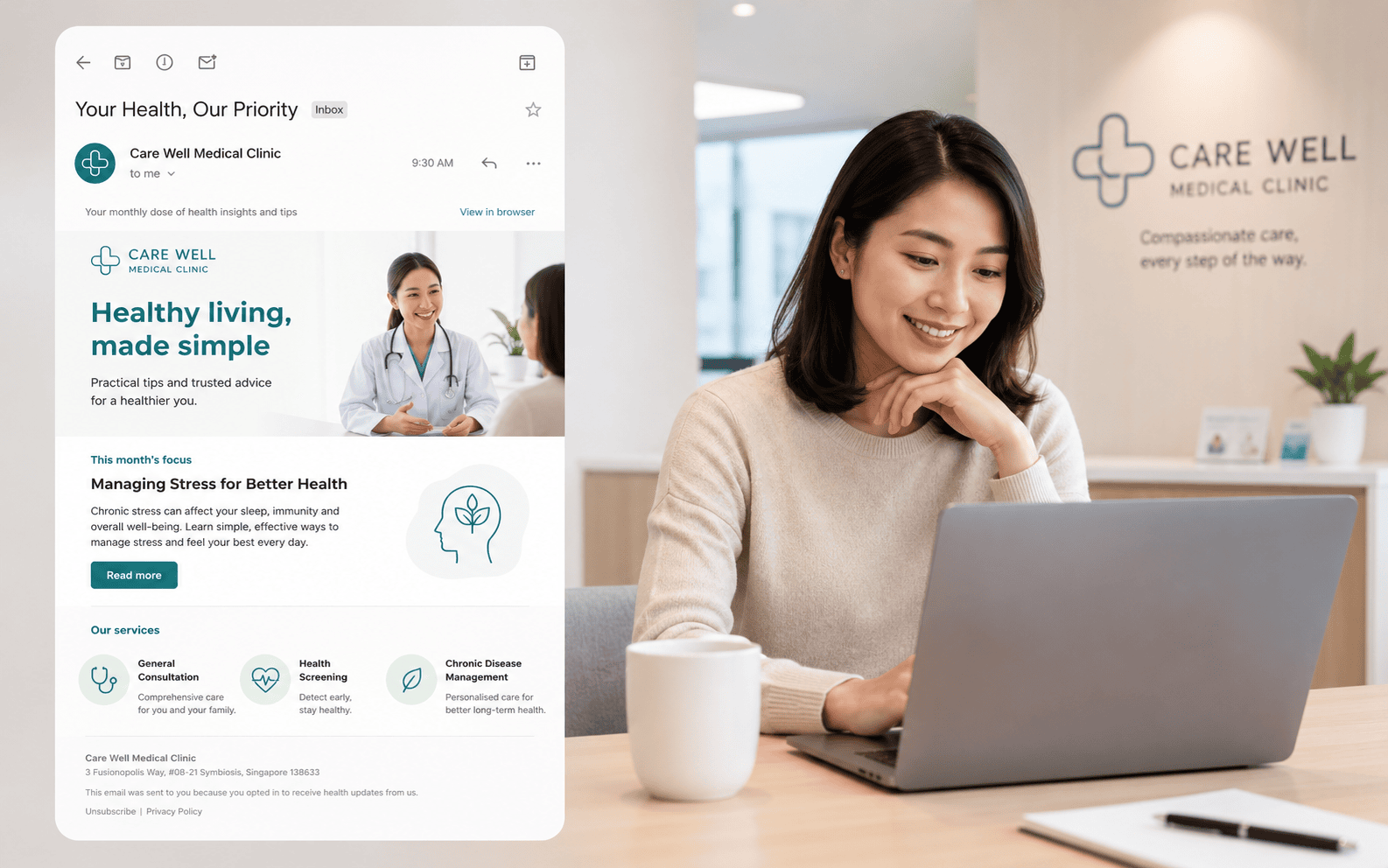
Email marketing is the most consistently underinvested and highest-ROI channel in the Singapore medical clinic channel mix, because it operates on an asset most clinics already have and do not use: the contact database of patients who have already attended the practice. Every patient who has attended the clinic and provided their email address with appropriate PDPA consent is a marketing contact the clinic can reach at near-zero marginal cost. The consultation booking that results from an email to an existing patient costs a fraction of the consultation booking generated from a cold Google Ad click, because the existing patient already trusts the clinic and does not need to be persuaded that it is worth contacting.
The email marketing approach for Singapore medical clinics follows the same educational content principle that governs all other channels: content should inform and provide value rather than promote. A monthly email newsletter that covers a health topic relevant to the clinic’s specialty, provides genuinely useful patient education, and naturally mentions the services the clinic offers in the context of that education, is compliant, commercially productive, and well-received by patients who have opted into the communication. An email that announces a “limited time offer” on treatments is both a compliance violation under the HCSA’s promotional mechanic prohibition and the kind of content that generates unsubscribe responses from the patient relationship the clinic has invested in building.
The specific email programs that produce the highest commercial return for Singapore medical clinics are: annual recall emails that remind patients of the review or follow-up appointment their treatment protocol recommends, condition-specific educational sequences that serve patients with a specific health concern between consultations, and post-procedure care sequences that support patient recovery while reinforcing the clinic’s care relationship. These email programs do not require a large contact database to produce meaningful revenue. A clinic with 500 existing patient contacts, a monthly educational newsletter, and an annual recall program across its main patient conditions, is generating repeat consultation revenue from those 500 contacts every month at a cost that makes every other channel’s cost per booking look expensive by comparison.
WhatsApp: The Direct Patient Communication Channel
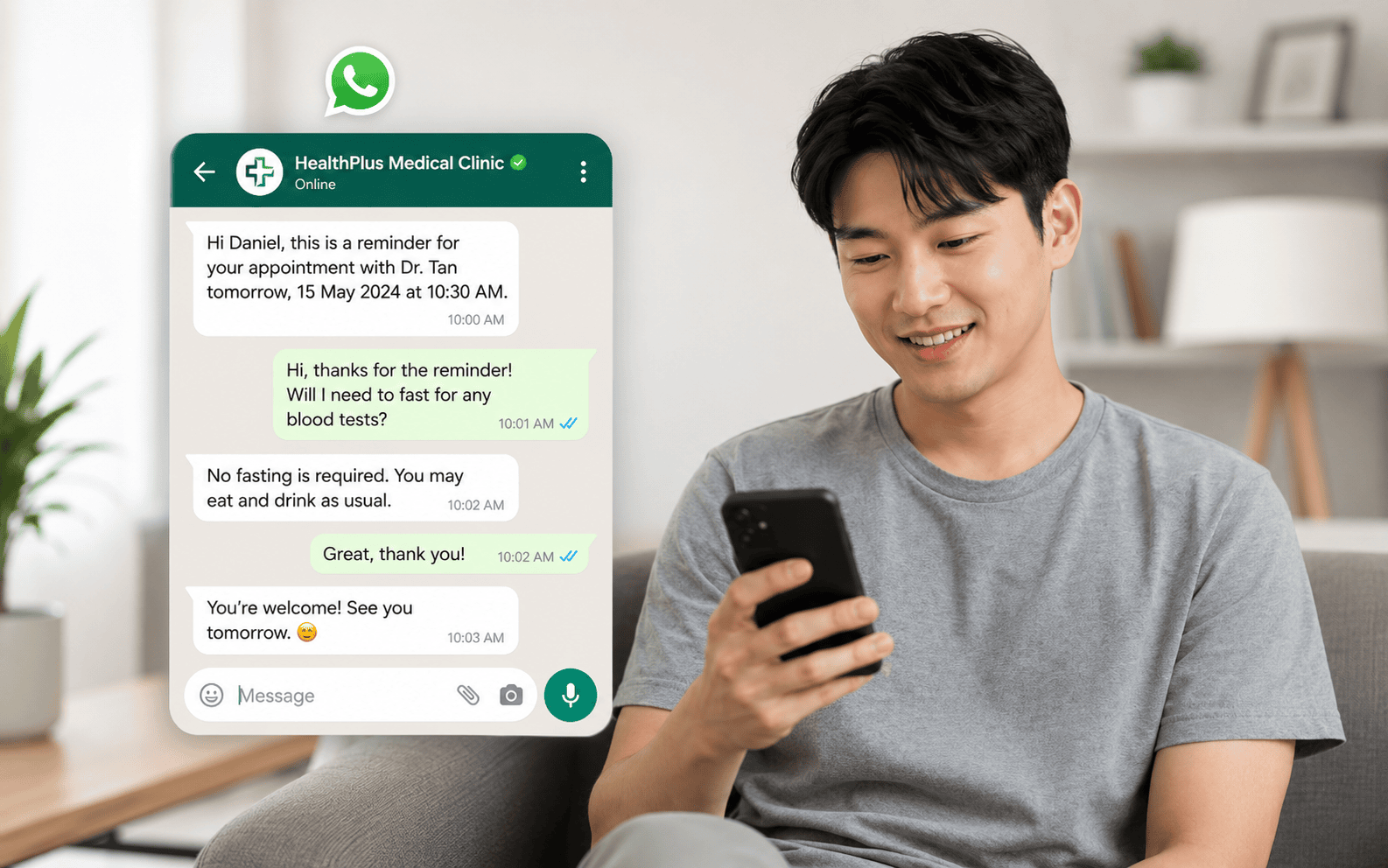
WhatsApp is the most distinctive channel in Singapore’s medical clinic marketing mix because it operates in the personal communication layer that Singapore’s patients use for trusted relationships rather than the broadcast media layer that advertising occupies. According to Best Marketing Singapore’s 2026 analysis, brands building owned micro-communities including WhatsApp channels are building direct audience relationships that compound in value because they do not depend on platform algorithm changes or advertising cost inflation. A 2,000-patient WhatsApp subscriber base is a more valuable and more durable commercial asset than 2,000 social media followers, because the WhatsApp relationship is one-to-one, opted-in, and operates in a platform the patient associates with personal communication rather than commercial advertising.
WhatsApp’s role in Singapore medical clinic marketing is primarily operational rather than acquisitive. It does not generate new patient discovery in the way Google Ads or Instagram does. What it does is dramatically reduce the friction in the existing patient communication cycle: appointment reminders that reduce no-show rates, post-appointment check-in messages that support patient care continuity, recall messages for routine health reviews, and practice update communications that keep the patient informed of relevant service additions or scheduling changes. Each of these communications serves the patient’s practical needs, which is why WhatsApp message open rates are materially higher than email in Singapore’s communication-dense environment where email inboxes are monitored less frequently than messaging apps.
The PDPA compliance requirement for WhatsApp in a clinic context is explicit opt-in consent for health-related communications. A patient whose contact details are in the practice management system from a previous visit has not necessarily consented to WhatsApp marketing. A patient who has signed a communication consent form at registration, specifying that they agree to receive appointment reminders and health information via WhatsApp, has consented. This consent distinction matters practically because WhatsApp’s business policies also restrict unsolicited commercial messaging, and a clinic sending WhatsApp messages to contacts who have not explicitly opted in risks both PDPA exposure and WhatsApp account suspension.
How Do You Build a Channel Mix That Works Together?
The channel mix that produces the most commercially efficient patient acquisition for a Singapore medical or aesthetic clinic is not the mix with the most channels. It is the mix where each channel does the specific job it is best suited for and where the channels together cover the patient’s full research and decision journey without leaving gaps that competitors fill.
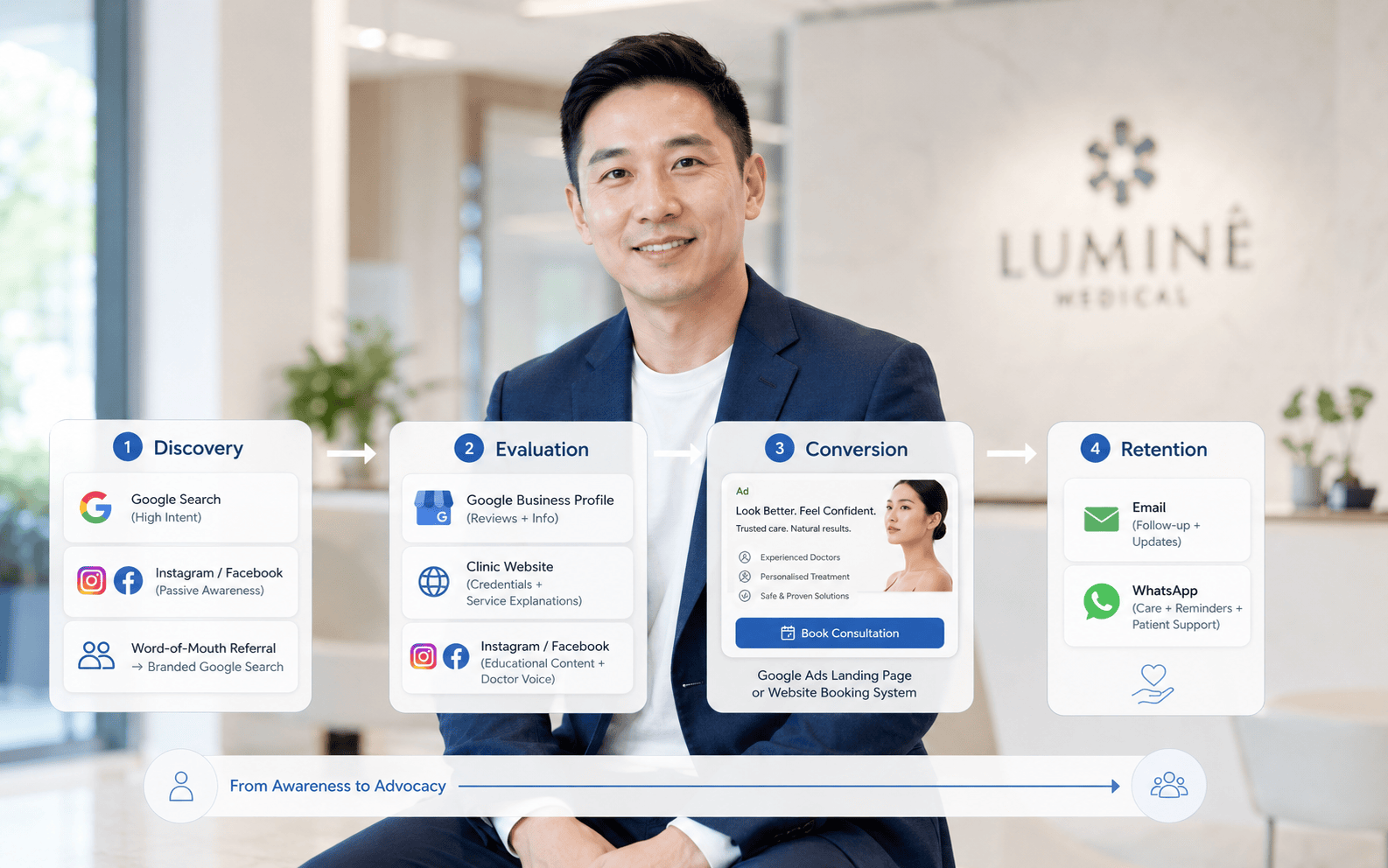
The patient journey that the channel mix needs to cover has four stages. Discovery is where the patient first encounters the clinic, which happens primarily through Google Search (high intent), Instagram or Facebook (passive awareness), or word-of-mouth referral that leads to a Google search for the clinic’s name. Evaluation is where the patient researches the clinic against alternatives, which happens through the Google Business Profile (reviews and information), the clinic’s website (credentials and service explanations), and Instagram or Facebook (educational content and doctor voice). Conversion is where the patient decides to book a consultation, which happens through the Google Ads landing page or website booking system. Retention is where the existing patient relationship is maintained and deepened, which happens through email and WhatsApp.
A channel mix that invests in Google Ads without investing in GBP, review generation, and website conversion infrastructure leaves the evaluation stage unsupported and loses the patient between discovery and conversion. A mix that invests in social media without investing in Google Ads misses the highest-intent patient acquisition channel. A mix that manages acquisition without managing existing patient communication through email and WhatsApp acquires new patients while losing existing ones at a rate that makes the acquisition investment run in place rather than produce net growth.
The most common channel allocation error is over-indexing on paid acquisition and underinvesting in the trust infrastructure and retention channels that make paid acquisition commercially efficient over time. According to Marketing Agency Singapore’s analysis, email and SEO consistently outperform traditional paid tactics in long-term ROI, with their compounding returns rewarding the practices that invest in them early and consistently. The clinics that build the full channel mix, high-intent paid search for immediate acquisition, educational social media for trust development, SEO for compounding organic visibility, email for retention, and WhatsApp for patient communication, produce patient acquisition economics that improve over time rather than remaining dependent on paid advertising costs.
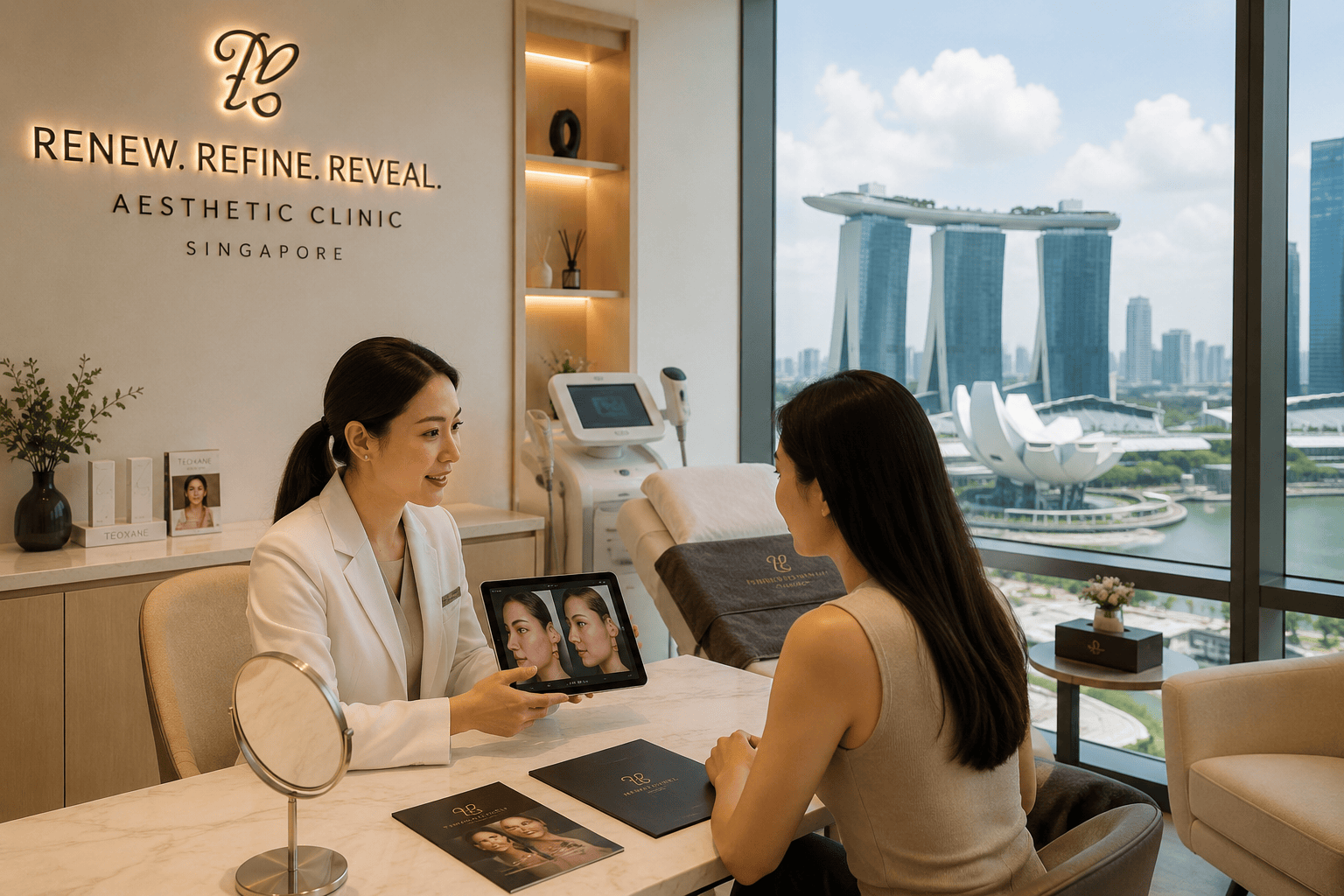
Creative For More’s medical and aesthetics digital marketing services build and manage the full channel mix described in this article for Singapore clinics. Our social media marketing programs produce the educational Instagram and Facebook content that builds the trust infrastructure making paid acquisition efficient. Our search engine marketing services manage the Google Ads campaigns that generate the immediate consultation booking volume. Our email marketing services build the existing patient retention programs that produce the highest-return bookings in any clinic’s revenue mix.
If your clinic wants a strategic marketing partner who understands how these channels work together in Singapore’s specific medical regulatory and patient acquisition environment, the Creative For More team can help. Book a discovery call to explore how we can support your practice’s growth.
Read More About Medical & Aesthetics
- How Aesthetic Clinics Can Market Ethically and Profitably in Singapore
- What Marketing Channels Work Best For Medical and Aesthetic Clinics in Singapore
- How Do You Measure the ROI of Digital Marketing for a Medical Practice?
- How Much Should a Medical Clinic Spend on Digital Marketing in Singapore?
- The Biggest Digital Marketing Mistakes Aesthetic Clinics Make (and How to Fix Them)
- What Is the SMC Advertising Code and What Does It Mean for Clinic Marketing?
- How to Build a Digital Marketing Strategy for a Medical Practice From Scratch
- What Is Medical Marketing and Why Do Clinics in Singapore Get It Wrong?
- How to Market a Medical Clinic in Singapore Without Violating MOH Guidelines

Geraldine Pang
Creative For More
Geraldine Pang is the founder of Creative For More, a cross-border digital marketing agency with offices in Singapore, Tokyo, and New York. She specializes in brand strategy, market entry, and cross-border marketing across Southeast Asia, Japan, and the United States.